Wholesale Pet Grooming Vacuum Cleaner | Factory OEM & Private Label Supply
Looking for wholesale pet grooming vacuum equipment with reliable bulk order capacity and custom OEM solutions? We supply premium-grade pet grooming vacuums and supporting equipment to distributors, resellers, and pet care businesses across global markets.
Bulk pet grooming vacuum equipment at exclusive wholesale pricing. OEM custom solutions available, volume discounts, fast worldwide delivery for distributors & resellers.
View Our Pet Grooming Vacuums


Common Headaches During Pet Grooming
Traditional pet trimming sends loose fur flying everywhere, covering floors, furniture and your clothes. After every grooming session, you spend extra‑long hours vacuuming up scattered hair.
Loud hair dryers and noisy clippers make dogs and cats anxious. Nervous pets struggle and resist grooming, making the whole process slow and difficult. If you run a pet salon, noisy equipment can even drive away sensitive‑animal clients.
Separate trimmers, vacuum cleaners and hair dryers take up lots of storage space. Switching between multiple tools slows down your workflow drastically.
Our multi‑functional pet grooming vacuum solves all these annoying problems in one single device.

All‑in‑One Pet Grooming Vacuum Cleaner: Your Complete Grooming Solution
Our pet grooming vacuum cleaner combines hair‑trimming, fur‑suction, deshedding and hot‑air drying into one compact system. When you trim your pet’s coat, loose hair gets sucked into the dust tank instantly before it floats into the air.
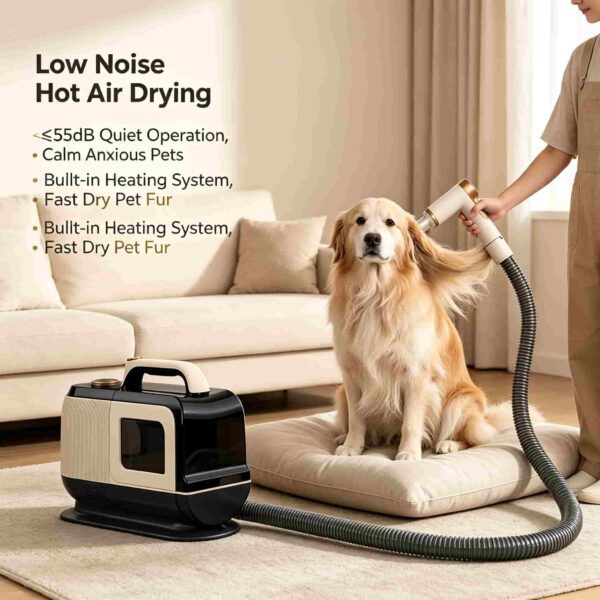
Engineered for low‑noise operation, the machine greatly reduces sound levels to keep pets relaxed and stress‑free throughout grooming. With optional warm‑air drying function, you can dry your pet right‑after bathing without switching tools.
Multiple detachable grooming heads are included, making this vacuum‑kit suitable for long‑hair, short‑hair dogs as well as cats. It works in both single-station grooming salons and high-volume commercial kennels, and end users can operate it without training./p>
One Machine, Works For Every Grooming Scenario
The same unit covers de-shedding, trimming, nail care and blow-drying, so salons can replace several separate tools with one station. Suction is adjustable in three levels and the dust cup holds 2 L, which is enough for a full day of grooming without emptying.


Every machine in the range is an all-in-one grooming station — trim and de-shed with the hair captured into a sealed cup rather than left on the floor — and every figure above is the published value for a specific model, not a marketing range. For the full side-by-side table and the fields that decide which model belongs in your market, see all five models and their published specifications. For the coat-by-coat selection logic, work through the pet grooming vacuum buying guide.
Match the model to the coat mix your market actually has
Buyers do not choose between models on the specification sheet; they choose on the animals in front of them. This is the mapping we see work, and it is the fastest way to decide what belongs on your shelf.
| Coat type / buyer | What they need from the machine | What to stock |
|---|---|---|
| Smooth and short coats | A brush head and a de-shedding tool; almost any unit keeps up | The quiet end of the range. This buyer is buying convenience, not power, and the differentiator on a shelf comparison is noise and the attachment fit. |
| Dense double coats, shedding season | Suction first — the undercoat is what fills the cup and what stalls a brush head | The high-suction models. Expect this buyer to empty the cup more than once on a full blow-out, so cup capacity sells alongside suction. |
| Curly and doodle coats | Clipper head first, with suction running to catch the trim | The multi-clip kits. This is the buyer who asks what else is in the box, so the printed attachment list matters more than the headline count. |
| Cats and small breeds | The quietest unit and the smallest attachments — not more power | The ≤50 dB model. A cat that will not sit still cannot be groomed, so noise is a functional requirement here, not a comfort feature. |
| Salons and mobile groomers | Duty cycle: hours a day, cup filling inside a single groom, consumables wearing out | The largest cup and the model whose spare parts are published. Keep a second head and filter on the shelf. |
| Retail shelf and private label | Packaging, claims and a price band the shelf can defend | The model with published filtration and certification, so the box claims are defensible in your market. |
Order minimums, volume tiers and how a first order is structured
Two published minimums cover the two ways buyers order this range, and the difference between them is packaging and artwork rather than the machine.
| Order type | What it is | Published minimum | Why buyers start here |
|---|---|---|---|
| Stock order | Machines shipped as they are, in standard retail packaging, with standard accessories | 10 units, per the order minimum published in the product data | The fastest route to market and the cheapest way to test a SKU, because nothing is tooled and nothing is printed for you. |
| Sample order | One unit, or a small set, shipped as standard production goods | Available before a bulk commitment | What you test is what ships. One sample answers more questions than a week of email: real suction on a real coat, real noise level, real weight with a half-full cup. |
| Private label / OEM run | Your logo, your colour box, your manual language, applied to the model of your choice | From 500 units per model, as published on the product pages | The point at which artwork, printing and packaging setup become worth doing — and the point at which the product stops competing on price alone. |
| Mixed order | Two or more models in a single shipment | Calculated on total order volume, not per SKU | A mixed order can reach a volume tier a single model would not, and it lets you test more than one price point in one shipment instead of committing the whole budget to one SKU. |
How to read the two minimums together: 10 units applies to a stock order, 500 units applies to a private-label run. They are not competing figures — one is a box off the shelf, the other is a printed carton with your brand on it. Tell us which you are doing and we will confirm the terms in writing before you commit.
Three levels of customisation, and what each one adds
| Level | What it covers | Effect on schedule | Who it suits |
|---|---|---|---|
| Level 1 · Branding | Logo and label on the machine and on the retail box | Fastest to set up — nothing on the machine changes | A first private-label programme, and the fastest way to stop your listing looking identical to everyone else’s. |
| Level 2 · Packaging | Custom cartons, inserts and a manual printed in your market’s language | Adds a printing and packing stage between approval and production | A distributor selling onto a retail shelf: this is the level where perceived value rises most per dollar spent. |
| Level 3 · Product | Housing colour, cord and plug type, dust cup configuration, control layout | Requires engineering time, tooling and market re-certification | A brand with a specification it intends to own, because this level changes the machine rather than its label. |
All three levels run under our OEM and ODM arrangements, and every private-label project is handled by a named account manager rather than a shared inbox.
Certification, voltage and plug type by market
This is the one block in a supply file that cannot be fixed after a container has landed, so it is settled before a purchase order rather than after.
| Market | Voltage | What the compliance file usually needs | What we write into the order |
|---|---|---|---|
| European Union / EEA | 220–240 V | CE marking and RoHS conformity for restricted substances | That the test report covers the model you are importing, plus the dominant plug type and the manual language. |
| United States / Canada | 110–120 V | FCC conformity, plus any local electrical safety requirement | That the unit is genuinely rated 110 V or 110–240 V, and that the cord and plug need no adapter. |
| United Kingdom | 220–240 V | UK conformity route, plus RoHS | Plug type G and cord length. |
| GCC states | 220–240 V | National conformity requirements at the destination | Certificate scope against the ordered model, voltage, plug type and manual language. |
| Australia / New Zealand | 220–240 V | Local conformity route for those markets | Plug type I, and any requirement that applies to the unit rather than the company. |
| Japan | 100 V | Local electrical safety scheme | That the voltage rating genuinely covers 100 V — 220 V will not run here at all. |
Three rules that protect this block: a certificate attaches to a model, not to a company — ask for the report number and the model name on it before paying. Voltage is not the whole story — plug type, cord length and socket compatibility are confirmed in writing per market. And the packaging decision is made before production, not during it, because artwork and manual language that slip will slide the whole shipment past your selling season.
How an order runs, step by step
- Tell us the market, the coat mix and the target retail price
Three pieces of information narrow five models to one or two before anyone talks about price: the market you are selling into, the coats the machine will actually meet, and the retail band you intend to hold.
- Take one sample unit and test it hard
On a real coat, with the tools that ship in the box, and with the cup half full — because weight, noise and suction all change as the cup fills. One sample answers more than a week of correspondence.
- Fix the customisation level
Branding, packaging or the product itself. Each level has its own schedule, and each one has to be settled before production rather than after.
- Confirm documents, voltage and plug in writing
Certificate scope against your model, voltage, plug type, cord length, manual language and the defect threshold go onto the purchase order or the proforma invoice — not into a phone call.
- Production, then shipment with clearance documents
Our published standard lead time is 30 days after artwork approval and deposit confirmation, and every order ships with the export documents your freight forwarder requires.
Sourcing guides for this range
Choosing the unit: the full buying guide
Coat-by-coat matching, the specification fields that actually decide whether a machine works, noise and filtration explained with measurement conditions, and what to verify before a purchase order. Written for buyers, not for browsers.
Read the pet grooming vacuum buying guideAll five models, side by side
Published suction, noise level, dust cup capacity, rated power and voltage for every model, in one table you can compare line by line before you request a quotation.
Compare all five pet grooming vacuum models


Reliable Wholesale Supplier For Pet‑Care Equipment
Each pet grooming vacuum passes strict functional testing before shipment, ensuring stable suction power and long‑term durability for daily heavy‑duty use.
We supply both household‑grade and commercial‑salon‑grade pet‑grooming machines. Bulk wholesale orders and custom‑branded OEM services are available, our flexible purchasing terms support buyers with different business needs.
Professional after‑sales assistance is ready whenever you need support.
About Us