Most bad buys in this category are not caused by a weak motor. They are caused by a unit that was chosen for the wrong coat type, the wrong noise level, or the wrong market voltage. This guide walks through all three, using the specifications we publish for every model.
- The short answer
- The five configurations you choose between
- The published figures for all five models
- The specifications that decide whether the unit works
- Matching the unit to the work
- Coat types and which attachment does the job
- Certification, voltage and plug type by market · certificate-scope guide
- Minimums, tiers and customisation levels
- What to verify before a purchase order
- Frequently asked questions
The short answer
- Adjustable suction beats peak suction. A 12 kPa unit with three or five levels handles a nervous cat and a Husky undercoat in the same session. A single-speed 12 kPa unit does one of those jobs badly.
- Noise is a functional specification, not a comfort feature. It decides whether the animal stays still, which decides whether the groom gets finished. Our range runs from ≤50 dB to ≤66 dB — a spread that matters more than most buyers assume.
- Size the dust cup to the number of pets per session, not to the number of pets in the house. 1.4 L, 2.0 L and 3.0 L are three different working rhythms.
- Ask what the filtration stack captures, not how many layers it has. Visible hair is the easy part. Dander is the particle that drives allergy complaints and returns.
- Confirm voltage, plug and certification scope per market before production, not after the container lands.
- Order one sample and use it hard. In this category a single test unit answers more questions than three weeks of supplier emails.
Two things happen when someone gets this purchase wrong. Either the unit is under-specified for the coat it was bought for, and it quietly stops being used — or it is perfectly good hardware that nobody can sell, because it arrived in the wrong voltage or with a test report that covers a sibling model instead of the one on the pallet. Both outcomes come from the same root cause: the decision was made on a headline number instead of on the job.
This guide is written for pet product distributors, private-label brand owners, pet salon operators and retail buyers — the people who commit to more than one unit. Home users who simply want less hair on the sofa will find the coat-type and noise sections useful too, but the sourcing logic at the end is aimed at people placing a purchase order.
What a pet grooming vacuum actually does — and what it will not do
A grooming vacuum does three jobs, and only one of them is the one buyers think about.
The obvious job is trimming and deshedding. A clipper head or a deshedding brush runs through the coat and lifts loose undercoat that a normal brush glides over.
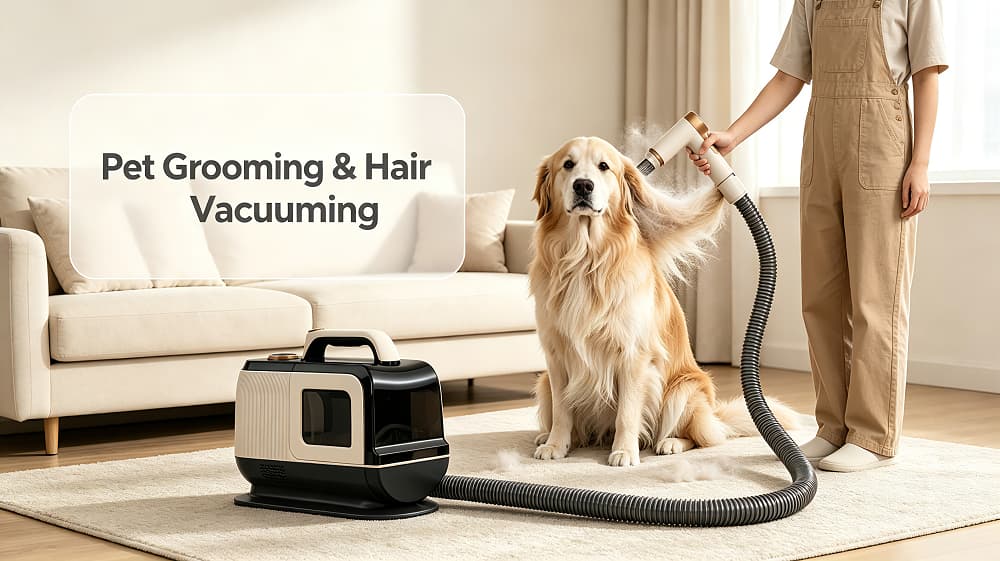
The second job is the one that sells the machine: capturing the hair at the source. This is the real difference between a grooming vacuum and a clipper. Clipping a dog with a hand clipper releases hair directly into the room, where it lands on every surface and stays airborne for a while. On a vacuum system the hair leaves the coat and enters the dust cup in the same motion. For a home user that is the end of the cleaning job. For a salon it is the difference between one clean-up at the end of the day and four clean-ups between appointments.
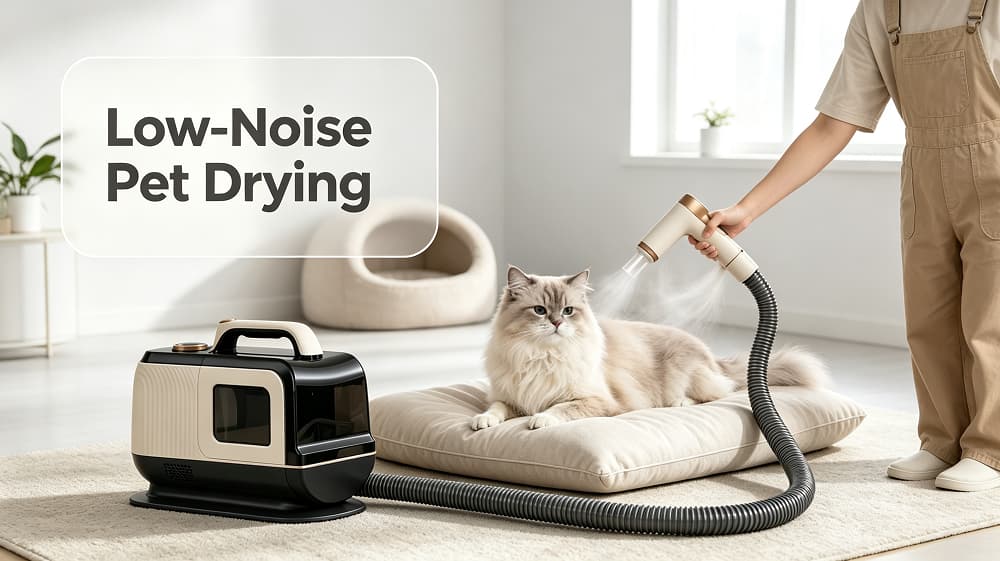
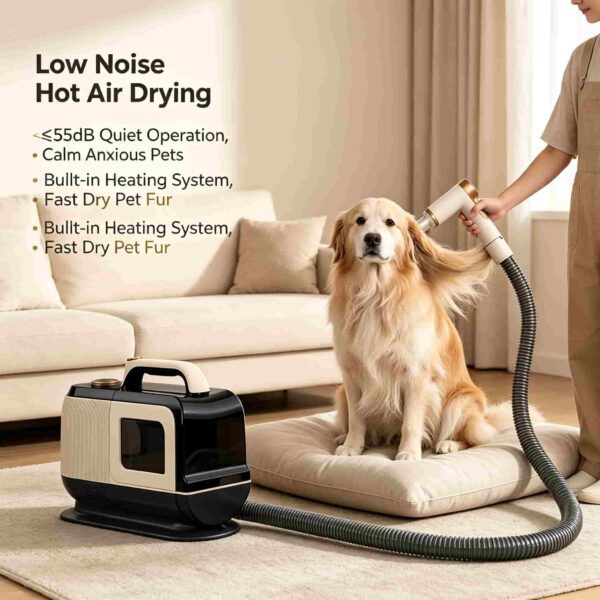
The third job, on warm-air models, is drying after a bath. A unit with a warm-air blow function means a wet dog does not have to sit under a separate box dryer.
What the machine will not do:
- It will not undo a matted coat. Mats are felted bundles of fur that have tightened against the skin. A grooming vacuum brush pulls at them and hurts the animal. Mats are removed with a clipper first, and in severe cases that is a welfare decision rather than a cosmetic one, because a matted coat traps moisture and hides skin problems underneath.
- It will not fix noise phobia by itself. A quiet unit removes the main trigger, but an animal that already panics at the sound of a machine needs short, calm introductions before the first real groom. Buy the quiet unit, then use it patiently.
- It will not replace a bath. Unless the model has a warm-air blow function, a grooming vacuum removes loose hair and nothing else. It is not a cleaning appliance for the animal, and no filtration system removes coat oils or odour from the pet itself.
- It will not make a single-coat breed shed less. Deshedding removes hair that was already leaving. It does not change how much a coat produces. Breeders who promise otherwise are selling a machine on a claim the biology will not support.
Set those expectations before the money moves, and again with whoever uses the machine. Most “this thing is useless” complaints trace back to a job that no unit at any price could have done.
- 6 kPa – 12,000 PaPublished suction across the range
- ≤50 – ≤66 dBPublished operating noise
- 1.4 – 3.0 LDust cup capacity, by model
- 110 – 240 VDual voltage across the range
The five configurations you are actually choosing between
Product listings blur the lines here, because the marketing language is nearly identical across very different machines. In practice you are choosing between five configurations, and the difference shows up on the first animal of the day.
| Configuration | What it does | Where it wins | Where it hurts |
|---|---|---|---|
| Hair-only grooming vacuum | Suction motor, brush and nozzle heads, no clipper | Light, cheapest to land, easy for an untrained end user to operate | No trimming and no drying; the animal still needs a clipper and a dryer |
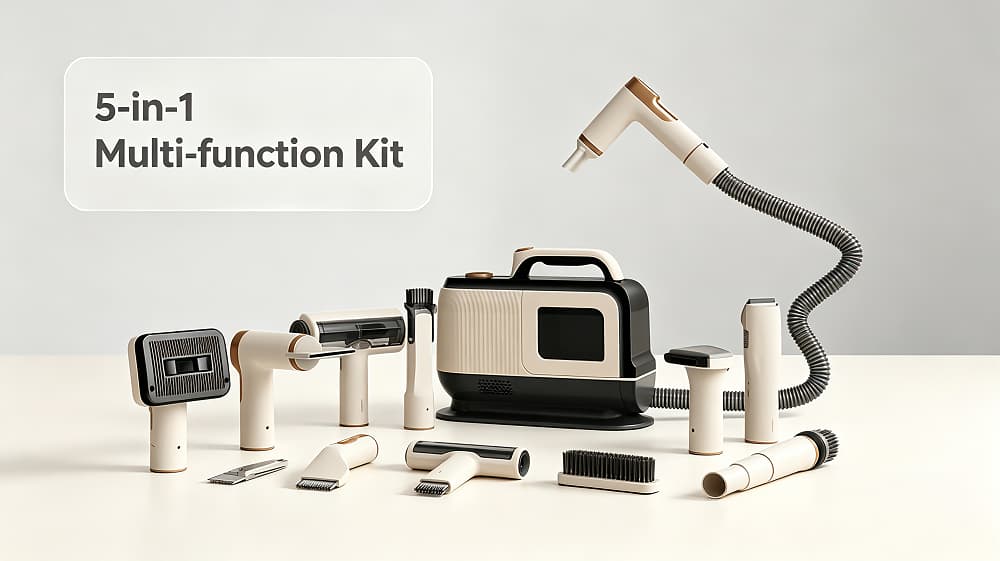
| 5-in-1 clipper + vacuum system | Rechargeable clipper plus deshedding brush, grooming comb, paw trimmer and crevice nozzle | Replaces a standalone clipper and a brush set; strong retail gift-box story | No warm-air drying; cordless clipper adds a battery to warranty scope |
| 6-in-1 suction + warm-air blow | Adds heated airflow to the grooming and trimming set | Bath-to-dry in one station, no separate dryer, fewer tools on the bench | Drying extends session time and run hours; warmer airflow on a heavily coated animal needs supervision |
| High-capacity station class | Larger dust cup, multi-speed brushless motor, longer cord, wider tool set | Salons, multi-pet homes, back-to-back appointments without emptying | Heavier, higher landed cost, over-specified for a single short-haired pet |
| All-in-one adjustable kit | Wide adjustable suction range, full attachment set, guide combs to 24 mm | One SKU covering short, medium and long coats — useful for distributors who cannot stock five SKUs | More attachments to cost, stock and replace; buyers compare it on price instead of on range |
The practical takeaway: the attachment set decides what the unit can do, and the motor decides how well it does it. A 6-in-1 with a warm-air function is the configuration that removes the most separate tools from the bench. A high-capacity station is the one that survives a full appointment book. If a single SKU has to serve several coat types, buy the adjustable one rather than the most powerful one.
The published figures for all five models
Each product page publishes its own parameter table, and this is those figures brought together in one place. A dash means the product page does not currently publish that value for that model; we have left those blank deliberately rather than estimating them, and we will confirm any of them for the exact variant you are quoting.
| Model | Suction | Noise | Dust cup | Rated power | Voltage | Product page |
|---|---|---|---|---|---|---|
| STCY‑005 | 6–12 kPa, 3 levels | 60 dB | 1.4 L | 130–300 W | 110–240 V | View model |
| STG20 | — | ≤66 dB | — | — | 110–240 V | View model |
| STG21 | — | — | — | — | 110–240 V | View model |
| STG22 | 12,000 Pa, 5 levels | ≤65 dB | 3.0 L | 400 W | 110–240 V | View model |
| STY100 | 12,000 Pa | ≤50 dB | 2.0 L | 600 W | — | View model |
Two notes on reading this table honestly. First, 12,000 Pa and 6–12 kPa are the same scale written two ways (1 kPa = 1,000 Pa), so the models are comparable — but a rating taken at the nozzle on a short hose is not the same measurement as one taken at the end of a longer run, so compare the configuration as well as the number. Second, the noise column is the field most likely to disappoint a buyer, because a dB figure is only meaningful with the measurement position attached to it; ask us for that before you put a number on a box in a market that regulates claims.
For the side-by-side view of the range that your buyers see, compare the five pet grooming vacuum models.
The specifications that decide whether the unit works
Six numbers on the label decide almost everything about day-to-day performance. Here is what each one actually changes, and where marketing language drifts away from reality.
Suction, measured in kPa and Pa
Suction determines how much loose hair and dander leaves the coat and how much of the surrounding surface mess goes with it. Across our range the published figures are:
| Model | Published suction | Speed settings |
|---|---|---|
| STCY-005 | 6–12 kPa adjustable | 3 levels |
| STG22 | 12,000 Pa | 5 levels |
| STY100 | 12,000 Pa | Multi-head grooming set |
| STG20 | Not published on the product page | — |
| STG21 | Not published on the product page | — |
Two things about these numbers trip up buyers, so they are worth stating plainly.
First, Pa and kPa are the same measurement at different scales. One kPa is 1,000 Pa. A unit rated at 12,000 Pa and a unit rated at 12 kPa are quoting the same performance level. When two listings show “12,000 Pa” and “12 kPa” and you read the first as ten times stronger, you have compared a number to itself. Convert both to kPa before you compare anything.
Second, a range is more useful than a ceiling. The low end of the range is what gets used on thin-skinned areas, on short-coated animals, and on the flanks of an anxious cat. The high end is what clears a heavy undercoat. A three or five level unit lets one machine serve both ends; a single-speed unit forces the operator to choose which customer it is built for.
If you are specifying a unit for a market that compares on suction, ask us for the number in both units and for the setting each figure was measured at. A figure with no test condition attached is not a specification.
Noise, measured in decibels
Noise is the specification that decides whether the groom finishes. Published figures across our range:
| Model | Operating noise | Everyday reference point |
|---|---|---|
| STY100 | ≤50 dB | Quieter than ordinary conversation |
| STCY-005 | 60 dB | Roughly the level of normal conversation |
| STG22 | ≤65 dB | Normal conversation, from across a room |
| STG20 | ≤66 dB | Normal conversation, from across a room |
Read the gaps carefully, because decibels are logarithmic and a two-digit number hides a large jump in energy. A rise of 6 dB is roughly four times the sound energy, not six percent more noise. Perceived loudness moves more slowly — as a rule of thumb, +10 dB reads as about twice as loud — so the practical difference between ≤50 dB and ≤66 dB is the difference between an animal that tolerates the machine and an animal that bolts at the switch.
That is why we treat the quiet tier as a distinct product class rather than a premium option. If you are selling into households with anxious rescues, or into salons that take nervous animals because other salons will not, the dB figure is the specification that generates reviews and repeat bookings.
The measurement condition matters here too. A dB rating taken at the operator’s ear in a quiet room is not the same as one taken at the animal’s ear next to a running brush head, and neither is the same as the peak on start-up. Ask which one the number describes.
Dust cup capacity and session rhythm
Cup capacity sets how long the operator can work before stopping, and stopping mid-groom is what breaks the calm of a nervous animal. Published capacities in our range are 1.4 L (STCY-005), 2.0 L (STY100) and 3.0 L (STG22).
- 1.4 L is comfortable for one small-to-medium pet, or a maintenance tidy-up between professional appointments.
- 2.0 L covers a full groom on a medium or large dog with coat to spare, and a two-pet household on a single pass.
- 3.0 L is the capacity that lets a salon or a multi-pet home finish a session without emptying mid-animal. For heavy double coats in shedding season, this is the tier to specify.
Two design details matter as much as the litres. A transparent cup lets the operator see the level without opening anything, and a one-touch release lets it be emptied with one hand while the other hand is holding a wriggling animal. A cup that has to be unscrewed or that hides its contents will be emptied less often, which means it will be working at reduced suction for part of every session.
Filtration: what actually gets captured
Pet hair is the visible problem. Pet dander — the microscopic flakes of skin and dried saliva protein that travel with the hair — is the one that causes allergic reactions and the one that keeps circulating after the grooming is finished. A transparent cup full of hair tells you nothing about whether the exhaust air is clean.
What to look for is the efficiency rating and the particle size it was measured at, not the layer count. The industry reference point for a HEPA-class filter is 99.97% of particles at 0.3 microns, which is the particle size where filter media are least efficient and therefore the standard rating point. Our STG22 carries a five-layer sealed stack — pre-filter sponge, fine mesh screen, activated carbon layer, high-density HEPA filter and a final exhaust filter — and is rated at 99.97% at 0.3 microns at the exhaust point. STCY-005 uses an H11 HEPA element plus a sponge pre-filter.
The word doing the work in that paragraph is sealed. A HEPA element inside a housing that leaks around the seams captures nothing useful, because the airflow takes the path of least resistance straight past it. When you evaluate a sample unit, hold it at the exhaust while it runs on a dusty surface. That tells you more than a layer count on a box.
Power, duty cycle and how many animals per day
Power draw tells you how much suction work the unit can sustain. Published figures are 130–300 W for STCY-005, 400 W for the STG22 brushless motor, and 600 W for STY100.
For a household doing one weekly groom, a lower-draw unit is the right answer — lighter, quieter and cheaper to run. For a salon running back-to-back appointments, the question is not peak power but what the motor is rated to do on the eighth animal of the day. That is a duty-cycle and service-life question, and it belongs in writing on the quotation. If a supplier cannot say how many working hours the motor is rated for, that is your answer.
Two other power-related details belong on the purchase order rather than in a brochure: cord length, which decides whether the operator needs an extension lead (STG22 publishes 5 m; STCY-005 publishes 2.3 m), and hose length, which decides how far the machine can sit from a nervous animal (STCY-005 publishes 1.6 m).
Voltage, plug and certification
This one quietly costs buyers the most money. If you stock or service more than one region, sourcing separate 110 V and 220 V production runs doubles your inventory risk and splits your spare-parts stock. Most of our range is rated 110–240 V, so a single SKU covers North America, Europe, the Gulf and Australia.
Voltage rating is not the end of the story, and it is not a substitute for the plug. Plug type, cord length and socket compatibility still have to be confirmed per market and written into the order rather than assumed — a unit that needs an adapter out of the box attracts returns and reviews that say so. On the compliance side, our models generally carry CE, FCC and RoHS, with ISO9001 covering the manufacturing system. What a buyer needs to check is the scope of each report: make sure it names the model you are actually importing, not a sibling in the same family. Re-testing a modified unit is a real cost and it belongs in your landed-cost calculation, not in your margin.
Matching the unit to the work it will actually do
Buyers who get this right work backwards from the job list rather than forwards from the product page. Write down what the machine will do in a typical week, and the shortlist builds itself.
One short-haired pet, home use
Light, quiet and simple wins. A 2.0 L unit with a comb attachment and a crevice tool covers a Beagle, a Boxer or a Dalmatian and then the sofa they sleep on. Buying a 3.0 L station here means paying for capacity and weight that will never be used, and a heavier machine is a machine that gets left in the cupboard.
Heavy double coat, shedding season
This is the demanding house. Huskies, German Shepherds, Akitas, Great Pyrenees and Malamutes blow undercoat twice a year, and the volume is not gradual. Specify the largest cup, the widest adjustable range, and an undercoat-focused attachment set. Suction here is genuinely the deciding figure, because the job is removing loose undercoat before it redistributes itself across the room. Do not shave a double coat to solve shedding — the coat insulates against heat as well as cold, and shaving changes the regrowth rather than the shedding.
Curly and doodle coats
Poodle crosses, Bichons and Poodles need length taken off regularly and need the coat kept clear of the skin. The trimming head and guide combs do the work; suction keeps the clippings out of the coat while you cut. Guide comb coverage is the specification to check here — STCY-005 and STY100 both publish six combs covering 3 mm to 24 mm, which is the range that lets one unit serve a summer clip and a winter tidy. If the operator trims away from a power point, the STG21 5-in-1 system with a USB-rechargeable clipper keeps the cutting tool cordless while the vacuum body stays on mains power.
Cats
Cats are the noise-sensitive end of the market and the reason the quiet tier exists. A long-haired cat needs low suction on thin skin, a brush that does not drag, and a machine that does not announce itself. Choose on the dB figure first and the brush head second; a cat that tolerates grooming at ≤50 dB will not tolerate the same session at 66 dB.
Salon and mobile groomer
Buy for hours, not features. A station-class unit with a 3.0 L cup, five speed settings, a 5 m cord and a published service-life figure beats a lighter machine with a nicer control panel every time, because downtime costs more than the machine. Check where the hose exits the body and how the unit is carried — if it travels between sites in a van, the housing, handle and cord-wrap design matter as much as the motor.
Retail shelf and private label
Here the deciding factors move away from the machine. Attachment count drives the perceived value on a gift box, colour and packaging options drive the shelf story, and certification scope decides which markets you can list in without re-testing. A five-in-one kit with full attachment coverage at a low price point outsells a technically better three-in-one, because the box has to explain itself in three seconds.
Distributor and cross-border seller
Voltage flexibility and certification coverage are the purchase, not the machine. A 110–240 V SKU that ships to the US, EU, UK and Australia without modification is one inventory line instead of three, one spare-parts bin instead of three, and one listing set instead of three. That structural saving is usually larger than any per-unit price negotiation.


Four profiles cover most of the orders we ship, and the deciding question is almost always the coat and the animal’s tolerance rather than the price tier. The STG22 grooming vacuum station — 12,000 Pa across five speed settings, a 3.0 L cup, ≤65 dB and a 5 m cord — is the one built for salons and multi-pet homes with heavy double coats. The STY100 quiet grooming vacuum — 12,000 Pa at ≤50 dB with a 2.0 L cup — is the quietest unit in the range and the one specified for cats, anxious rescues and allergy households. The STG20 6-in-1 with warm-air blow is the bath-to-dry profile: six attachments and a heated airflow function in a single station, so no separate dryer is needed. The STCY-005 adjustable all-in-one kit — 6–12 kPa in three levels, 60 dB, a 1.4 L cup and eight attachments including guide combs to 24 mm — is the single-SKU answer for distributors who need one unit covering several coat types.
Here is the range those profiles map onto, with the published figures for each unit:



Tap any model to open its full specification page. Figures shown are the published values for each unit.
Coat types and which attachment does the job
Grooming failures are not usually mechanical failures. They are attachment failures — the right machine with the wrong head on it. This table maps the coat to the tool and the setting.
| Coat type | Typical breeds | Primary attachment | Suction setting | What goes wrong |
|---|---|---|---|---|
| Smooth / short | Beagle, Boxer, Dalmatian, Boston Terrier, French Bulldog | Deshedding brush, then grooming brush | Low to medium | Over-brushing irritates skin; a wide-open suction on a smooth coat pulls rather than lifts |
| Double coat | Husky, German Shepherd, Malamute, Akita, Labrador, Great Pyrenees | Deshedding brush to lift undercoat, comb to finish | Medium to high | Stopping at the surface layer; the undercoat that matters is not on top of the coat |
| Curly / wool | Poodle, Doodle crosses, Bichon, Schnauzer | Trimming head with guide comb, then wide nozzle | Medium | Cutting without suction running; clippings stay in the coat and tighten into the new length |
| Long silk | Yorkshire Terrier, Shih Tzu, Maltese | Grooming comb, wide-surface nozzle | Low | High suction on long fine coat mats it at the nozzle instead of collecting it |
| Cat, short and long | Domestic shorthair, Persian, Maine Coon, Ragdoll | Grooming brush and paw trimmer | Lowest available | Noise, not suction; thin skin means the low end of the range is the working setting |
One rule covers the whole table: the attachment has to match the coat before the suction dial is touched. An undercoat rake on a smooth coat does nothing useful; a trimming head on a matted coat is painful. Get the tool right, then set the power to the animal’s tolerance and work up.
Beyond the animal itself, every model in this range is also built to clear the surfaces a pet lives on. Sofa, carpet, stairs, car seat and hard floor are listed as core application scenarios across the lineup, which is why a grooming purchase often replaces a second household vacuum rather than adding to it.


Certification, voltage and plug type by market
This is the one block in a supply file that cannot be corrected after a container has landed, so it is settled before the purchase order rather than after. The range is dual voltage almost throughout, which means the remaining work is confirming, in writing, which certificate and which plug reach which market.
| Market | Voltage | What the compliance file usually needs | What goes into the purchase order |
|---|---|---|---|
| European Union / EEA | 220–240 V | CE marking and RoHS conformity for restricted substances | That the test report covers the model being imported, the dominant plug type, and the manual language |
| United States / Canada | 110–120 V | FCC conformity, plus any local electrical safety requirement | That the unit is genuinely rated 110 V or 110–240 V, and that cord and plug need no adapter |
| United Kingdom | 220–240 V | UK conformity route, plus RoHS | Plug type G and cord length |
| GCC states | 220–240 V | National conformity requirements at the destination | Certificate scope against the ordered model, voltage, plug type and manual language |
| Australia / New Zealand | 220–240 V | Local conformity route for those markets | Plug type I and any requirement that attaches to the unit rather than the company |
| Japan | 100 V | Local electrical safety scheme | That the voltage rating genuinely covers 100 V — 220 V will not run here at all |
Each of those routes is checked against the model you actually import, not against the catalogue name it was sold under. The certificate-scope checklist covers the three scopes that have to match, the eight documents worth reading yourself, and what to put on the purchase order so the question cannot be reopened after the container lands.
Three rules that protect this block. A certificate attaches to a model, not to a company: ask for the report number and the model name printed on it before paying. The three scopes that have to match — model, function and market — are set out in what a certificate has to name before you pay a balance. Voltage is not the whole story: plug type, cord length and socket compatibility are confirmed per market and written into the order. And the packaging decision is made before production, not during it, because artwork and manual language that slip take the whole shipment past your selling season.
Minimums, volume tiers and customisation levels
Two published minimums cover the two ways buyers order this range, and the difference between them is packaging and artwork rather than the machine itself.
| Order type | What it is | Published minimum | Why buyers start here |
|---|---|---|---|
| Stock order | Machines shipped as they are, in standard retail packaging with standard accessories | 10 units, per the order minimum published in the product data | Fastest route to market and the cheapest way to test a SKU, because nothing is tooled and nothing is printed for you |
| Sample order | One unit, or a small set, shipped as standard production goods | Available before a bulk commitment | What you test is what ships. One sample on a real coat answers more than a week of correspondence |
| Private label / OEM run | Your logo, colour box and manual language, applied to the model of your choice | From 500 units per model, as published on the product pages | The point at which artwork, printing and packaging setup become worth doing, and where the product stops competing on price alone |
| Mixed order | Two or more models in a single shipment | Calculated on total order volume, not per SKU | Can reach a tier a single model would not, and lets you test more than one price point in one shipment |
Three customisation levels, and what each one adds
| Level | What it covers | Effect on schedule |
|---|---|---|
| Level 1 · Branding | Logo and label on the machine and the retail box | Fastest to set up — nothing on the machine changes |
| Level 2 · Packaging | Custom cartons, inserts and a manual printed in your market’s language | Adds a printing and packing stage between approval and production |
| Level 3 · Product | Housing colour, cord and plug type, dust cup configuration, control layout | Requires engineering time, tooling and market re-certification |
The two published minimums are not competing figures: 10 units is a box off the shelf, 500 units is a printed carton with your brand on it. Tell us which you are doing, with the models and the destination market, and the terms are confirmed in writing before you commit. The commercial side of this range lives on the bulk and OEM terms page for pet grooming vacuums.
From shortlist to purchase order: what to verify first
Once two or three models are in contention, the deciding factors move away from the machine and towards the supply. This is the part most buyers skip, and it is the part that decides whether the unit becomes a stock item or a problem sitting in the warehouse.
- Get a sample unit and use it hard. Not a demo video, not a showroom test on a calm, clean, short-haired dog. A sample, on a real coat, with the tools that ship in the box. Check stability on the animal’s stress behaviour, weight when the cup is half full, hose reach, and how the machine behaves on a long session rather than the first ninety seconds. What the sample can prove, what it cannot, and the values worth recording →
- Confirm the consumables and spares picture. Brush heads, filters, guide combs and hoses wear out, and the brush is the part that wears first. Ask how long those parts stay available and whether they ship in small quantities. A unit with no replacement tooling becomes scrap at the first filter change.
- Check the compliance documentation for your market. Ask what test reports come with the shipment, and confirm each one names the model you are importing. Re-testing modified hardware is a real cost, and it belongs in your landed-cost calculation rather than in your margin. The full document-by-document routine is in our certificate-scope checklist.
- Write the order terms down. Voltage, plug type, cord length, hose length, accessory kit contents, packaging language, defect-rate threshold and warranty spare-parts ratio all belong on the purchase order or the proforma invoice. Verbal confirmations are worth very little when a container lands short.
- Decide the packaging before production, not after. If the unit is going onto a retail shelf, carton artwork and manual language have to be locked before assembly. Colour options and retail packaging are production decisions, not fulfilment decisions.
- Pin down the lead time against your launch date. Our standard lead time for OEM and ODM orders is 30 days from settled artwork and deposit. Build the buffer into the launch plan rather than discovering it during it.
If you are buying a single unit for your own animal, the sample test and the spares question are still the two that matter. If you are buying to sell — shelf stock for retail, or a fleet for a salon group — the picture widens. The full breakdown of model tiers, MOQ levels and OEM options sits on our bulk and OEM pet grooming vacuum supply page, and if you want the five models side by side with their suction, noise and cup specifications, go straight to the pet grooming vacuum range and compare the models.
Mistakes I see repeatedly in this category
After enough purchase conversations, the same handful of errors comes around. All of them are cheap to avoid and expensive to fix.
- Buying on a single headline figure. The loudest suction number does not identify the best unit. Adjustability, dB rating, cup capacity and duty cycle decide how the machine performs in month two, not how it looks on the listing.
- Treating noise as a comfort feature. It is a performance specification. A unit that frightens the animal produces three outcomes that all cost money: unfinished grooms, bad reviews and a salon that loses the anxious-animal bookings other salons would refer to it.
- Ignoring who empties the cup, and how often. Capacity and release design decide whether the suction is stable through the second half of a session.
- Comparing kPa against Pa. Twice the number is not twice the performance. Convert before you compare.
- Choosing an attachment set by count instead of by coat. Six heads that do not fit your market’s dominant breed are worth less than three that do.
- Ordering without confirming voltage, plug and cord length. The most expensive mistake on the list, because it is only discovered after the container arrives.
- Skipping the sample. A sample unit costs a fraction of a bad bulk order, and it answers questions no specification sheet will.

Where this category is heading
Nothing here is speculative. These are the directions visible in current hardware and in what buyers keep asking for.
Quieter as standard, not as a premium tier. Motor and airflow-path refinement keeps pushing the floor down. As dB figures become published and comparable, silence stops being a differentiator and becomes the entry requirement — the way HEPA did in residential vacuums.
Sealed multi-stage filtration. The shift from a single sponge to a layered sealed stack, with the efficiency figure published and testable, is already underway. Buyers whose listings carry a verifiable 99.97% at 0.3 microns claim are the ones who will hold up when a competitor claims the same thing without a report.
Warm air rather than hot air. Constant-temperature drying airflow instead of a fixed heat cycle, so the dry-down is safe enough to be supervised on a heavily coated animal. The practical effect is fewer separate tools on the bench.
Serviceable, modular assemblies. Filters, brush heads and cords designed to be replaced in the field, and published service-hour figures instead of warranty months. For salons this is the specification that determines cost of ownership, and it is the one buyers should be asking for now.
Honest labelling. Regulators and retail buyers are both pushing suppliers to state suction with a test condition, noise with a measurement position, and service life in hours. Buyers who collect those numbers today will be the ones whose listings survive the next round of comparison shopping. The same discipline applies to the compliance file: a test report that does not name your model documents nothing.
How we publish our specifications
Every figure in this guide comes from our own published product specifications, and we quote each one the way it appears on the model page — including the two figures our pages do not yet publish. That is deliberate. If a specification matters enough to decide a purchase, it should be on the page rather than in a sales email.
We are a manufacturer supplying pet-care equipment to distributors, retailers, private-label brands and salon operators — the trade rather than end users — and we do not publish a specification we have not measured. If a number you need is missing from this guide, ask us and we will answer it with the figure and the test condition it was measured under.

Frequently asked questions
What suction do I need for a dog grooming vacuum — 6 kPa, 12 kPa or more?
Match the range to the coat rather than aiming for a single high figure. Six kPa is enough for smooth and short coats, low-suction work on cats and the low setting on calm animals. Twelve kPa handles heavy double coats and shedding-season volume. The most useful specification is not the ceiling but the number of steps below it, because grooming often needs two settings in the same session: low for thin-skinned areas and the flank, high for the undercoat. Note also that 12,000 Pa and 12 kPa are the same rating at different scales — one kPa equals 1,000 Pa.
How loud is a pet grooming vacuum, and will it scare my dog or cat?
Our range publishes ≤50 dB, 60 dB, ≤65 dB and ≤66 dB on different models, which spans the level of ordinary conversation. Noise is the specification that decides whether an animal stays still, so it is worth treating as a functional requirement rather than a comfort feature. Decibels are logarithmic: a rise of 6 dB is roughly four times the sound energy, so the practical distance between the quietest and loudest unit in a range is larger than the two-digit numbers suggest. A quiet unit removes the main trigger, but an animal that already panics near machines still needs short, calm introductions before the first full groom.
Do I need HEPA filtration in a pet grooming vacuum?
If the animal or the household has allergies, yes — and the reason is dander rather than hair. Visible hair falls out of the air quickly. Pet dander, the microscopic flakes of skin and dried saliva protein that travel with the coat, stays airborne and is the main driver of allergic reactions and repeat cleaning. The reference point for a HEPA-class filter is 99.97% of particles at 0.3 microns, which is the particle size where filter media are least efficient and therefore the standard rating point. Check the efficiency figure and the particle size, and check that the filter housing is sealed — an element that air can route around captures nothing.
What size dust cup do I need — 1.4 L, 2.0 L or 3.0 L?
Size it to the number of animals per session, not the number of animals in the house. 1.4 L suits one small-to-medium pet or a between-appointment tidy-up. 2.0 L covers a full groom on a medium or large dog with margin. 3.0 L is the tier that lets a salon or multi-pet home finish a session without emptying mid-animal, and it is the right choice for heavy double coats in shedding season. A transparent cup and a one-touch release matter as much as the litres, because a cup that is awkward to empty gets emptied less often than it should.
Can I groom a cat with a pet grooming vacuum?
Yes, and cats are the reason the quiet product tier exists. Three things matter, in this order: the dB rating, the low end of the suction range, and the brush head. Cats have thin skin and low tolerance for noise and drag, so the working setting is usually the quietest one the unit offers. Long-haired cats need a brush that collects rather than pulls, and a grooming session on a cat should be short and stop before the animal is done tolerating it.
Should I shave a double-coated dog instead of deshedding it?
No. A double coat insulates against heat as well as cold, and shaving it does not stop shedding — it only makes the hairs that fall out shorter. The coat also protects the skin from sunburn. Deshedding with the right tool, at the right point in the shedding cycle, is the method that reduces loose hair without changing how the coat grows back. Heavy shedding is a seasonal volume problem, and deshedding is the tool for volume.
Can one pet grooming vacuum replace a clipper, a dryer and a vacuum?
It depends on the configuration. A 5-in-1 clipper and vacuum system replaces a standalone clipper and brush set but not a dryer. A 6-in-1 with a warm-air blow function replaces the dryer as well, which is the configuration that removes the most separate tools from the bench. What none of them replace is a bath, and a grooming vacuum should not be bought as a cleaning appliance for the animal — it removes loose coat, not coat oils or odour.
What should a distributor check before placing a wholesale pet grooming vacuum order?
Six things: a sample unit tested on a real coat rather than a demo dog; the published suction with its test condition and setting; the dB rating with its measurement position; the rated service life in hours rather than warranty months; the spare-parts and consumables supply, especially brush heads and filters; and the written order terms — voltage, plug, cord and hose length, accessory kit, packaging language, defect threshold and warranty spare-parts ratio. If you are weighing model tiers, MOQ levels and OEM branding, the bulk and OEM terms for this range cover those in one place. The supplier vetting checklist turns those six checks into a sequence you can send a shortlisted supplier, with the eight signals that should pause a payment.
What is the minimum order quantity, and how do stock orders differ from OEM runs?
Two published figures cover the two ways buyers order this range. Stock orders ship against a minimum of 10 units, per the order minimum published in the product data. Private-label runs start from 500 units per model, which is the point at which custom logos, colour boxes and printed manuals become worth setting up. They are not competing figures — one is a box off the shelf, the other is a printed carton with your brand on it. Send us the models, the destination market and the expected annual volume and we will confirm in writing which applies to your order.
Can I mix different models in one order to reach a better volume tier?
Yes, and for a first order it is usually the sensible way to buy. Tiered volume pricing is calculated on the total volume of the order rather than per SKU, so a mixed order of two or three models can reach a tier that no single model would reach on its own. It also lets you test more than one price point in a single shipment instead of committing your whole budget to one SKU, which lowers the risk of a first container. Send us the mix and the destination market and we will confirm the tier the order qualifies for.
Which certifications and documents ship with the machines?
CE, FCC and RoHS are published against the models in this range, and the STY100 additionally lists ISO9001. Two things are worth confirming in writing rather than assuming. First, that the test reports were issued against the exact model you are importing and not against a sister model — ask for the report number and the model name printed on it. Second, the market-specific items: voltage range, plug type, cord length and the language of the manual belong on the purchase order, because those are the details that decide whether a container clears customs or sits. Every order ships with the export documents your freight forwarder requires.
What is the lead time for a wholesale order, and when does it start?
Our published standard lead time is 30 days after artwork approval and deposit confirmation — not from the date of the enquiry. The clock has two pre-conditions for a reason: artwork approval covers the logo, colour box and manual language, and the deposit starts production. Deeper customisation adds stages that can each take their own time, so if your launch is tied to a selling season, allow a margin and tell us the target date early. Peak-season schedules are confirmed per order, and we will say at quotation stage whether your target date is achievable rather than after you have committed.
Which certificate does a pet grooming vacuum need, and does it have to name my model?
It has to name the exact model you are importing, and it has to match that market’s route. A CE document for one configuration does not carry over to a different voltage build or a unit with a rechargeable clipper in the box, because the tested article is different. Ask for the report number and the model name printed on the report before you release a balance payment — the three scopes that have to match are the fastest way to tell whether a file is real.
Ready to shortlist?
Compare the five models
Suction from 6 kPa to 12,000 Pa, noise from ≤50 dB to ≤66 dB, dust cups from 1.4 L to 3.0 L, with attachment sets from five to eight pieces.
Compare the pet grooming vacuum modelsBuying for resale?
Flexible MOQ, tiered volume pricing, private-label branding, custom cartons and manuals in your market’s language.
See bulk and OEM termsThe rest of this series
This page is the hub for everything we publish on pet grooming vacuum equipment. Each guide below takes one decision and goes all the way down into it. Titles are listed here first and linked as they go live, so you can bookmark this page and come back to it.
For distributors, private-label brands and retail buyers
- How to vet a pet grooming vacuum supplier before you payPublished The seven questions to send before you request a sample, the values worth recording with their measurement conditions, and the eight signals that should pause a payment.
- Pet grooming vacuum certification: why a CE or FCC report must name the exact model you importPublished The three scopes that have to match, the eight documents worth reading before you release a balance, and the document route for each market.
- Voltage, plug and certification by market: a distributor’s checklistIn progress 110 V, 220 V and 110–240 V configurations, plug standards, and the compliance documents buyers ask for market by market.
For end users and retail buyers
- How to groom a dog at home with a vacuum, step by stepIn progress The full routine: coat check, first introduction, attachment choice, working order, and when to stop.
- Opening a pet grooming salon: the equipment list and payback mathsIn progress What the first unit needs to be, plus the consumables and transport kit that go with it, and how many grooms pay it back.
Written by the Stonebotclean product team. We design and supply pet grooming vacuum systems for distributors, retailers, private-label brands and salon operators, and we publish our suction, noise, capacity, filtration and certification figures for every model. If a specification question is not answered here, ask us and we will answer it with the number. This guide covers equipment selection and sourcing; grooming technique for animals with skin or coat conditions belongs with a veterinarian or a professional groomer.
Pingback: Pet Grooming Vacuum Certification: Name the Exact Model