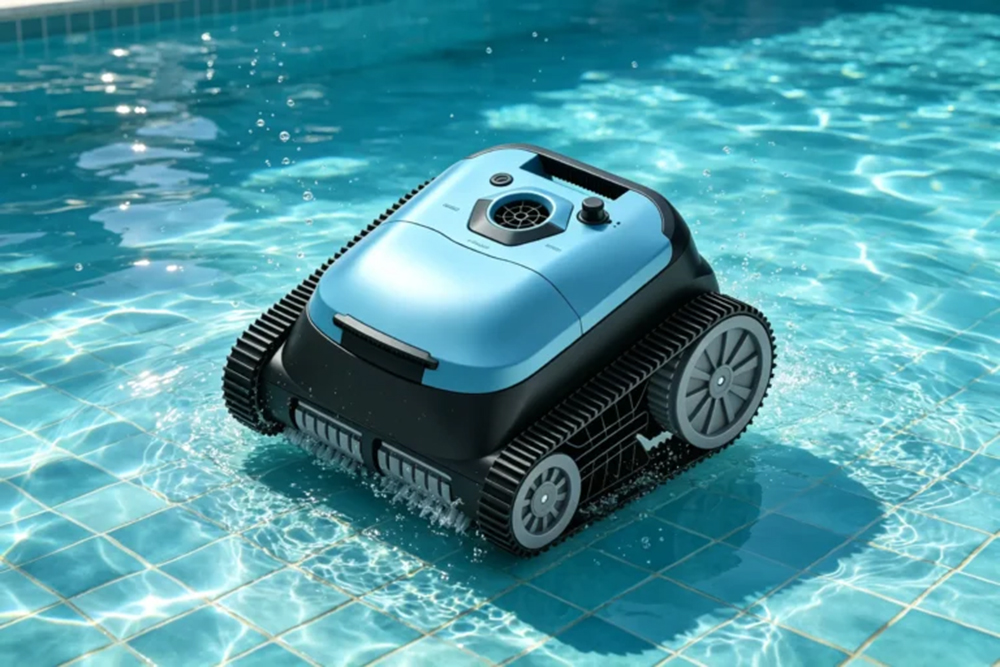
| Attribute | ST-BM5 specification |
|---|---|
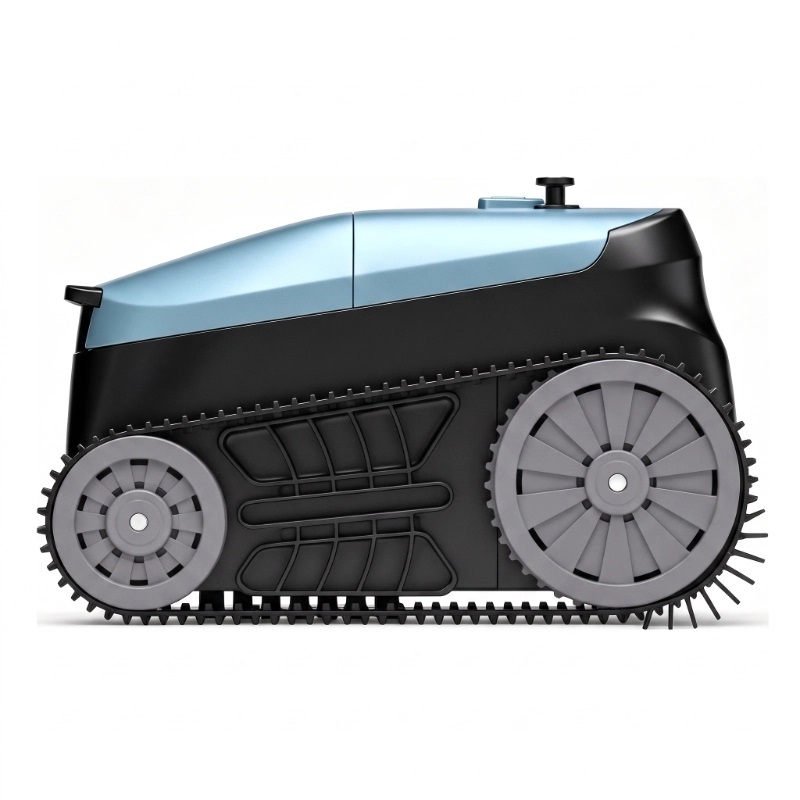
| Color | Light blue body, black chassis |
| Plug type | Cordless body, no plug; charger plug matched to the destination order |
| Voltage | 25.2 V DC charging, charger rated 25.2 V / 2.2 A |
| Charging time | 2.5 hours |
| Model | ST-BM5 |
| SKU | ST-BM5 |
| Product type | Wall climbing robotic pool cleaner |
| Pool type and size | In-ground pools up to 300 m² |
| Cleaning coverage | Pool floor, walls and waterline |
| Drive | Differential drive on rubber tracks |
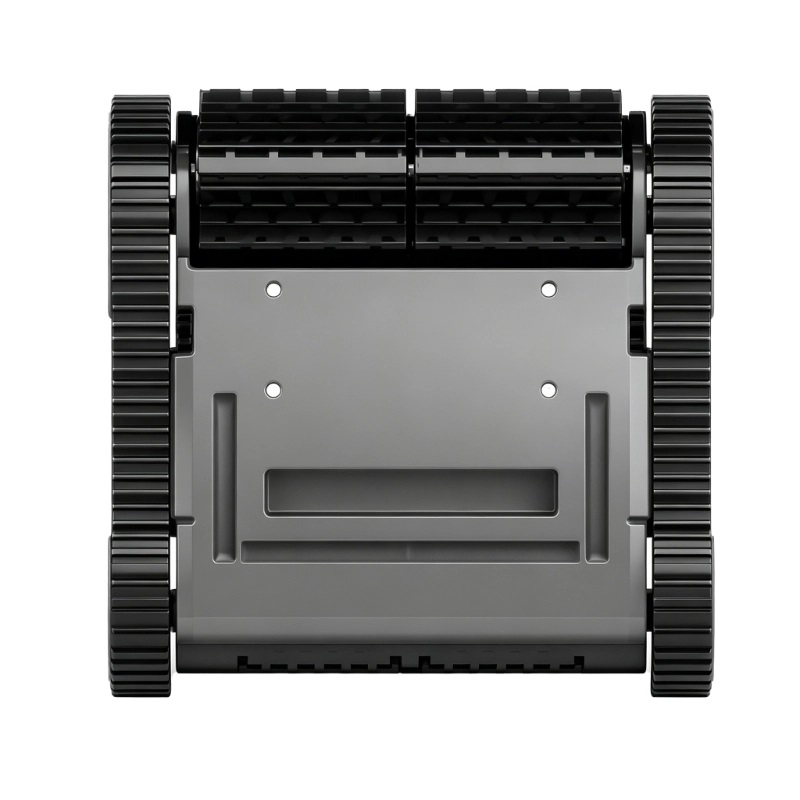
| Brush system | Dual roller brushes |
| Motors | Three high-power brushless motors |
| Total power | 45–60 W, 60 W maximum during wall climbing |
| Battery capacity | 4,500 mAh (6S1P, 21700 cells) |
| Runtime | Approx. 150–170 minutes |
| Water flow rate | 240–350 L per minute |
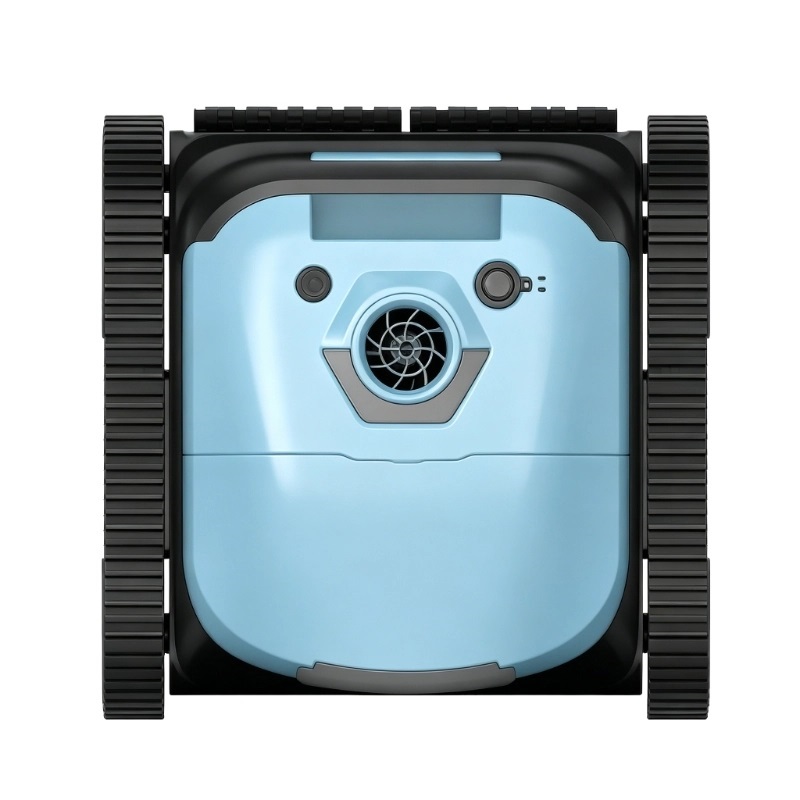
| Control modes | AUTO, FLOOR and WALL on the top panel |
| Navigation | Intelligent navigation |
| Waterproof rating | IPX8 |
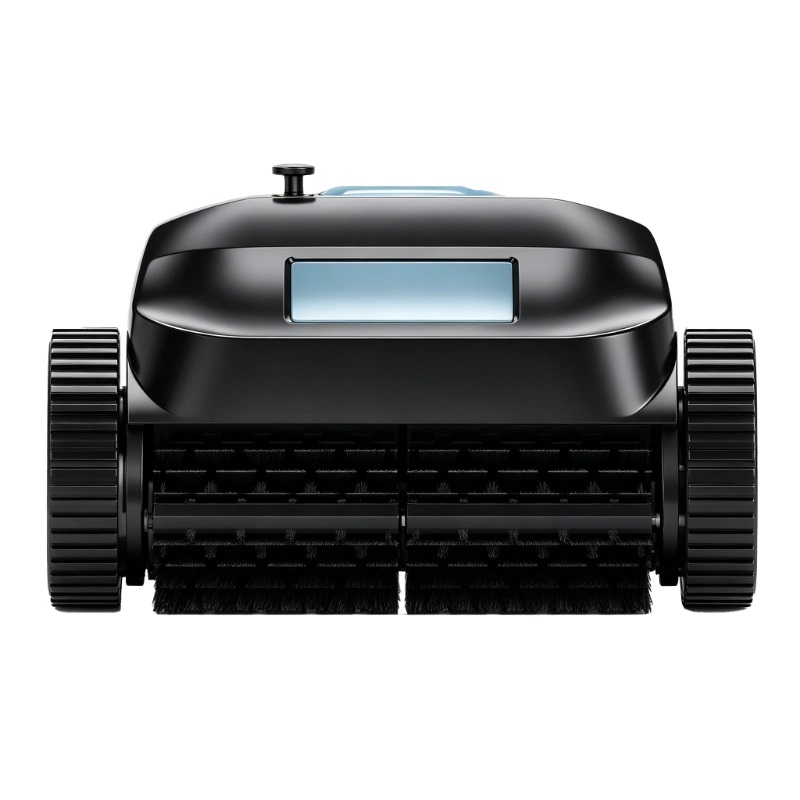
| Product dimensions | L384 × W386 × H242 mm |
| Net weight | 8.2 kg (18 lbs) |
What the ST-BM5 Wall Climbing Pool Cleaner Is
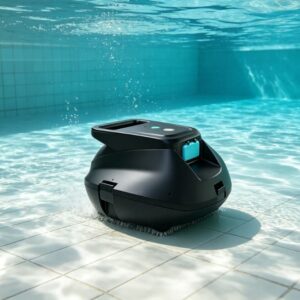
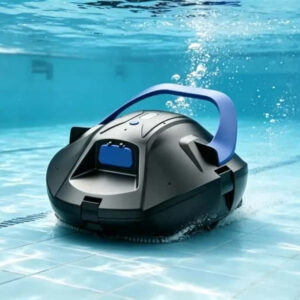
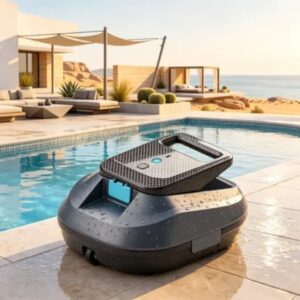
The ST-BM5 is a wall climbing robotic pool cleaner for in-ground pools up to 300 m². It drives on rubber tracks with differential steering, cleans with dual roller brushes driven by three brushless motors, and covers the pool floor, the walls and the waterline in the same cycle. Total power is 45 to 60 W, with 60 W drawn during wall climbing, from a 4,500 mAh battery on 21700 cells charged at 25.2 V / 2.2 A.
That combination is the reason this page exists. A floor-only unit leaves the wall and the scum line to a brush on a pole; this machine drives up the wall and along the waterline under its own power, which changes both the labour per pool and the accessories a buyer needs to stock.
Floor, Wall and Waterline in One Cycle
Three modes sit on the top panel: AUTO, FLOOR and WALL. AUTO runs the full sequence unattended; FLOOR keeps the machine on the horizontal surface; WALL sends it up the side. For a trade buyer the useful reading is that the mode is selectable at the pool, not fixed at the factory, so one unit covers a plaster pool with tiled walls and a liner pool with a smooth wall in the same week.
The power budget explains the design. The specification quotes 45 to 60 W total, with 60 W available during wall climbing, because holding a body of 8.2 kg against a vertical surface takes more torque than driving it across a floor. A wall climbing pool cleaner that quotes a single wattage figure is usually quoting the floor number. Most of the inground pool cleaner robot category is floor-only for exactly this reason, and the wall and waterline coverage is the line item that separates this machine from that group.
240 to 350 Litres per Minute: Reading the Flow Figure
Flow is the number that decides how much debris enters the intake per pass. This machine moves 240 to 350 litres of water per minute, which is the high end of the cordless class and the reason dual roller brushes are fitted ahead of the intake: loose material is lifted off the surface into the water column before the pump has to carry it.
Multiplied by the runtime, that gives a per-cycle figure worth putting in front of a buyer. At 150 to 170 minutes and 240 to 350 litres per minute, one cycle passes roughly 36,000 to 59,500 litres through the machine. On a 300 m² pool at an average depth of 1.5 m, the body of water is about 450,000 litres, so a cycle moves somewhere between 8 and 13 percent of it. This is a debris collector working the surfaces, not a filtration system for the whole volume, and the specification makes no claim otherwise.
Sizing an In-Ground Pool in Square Metres
The rating is given as area, not volume, so the check is a tape measure rather than a calculation of litres. A 6 × 12 m pool is 72 m², a 10 × 20 m pool is 200 m², and 300 m² is reached at 15 × 20 m. Most residential in-ground pools sit far below the ceiling; commercial and hotel pools are where the 300 m² figure starts to matter, and where a single wall climbing pool cleaner per pool stops being enough.
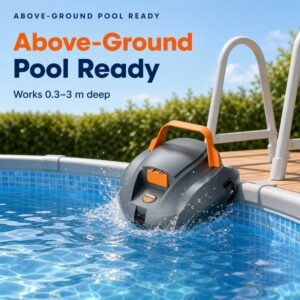
Two exclusions belong in the same paragraph, because they are the two that cause returns. The specification covers in-ground pools, and it states a 300 m² ceiling; a pool larger than that is outside the rating however clean the water looks. The supplied material also gives no working-depth figure — it states pool area instead — so a buyer with a deep diving pool should ask for the depth rating in writing before quoting, rather than assume it from the class.
4,500 mAh on 6S1P 21700 Cells at 25.2 V
The pack is 4,500 mAh in a 6S1P arrangement of 21700 cells, charged at 25.2 V and 2.2 A. Three figures follow from that and they are the three a buyer should be able to repeat: 25.2 V is a six-cell series voltage, 4,500 mAh at that voltage is roughly 113 Wh of stored energy, and a charger delivering 25.2 V at 2.2 A supplies about 55 W, which is why 2.5 hours is enough for a full charge.
Runtime then becomes arithmetic rather than marketing. A 150 to 170 minute cycle from a 113 Wh pack implies an average draw in the region of 40 to 45 W, with the 60 W ceiling applying during the wall-climbing phase. Charging at 2.5 hours against a runtime of 2.5 to 2.8 hours means one charger per unit is the realistic minimum for a route, and two units sharing a charger will idle.
Differential Drive and Rubber Tracks
Differential drive steers by running the two tracks at different speeds, so the machine can turn on the spot at a wall corner instead of performing a three-point turn against the coping. On a rectangular pool that matters at every corner; on a freeform pool it is the difference between following a curve and scraping along it.
Rubber tracks also spread the load. A body of 8.2 kg on tracks sits on a longer contact patch than the same body on four small wheels, which is what allows a wall climbing pool cleaner to hold a vertical surface without slipping, and what keeps the brushes at a consistent depth on a floor that is not perfectly flat.
Three Brushless Motors and Dual Roller Brushes
The specification names three high-power brushless motors and a dual roller brush system. Roller brushes rotate into the debris rather than sweeping across it, which lifts sand and silt out of a plaster surface instead of pushing it forward, and two brushes side by side cover the full width of a 386 mm body in one pass.
Brushless motors carry no carbon brushes to wear, which is why the motor type appears on a trade sheet at all: on a machine that runs 150 to 170 minutes at a time, motor life is a service cost, not a specification detail. The specification states the motor type and the power range; it does not state motor life in hours, and this page does not invent one.
8.2 kg at 242 mm: Lifting, Transport and Storage
At 8.2 kg, or 18 lbs, this is a two-handed lift out of the water rather than a one-hand retrieve, and that single fact shapes how the machine is sold. A domestic buyer lifting it once a week will not care; a service technician lifting it eight times a day will, and a trolley or a deck hook becomes part of the kit.
The dimensions matter in the other direction. At L384 × W386 × H242 mm and 8.2 kg, a dealer can stack and shelve units without a pallet, and a van can carry a route load in the footprint of a few crates. Height is the figure to check against a storage bench or a shelf gap, because 242 mm is taller than most cordless floor cleaners in the category.
What the Supplied Specification Does Not List
It lists no working depth, no app, no remote control, no schedule timer, no mapping, no coverage report, no filter media rating and no debris basket volume. It describes navigation only as intelligent navigation and names no method. Where a buyer needs any of those, the answer is to confirm it in writing against the model being quoted rather than to assume it from the category.
Commercial terms sit outside this page for the same reason. What a buyer pays, how many units an order starts at and how long production takes belong in a quotation, not in product copy. Nothing on this page should be read as a promise on those points.
Goods-In Checks a Buyer Can Run in Twenty Minutes
Every figure below is stated in the specification, so every one of them is testable on arrival with a scale, a tape, a charger and a stopwatch:
- Weigh the unit: 8.2 kg, or 18 lbs, dry
- Measure the body: L384 × W386 × H242 mm
- Turn both tracks by hand and confirm the differential drive moves each side independently
- Confirm both roller brushes rotate freely and sit level with the base
- Check the IPX8 marking on the housing before the first immersion
- Read the charger label: 25.2 V at 2.2 A, and time a full charge at about 2.5 hours
- Run a full cycle and time it against the 150 to 170 minute window
- Select AUTO, FLOOR and WALL at the panel and confirm each mode engages
Who Buys the ST-BM5
This is an equipment purchase with a defined job, and five buyer types account for most enquiries:
- In-ground pool owners with plaster or tiled walls, where the scum line is the part of the pool nothing else reaches
- Pool service companies running a route, where wall and waterline cleaning is the labour line item that eats a schedule
- Hotels, resorts and villa managers with pools at or below the 300 m² rating and a daily presentation standard
- Pool shops and dealers adding a wall-climbing model above the cordless floor-only units they already stock
- Importers and distributors building an in-ground range around one machine that covers floor, wall and waterline, instead of listing an automatic pool cleaner for inground pools beside a separate wall brush
Specifying a Wall Climbing Robotic Pool Cleaner for a Project
Five lines settle most specifications, and all five are in the table at the top of this page:
- Pool area. In-ground pools up to 300 m², which is the first number to check against a site plan
- Coverage. Floor, walls and waterline, with AUTO, FLOOR and WALL modes selectable at the pool
- Flow. 240 to 350 litres per minute, the figure that sets debris pickup per pass
- Cycle and charge. 150 to 170 minutes of runtime, 2.5 hours to charge at 25.2 V / 2.2 A
- Handling. 8.2 kg at L384 × W386 × H242 mm, cordless with no cable to the skimmer and no hose on a pole
Written into a quotation, those five lines answer the questions that arrive after delivery. They also separate a wall climbing pool cleaner from a floor-only unit sold on battery life alone, and they keep the conversation on measurable ground rather than on category adjectives.
Frequently Asked Questions
What is the ST-BM5 wall climbing pool cleaner?
It is a cordless wall climbing robotic pool cleaner for in-ground pools up to 300 m2. It drives on rubber tracks with differential steering and cleans with dual roller brushes driven by three brushless motors, covering the pool floor, the walls and the waterline in one cycle.
Does the ST-BM5 clean the walls and the waterline, or only the floor?
Floor, walls and waterline. Three modes are selectable on the top panel: AUTO for the full sequence, FLOOR to keep the machine on the horizontal surface, and WALL to send it up the side. Total power is 45 to 60 W, with 60 W available during wall climbing, which is what separates it from a floor-only inground pool cleaner robot.
What size in-ground pool does it cover?
The specification rates it for in-ground pools up to 300 m2. For scale, a 6 x 12 m pool is 72 m2, a 10 x 20 m pool is 200 m2, and 300 m2 is reached at 15 x 20 m. A larger pool is outside the rating.
How deep can the ST-BM5 work?
The supplied specification gives pool area rather than a working depth, so no depth figure is claimed here. A buyer with a deep pool should ask the supplier for the depth rating in writing before quoting.
How long does one charge last, and how long does charging take?
Runtime is approximately 150 to 170 minutes. The 4,500 mAh pack in a 6S1P arrangement of 21700 cells charges at 25.2 V and 2.2 A in about 2.5 hours.
How much water does the pump move?
240 to 350 litres per minute. Multiplied by the runtime, one cycle passes roughly 36,000 to 59,500 litres through the machine, which is a surface debris figure rather than a whole-pool filtration figure.
How does the machine turn at a wall corner?
Differential drive runs the two rubber tracks at different speeds, so the unit can turn on the spot instead of performing a three-point turn against the coping. The longer track contact patch also helps it hold a vertical surface at 8.2 kg.
What are the dimensions and the weight?
L384 x W386 x H242 mm at 8.2 kg, which is 18 lbs. The 242 mm height is the figure to check against a storage bench or a shelf gap, and the weight makes it a two-handed lift out of the water.
What plug type and voltage does the ST-BM5 use?
The body is cordless and carries no plug. The charger is rated 25.2 V at 2.2 A and its plug is matched to the destination order, so the mains side should be confirmed per market rather than assumed.
What can a buyer check at goods-in?
Weigh the unit at 8.2 kg, measure L384 x W386 x H242 mm, turn both tracks and confirm each side moves independently, check both roller brushes, read the IPX8 marking, confirm the charger label at 25.2 V / 2.2 A, time a full charge at about 2.5 hours, and time a cycle against the 150 to 170 minute window.