| ST-BP8 — Specification | |
|---|---|
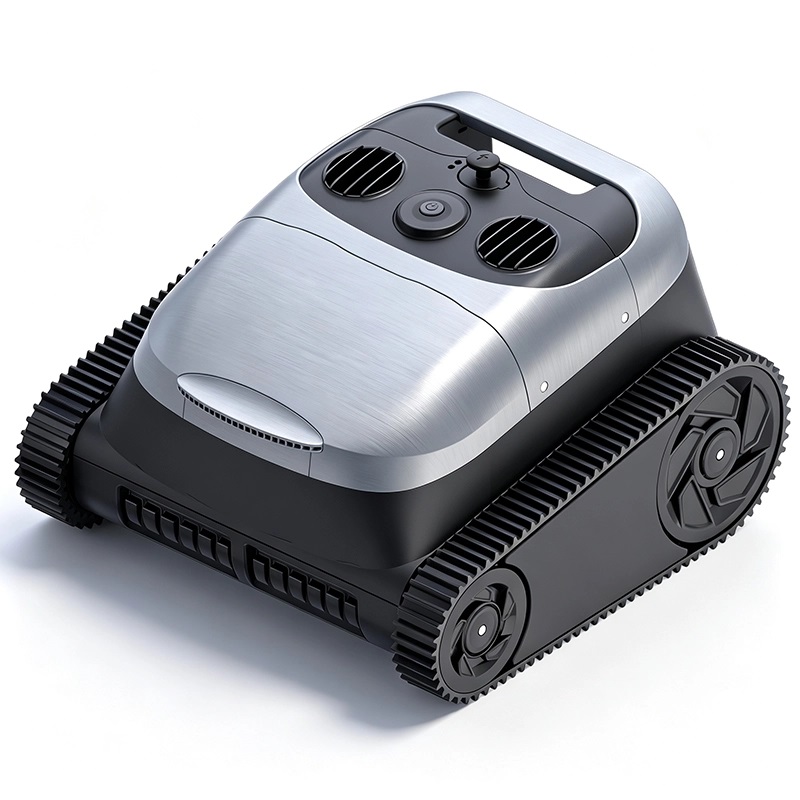
| Color | Black body, silver-grey top cover |
| Plug type | Cordless body, no plug; charger plug matched to the destination order |
| Voltage | 25.2 V DC charging, charger rated 25.2 V / 3.5 A |
| Model | ST-BP8 |
| SKU | ST-BP8 |
| Power system | Differential drive with dual roller brushes |
| Total power | 45–100 W; peak power up to 100 W while climbing walls |
| Battery capacity | 8,700 mAh (6S1P, 21700 cells) |
| Charging time | Approx. 3 hours at 25.2 V / 3.5 A |
| Runtime | Approx. 150–180 minutes per charge |
| Water flow rate | 480–700 L per minute |
| Pool coverage | In-ground pools up to 300 m² |
| Cleaning surfaces | Pool floor, walls and waterline |
| Navigation | Inertial navigation, gyroscope, infrared obstacle avoidance, active recall |
| Motor configuration | Four high-power brushless motors |
| Waterproof rating | IPX8 |
| Product dimensions | L384 × W386 × H254 mm |
| Net weight | 8.9 kg (19.6 lbs) |
The ST-BP8 is a wall climbing pool cleaner sized for in-ground pools up to 300 m², and its specification sheet is unusually easy to argue with on the numbers alone: 480 to 700 litres a minute, a 45–100 W power band with a 100 W peak while climbing walls, four brushless motors, and 150 to 180 minutes of runtime out of an 8,700 mAh pack. Add infrared obstacle avoidance and active recall and the machine is doing something the rest of the category mostly talks about rather than lists. This page is written for trade buyers — distributors, dealers, service companies, builders — so it opens with the table and spends the rest of its length explaining what each figure changes at the pool.
ST-BP8 at a Glance
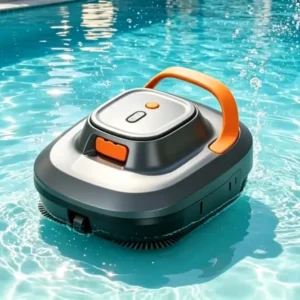
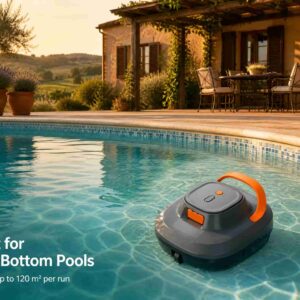
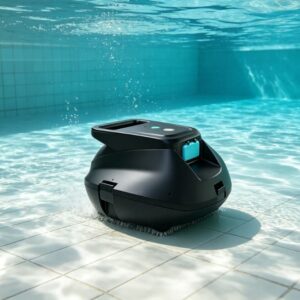
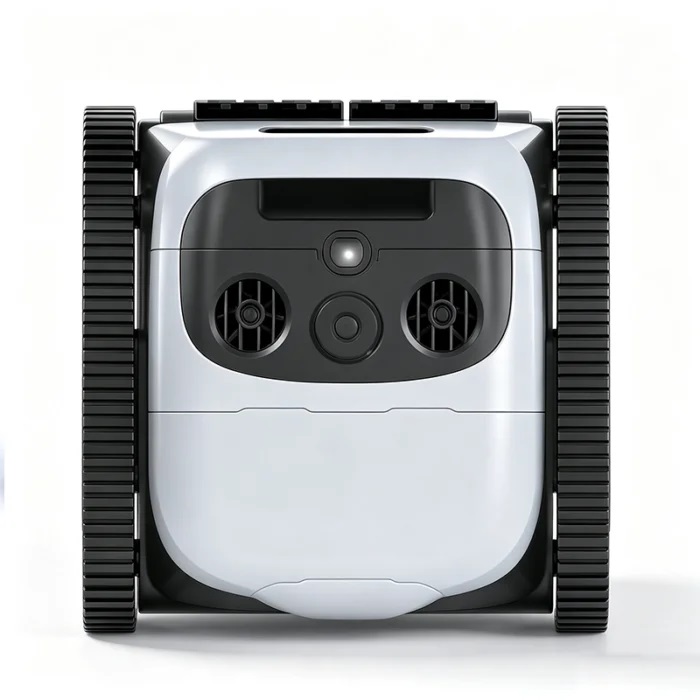
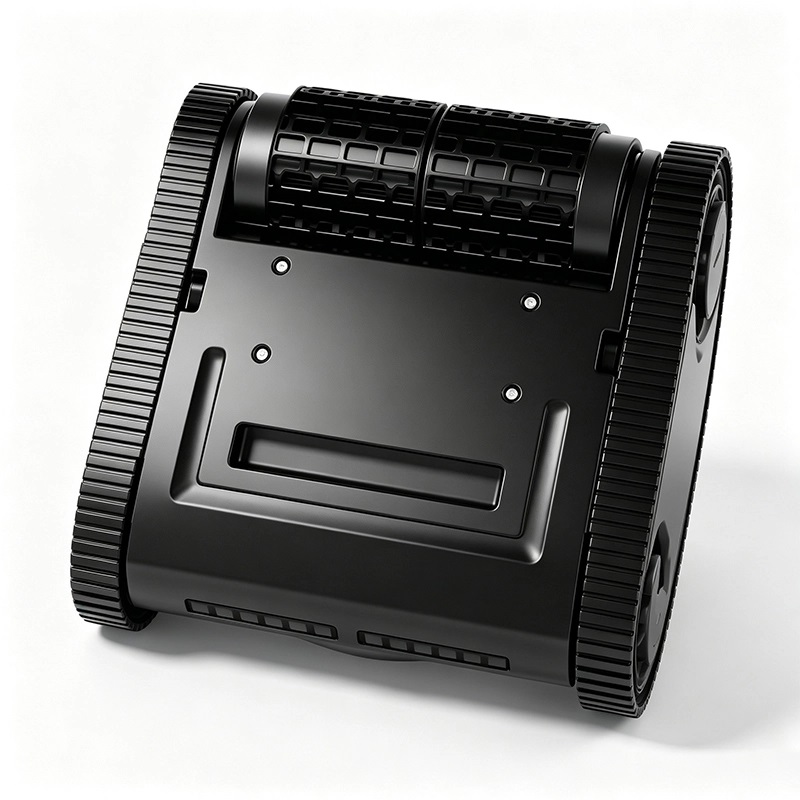
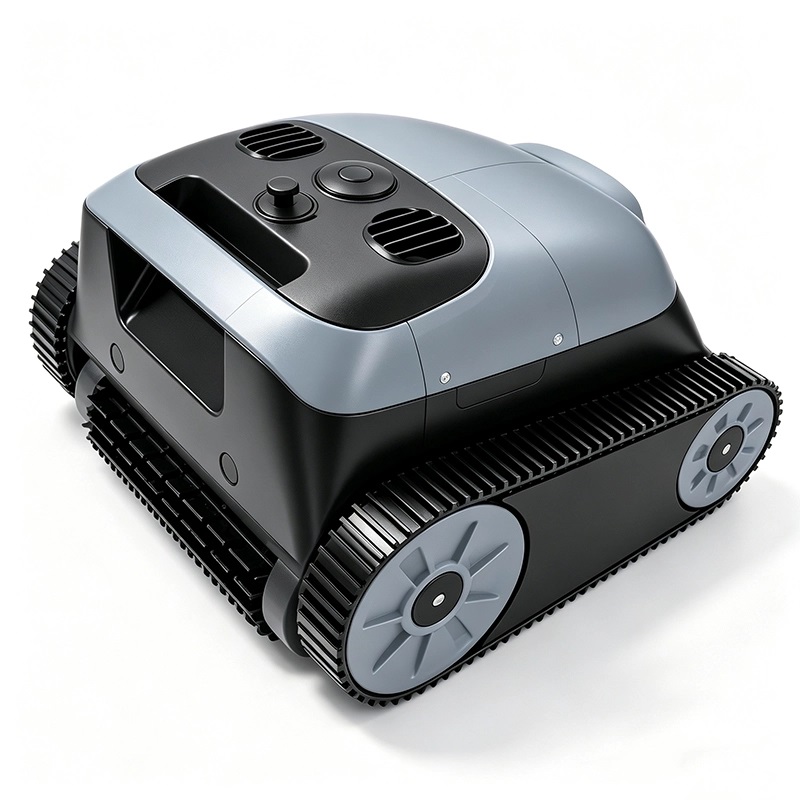
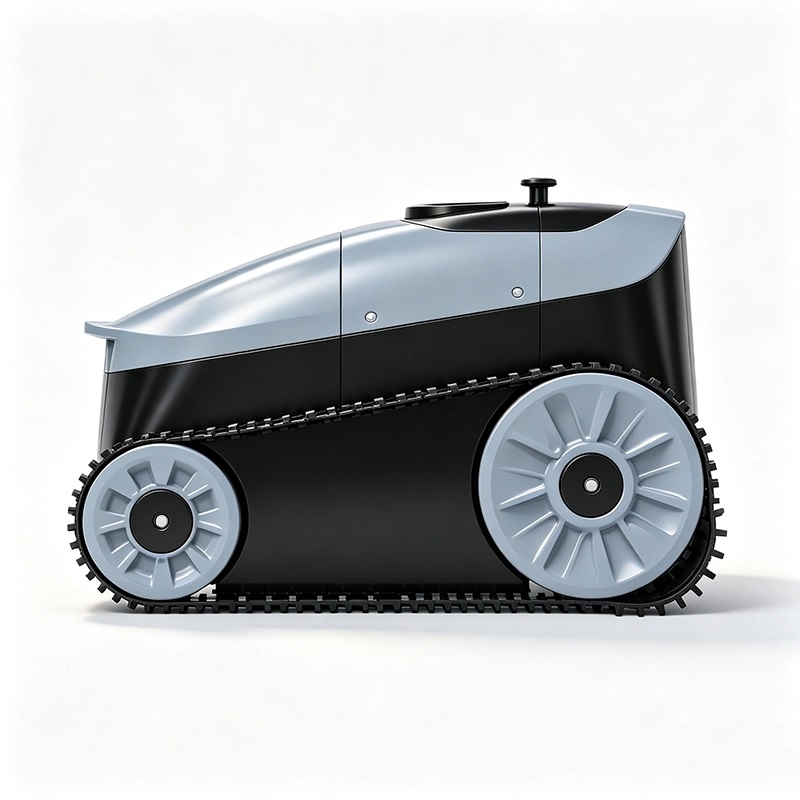
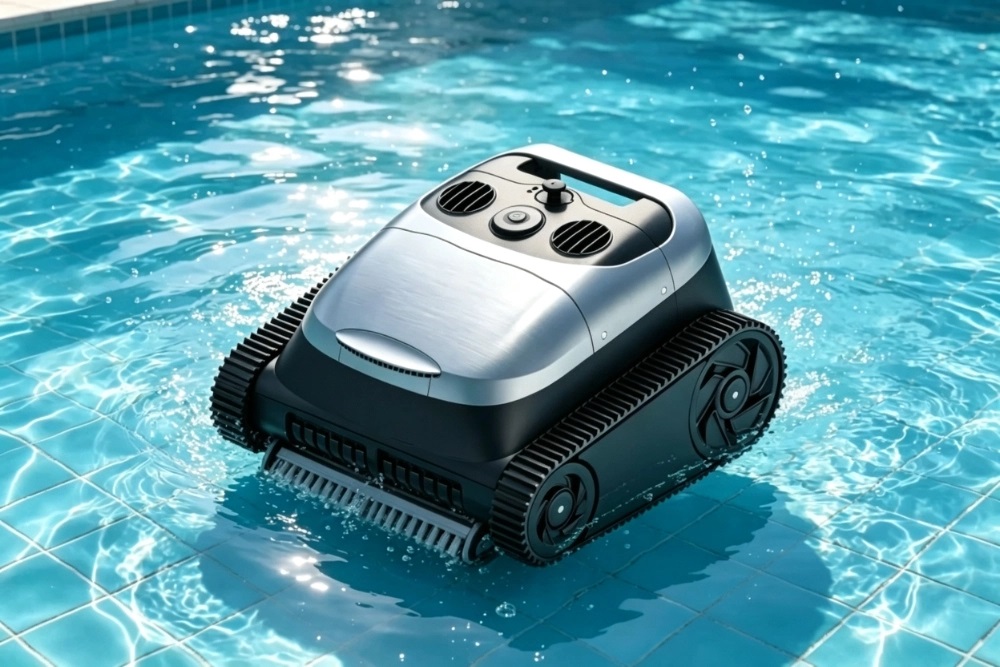
A black body under a silver-grey top cover, two lugged tracks down the sides, and a top deck carrying the handle and a control knob. Inside: four high-power brushless motors driving through a differential, a pair of roller brushes feeding the intake, an 8,700 mAh battery in a 6S1P 21700 arrangement, and a flow path rated 480–700 L per minute. The body is L384 × W386 × H254 mm and weighs 8.9 kg — 19.6 lbs — which is a two-hand lift for most people and a one-hand lift for a pool technician who does it forty times a week.
Nothing in that list is decorative. The height, the weight and the flow rate all move together: a bigger flow path needs a bigger motor set, a bigger motor set needs a bigger pack, and the pack is what sets the weight. Reading the sheet in that order is how a distributor decides whether the machine belongs in the mid-range or the top of the range.
What 480 to 700 Litres a Minute Buys
Flow is the first number to read, because it sets the ceiling on everything else. At 480 L per minute the machine is moving eight litres a second past the intake; at 700 it is close to twelve. Over a full 150 to 180 minute cycle that compounds into somewhere between 72,000 and 126,000 litres through the body — a figure worth putting in front of a buyer, because it is the honest measure of how much water the machine actually processes rather than how long it stays switched on.
The ratio against power is the second thing to write down. 480 L per minute against a 45 W floor is about ten and a half litres for every watt drawn; 700 L per minute at the 100 W end is seven. So the machine holds a band of roughly seven to ten litres per minute per watt across its whole operating range — a narrow spread, which is what you want, because it means the flow is not being bought with disproportionate power at either end.
Why a Wall Climbing Pool Cleaner Peaks at 100 W
The power band is 45–100 W, and the sheet is specific about where the top of it sits: peak power up to 100 W while climbing walls. That is the useful half of the sentence. A machine running flat out on the floor does not need the ceiling; a machine holding itself against a vertical surface at the waterline does, and the 100 W figure is there to tell a buyer that the wall segment is the expensive part of the cycle rather than an afterthought.
Four brushless motors carry that work — brushless because there are no brushes to wear and nothing to spark inside a sealed body, and four because the drive, the flow path and the wall segment do not all peak at the same moment. The drive itself is a differential arrangement: the two tracks run at different speeds to turn the body on the spot, so steering happens through the tracks rather than through a separate linkage that could foul on a ladder or a step.
Infrared Obstacle Avoidance: Sensing Before Contact
Infrared obstacle avoidance is listed as part of the navigation set, and it is the one line on the sheet that changes how a machine behaves in a pool that is not an empty rectangle. Most in-ground pools are not: there is a ladder, a skimmer mouth, a light housing, a step, sometimes a cover anchor. A body that meets those things learns about them by contact, and contact is where a track slips and a cycle is lost.
Infrared sensing moves that discovery earlier. The body reads an obstruction ahead and alters course rather than driving into it, which matters most at the waterline, where a machine is holding on with the least margin it will have all cycle. For a service company the practical result is a route that finishes, and for a dealer it is one fewer conversation about a machine that got stuck behind the ladder.
Active Recall and the End of a Cycle
Active recall is the second navigation line, and it addresses the least glamorous part of ownership: getting the machine back. In a 300 m² pool a cleaner can finish anywhere — mid-floor, against a wall, at the far end of the deep section — and every one of those endings costs the same thing, which is a walk around the pool to find it.
Recall shortens that. The specification lists it alongside inertial navigation and the gyroscope rather than as a separate accessory, which is the right way to read it: it is part of how the machine closes a cycle, not something bolted on afterwards. Buyers evaluating it should ask the same question they ask of any navigation feature — where does the cycle end, and how long does it take to retrieve the body from there.
8,700 mAh: 219 Watt-Hours, and the Average Draw Behind It
Eight thousand seven hundred milliamp-hours against 25.2 V nominal is about 219 watt-hours — close to double what a 4,500 mAh pack at the same voltage carries. Keep that figure. It is the one that lets a technical buyer check the runtime instead of taking it on trust.
Divide 219 Wh by 150 to 180 minutes and the average lands at 73–88 W — inside the 45–100 W band, and consistent with the 100 W peak being placed on the wall segment rather than across the cycle. Hold a flat 100 W and the pack is empty in roughly two hours ten, which is short of the stated runtime; so the peak is a peak and the average sits under it. Thirty seconds of arithmetic, and the result decides how much weight the rest of the sheet deserves.
Three Hours to Charge, Two and a Half to Three Hours to Run
The charger is rated 25.2 V / 3.5 A, which is 88 W at the wall, and it brings the pack back in about 3 hours. Runtime is 150–180 minutes. Charge and run therefore sit at roughly one to one — three hours of charging returns two and a half to three hours of work.
That ratio is what makes a two-unit operation viable. One machine works the pool while the other sits on the charger, and the pair covers a route that a single unit cannot. It also sets the honest expectation for a single-unit owner: the machine runs one long cycle, then it is off the water for three hours, and no amount of scheduling changes that.
300 m² at 1.67 to 2.0 m² a Minute
Divide the covered area by the runtime and the pace falls out. 300 m² over 180 minutes is 1.67 m² a minute; over 150 minutes it is 2.0. That is the rate the route has to sustain for the coverage claim to hold, and it is why overlap matters more than top speed — a machine that re-covers ground spends its minutes twice on the same square metre and finishes with a smaller clean area than the runtime suggests.
Navigation is inertial, referenced to a gyroscope. Practically, the body holds a heading across the floor instead of wandering, and the gyroscope stops one pass drifting out of parallel with the one before it. On a rectangular in-ground pool that is the whole game: parallel passes with a small overlap cover the floor predictably, and drifting passes leave strips that nobody sees until the water clears.
Floor, Wall and Waterline Coverage
Three surfaces on one route. The floor takes the bulk of the 300 m². The walls are where a wall climbing pool cleaner earns the name, and where the 100 W peak and the tracks are doing their work. The waterline is where film gathers unseen from the deck until it has set, and it is the band a manual brush reaches least often.
A body that works the floor and stops there leaves a band at the top of the wall, and the band shows within a week or two once the water clears. Callbacks start at that band rather than at the floor. The sheet lists all three surfaces, and moving between them needs no lift-out.
8.9 kg at 384 by 386 by 254 mm
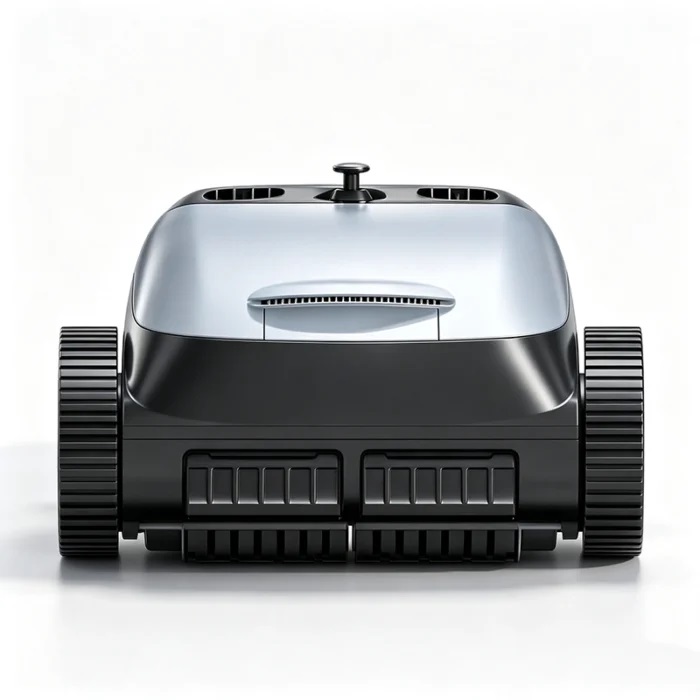
Length 384 mm, width 386 mm, height 254 mm, mass 8.9 kg. The footprint is very nearly square, which makes the body behave like a box in a corner rather than a hull that needs clearance behind it. The extra height over a lower machine comes from the pack and the top deck, and it is the dimension that decides whether the unit fits under a cover or into a shelf bay.
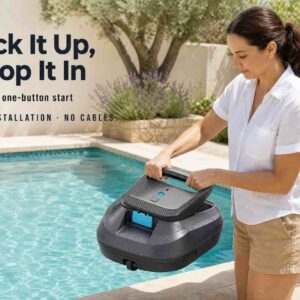
At 8.9 kg it is a two-hand lift for a homeowner and a routine one-hand lift for a technician. That distinction is worth naming on a trade page, because a service company’s cost per pool is set by how many times a day somebody bends over, and half a kilo either way is what decides which machine stays in the van.
IPX8, and What Happens on the Deck
IPX8 is the continuous-immersion grade, and it is the grade a body that lives underwater should carry. It describes the body at work. It says nothing about the charger, and it does not turn the unit into a fixture: body out, deck, connect, three hours, disconnect, back in.
Two habits keep that honest, and both belong on the sheet a dealer hands over. Nothing gets connected until the body is out, and the unit does not stay in the pool between visits — the grade covers immersion while working, not storage in water that is being treated.
The Finish: Black Body, Silver-Grey Top Cover
The body is black; the top cover, the deck and the wheel hubs are silver-grey. Nothing about the finish changes a number on the sheet, and this page will not claim that it does. What it changes is how the unit reads in a catalogue and on a display floor: the two-tone treatment marks out a wall climbing pool cleaner at a glance, and it photographs without the flatness that a single dark colour gives under showroom lighting.
It also answers the question a buyer asks before anything else — whether two machines in the range are the same machine. Where the finish differs and the specification differs, both should be read from the tables rather than from the pictures.
Who Orders the ST-BP8
Five buyer types, each for a different reason. Pool equipment distributors carry it as the high-flow end of the range, where the 480–700 L/min figure separates one wall climbing pool cleaner from the next. Pool dealers and retail shops use the two-tone finish and the obstacle avoidance line to justify the step up on a display floor. Pool service companies buy the runtime-to-charge ratio and the recall function, because both are measured in minutes saved per pool. Landscapers and pool builders deliver it with the finished pool, since the first clean sits inside their own handover. Online and marketplace sellers need listings they can write from the sheet rather than from a call to a sales desk.
All five are buying a specification rather than a demonstration, which is why the table sits at the top of this page. It is the document they will forward, and it is the one they will be held to when a customer compares two listings side by side.
What an Enquiry Needs to Contain
Five lines and the answer comes back correct. Start with the model or SKU, ST-BP8. Then the market the units are going to, because the plug on the charger is set from it. Then the quantity, and whether the shipment travels as single cartons or consolidated. Then the route — warehouse or straight to a dealer — since that decides how many cartons are needed. Last, the pool sizes the end buyers really work with — 300 m² is the ceiling of the range, and a market of smaller pools needs the number below it.
No trading term appears on this page and none should be inferred from it. Terms sit in the quotation, built from those five lines.
Buyer Questions on the ST-BP8
Is the ST-BP8 a cordless wall climbing pool cleaner?
It is. The pack sits inside the body at 8,700 mAh and 25.2 V, and the sheet lists the unit as cordless with no plug. Everything that happens on the deck is charging, on a 25.2 V / 3.5 A charger, once the body has been lifted clear of the water.
What flow can it hold?
Between 480 and 700 litres a minute, drawn through a mouth that two roller brushes feed from the front edge of the body.
How does it handle a ladder or a light housing?
That is what the infrared pair is for. An obstruction ahead registers before the body reaches it, and the course changes rather than the track slipping. Steps, skimmer mouths and cover anchors are the cases it exists for.
What is active recall for?
Retrieval. A cycle in a 300 m² pool can finish anywhere — mid-floor, against the far wall, at the deep end — and recall is the part of the navigation set that shortens the walk to the body.
How much pool does a charge cover?
The sheet puts coverage at in-ground pools up to 300 m² against 150–180 minutes of runtime, which works out at 1.67 to 2.0 m² for every minute of the cycle.
How long is a charge?
Three hours on a 25.2 V / 3.5 A charger, which is about the length of a full run. Two units sharing a route can therefore alternate rather than wait.
Where does the 100 W go?
To the wall. The band runs 45–100 W and the peak is stated while climbing; 219 watt-hours spread across 150–180 minutes implies 73–88 W as an average.
Footprint and weight?
384 mm by 386 mm by 254 mm, at 8.9 kg (19.6 lbs). The handle on the top deck takes the lift.
What is IPX8 covering here?
Immersion of the body while it works. The charger is outside that description and is not used near water — charging is a dry step, done on the deck.
Will the charger plug suit my market?
The plug is set against the destination on the order, so name the market on the enquiry and it comes back quoted with the rest.