Reading time: 11 min | Field notes for importers, distributors & private-label buyers worldwide
Over 8 years advising wet-dry cleaning appliance buyers across Europe, North America, Oceania, Southeast Asia and the Middle East, three questions come up in almost every first consultation: What’s the actual minimum order? How long will production really take? And what will this cost me, all things considered?
Too many new importers lock in bulk orders based on a single EXW per-unit price scraped from a B2B marketplace listing. I’ve watched this mistake erase entire profit margins time and time again — hit by unstated MOQ thresholds, unplanned production delays, hidden one-time fees, and freight and duty costs no one mentioned upfront.
Smart floor washers aren’t cheap plastic gadgets. They pack lithium-ion batteries, brushless motors, sealed water tanks and embedded sensors. Component availability, regional certification requirements and customisation depth all shift MOQ, pricing and lead times. This guide pulls from real 2026 supply chain data and dozens of client projects across global markets — not factory marketing copy.
If you’re mapping out your full sourcing strategy, start with our complete smart floor washer wholesale & OEM sourcing guide. If you’re ready to review model specs and product tiers, jump straight to our full smart floor washer collection.
1. Minimum Order Quantity (MOQ): Why numbers vary so wildly between suppliers
You’ll see everything from “1 unit MOQ” homepage banners to “5,000 pieces per model” minimums. These numbers aren’t lies — they’re just talking about completely different order types. After negotiating with dozens of Chinese factories on behalf of international buyers, I break it down into four clear tiers, with context for what buyers in most major markets typically actually secure:
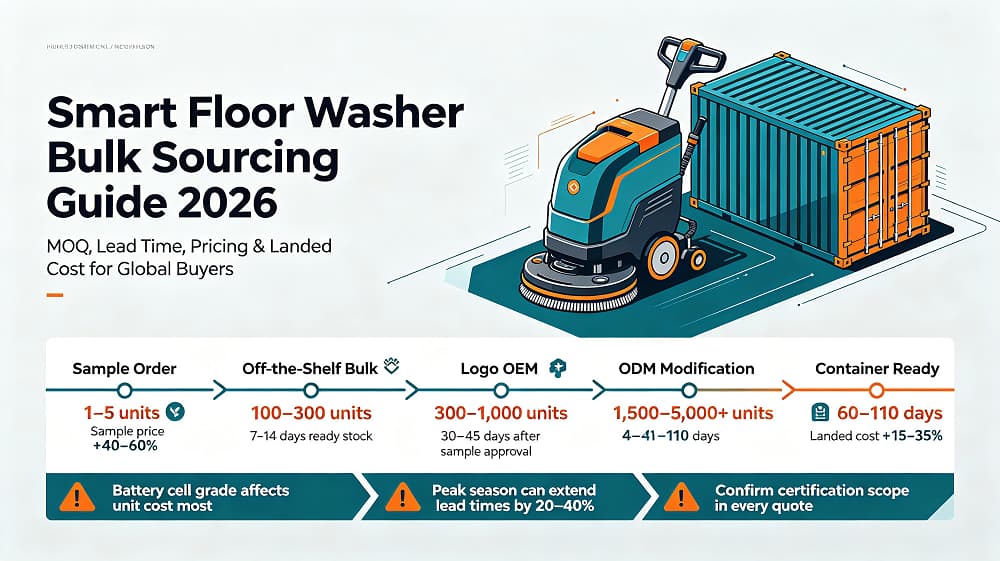
- Sample orders: Almost all reputable factories will supply 1–5 units for product evaluation. Just expect sample pricing to be 40–60% higher per unit than bulk rates, plus international courier fees. I always tell new clients to budget for 2–3 samples before committing to a bulk run.
- Off-the-shelf standard bulk: Finished goods with no custom branding. Realistic baseline MOQ sits at 100–300 units for most models. For buyers testing a new market, many factories will accept 80–100 unit trial runs at a small per-unit premium — if you frame the conversation around future repeat orders.
- Logo OEM (silk print + custom packaging): Print setup and custom box tooling create fixed overhead, pushing baseline MOQ to 300–1,000 units for most smart floor washer SKUs. This is the sweet spot for most private label brands we work with around the world.
- Deep-spec ODM hardware modification: When you need new moulds, reworked electronics or custom battery tuning, minimum production runs start at 1,500–5,000 units depending on project complexity.
2. Pricing Tiers: What’s actually included (and excluded) in your bulk quote
Comparing quotes is never as simple as ranking per-unit prices. Two suppliers can quote almost identical EXW numbers, but your final total cost can differ by 25% or more once you add one-time fees and missing deliverables. I’ve seen buyers get burned by “cheap” quotes that didn’t include mandatory market certification, or hit with unexpected testing fees later.
Cost components you must explicitly confirm in every single quote:
- Base EXW unit price at your exact order volume tier
- One-time fees: screen print setup charges, custom box die-cut cost, mould tooling investment for ODM work
- Sample unit cost plus international courier freight for pre-production samples
- Certification scope: Does the price include test reports for your target market? CE for EU/EEA, FCC for the US, UN38.3 for battery shipping, and regional safety marks as required? Certification as an add-on can add 3–8% per unit.
- Standard accessory kit included inside each carton (rollers, filters, power adapter etc.)
- Warranty spare-parts allocation percentage for bulk shipments
2026 industry benchmark from our global client data: Entry-level cordless smart floor washers sit in the lower-mid EXW price bracket. Mid-tier models with self-cleaning and electrolytic sterilisation command a clear premium. Flagship 24,000Pa suction models with hot-air drying and 180° flat-lay design carry the highest factory pricing. Battery cell grade remains the single biggest cost driver across every tier — and the number one place factories cut corners to hit a low price.
3. Lead Time Breakdown: From PO placement to container ready for shipment
Buyers love to copy-paste a “30-day lead time” expectation into every project. I can tell you from experience: that only applies to ready-stock orders. Production timelines break into three very different phases, and they shift dramatically by time of year — especially for markets with peak holiday retail seasons.
- Ready-made stock units (no customisation): 7–14 working days for consolidation and container packing after deposit confirmation. Subject to on-hand inventory availability. Great for fast restocks for retailers who need quick inventory turns.
- Standard logo OEM (existing hardware platform): 30–45 calendar days after signed-off sample confirmation. Lead time covers screen-print preparation, custom-box printing cycle, assembly and quality inspection.
- ODM modified-spec projects: 60–110 calendar days, and can stretch much further when new third-party certification testing is required for your target region.
What most commonly delays bulk smart floor washer orders?
- Global component shortages: Brushless motor and high-density lithium-ion cell supply fluctuates seasonally.
- Peak manufacturing season (Q3–Q4): Factory lines fill up fast ahead of major global retail peaks. Lead times can expand by 20–40% during this window.
- Buyer-side slow sample-approval cycles: Delayed feedback on prototype packaging or logo proofs directly push out mass-production start dates.
- Certification lab backlogs: Common when performing modified-spec ODM work that requires re-testing for regional compliance marks.
4. Critical Calculation: Landed cost is your real cost — not EXW factory price
This is the biggest mistake new importers make. They compare EXW factory prices and completely ignore downstream logistics. For lithium-ion powered consumer electronics like smart floor washers, total landed cost can easily add 15–35% on top of the original EXW value, depending on your destination port, import tariff regime and inland distance.
Major landed cost items for sea-freight bulk shipments:
- Ocean freight container cost + terminal handling charges
- Marine cargo insurance
- Import customs duty + local VAT / sales tax for your destination market
- Destination-port inland trucking / last-mile warehouse delivery
- Third-party pre-shipment inspection expense (if you hire a QC firm)
- Potential extra battery-related shipping surcharges for lithium-ion-containing goods
As a rough rule of thumb from our 2026 data: shorter-route regional imports typically see landed cost add 15–25% on top of EXW; longer-haul intercontinental imports add 22–35%. Always build out a full landed-cost spreadsheet before finalising your purchase order, and verify tariff codes for your specific country.
5. Practical Advice: Get balanced pricing & terms without sacrificing quality
After watching dozens of buyers navigate this space — some successfully, some very unsuccessfully — these are the non-negotiable rules I tell every global client to follow:
- Never chase the absolute rock-bottom per-unit price at the expense of battery quality and safety certification. An importer I worked with in 2025 switched to a cheaper supplier to save $7 per unit, only to face a 22% return rate and a product compliance scare due to substandard lithium cells. The cost of that mistake far outweighed any per-unit savings.
- Separate sample-evaluation phase from mass-production commitment. Never sign a large-volume PO before you physically test sample hardware and verify full model-matching certification documentation for your market.
- Share your sales forecast honestly. Factories will propose better pricing tiers and production-scheduling arrangements when they understand your medium-term business trajectory.
- Write every critical parameter down on a formal PI / contract document: MOQ, lead time, included accessories, defect-rate acceptance threshold, warranty spare-parts ratio. Verbal promises carry almost zero recourse when things go wrong.
FAQ: MOQ, Lead Time & Pricing for Bulk Smart Floor Washer Orders
Request a tailored bulk-order quotation for smart floor washers
Our product portfolio includes ready-to-ship wholesale models alongside OEM-customisable platforms. We can share realistic MOQ tiers, estimated lead times, accessory bundle options and compliant documentation for your target sales territory anywhere in the world.
Further reading: Complete Wholesale & OEM Sourcing Guide for Smart Floor Washers 2026