Cordless Pool Vacuum Cleaner Battery, Runtime and IPX8: What the Specs Actually Mean
Written by the Stonebotclean product team · Updated October 2026 Three numbers decide whether a cordless pool vacuum cleaner is
Robotic and manual pool vacuums solve different problems, and most pool-cleaning complaints trace back to that mismatch rather than to build quality. The guides in this section take one decision at a time: how robotic, suction-side, pressure-side and manual cleaners differ in how they are driven; what battery runtime, filter mesh and IPX8 immersion ratings actually mean under load; how to lift sand, silt and settled algae out of a pool floor without spreading it; and how to diagnose weak suction, a stalled drive or a clogged filter basket before replacing the unit. Everything here is written from the supply side, with the specifications we publish for every model and the failure patterns we see across distributor and service-contractor orders.
Looking for the machines themselves rather than the guides? Every model, with the floor type it is rated for, its filter basket and its drive system, is listed on the pool vacuum cleaner range page. Buying in volume, or supplying pool businesses under your own label? Bulk pricing, OEM and private-label terms are handled on the wholesale pool vacuum cleaner supply page.
Written by the Stonebotclean product team · Updated October 2026 Three numbers decide whether a cordless pool vacuum cleaner is
Buyer’s Guide Written by the Stonebotclean product team · Last updated: September 2026 · Reading time: about 20 minutes Most
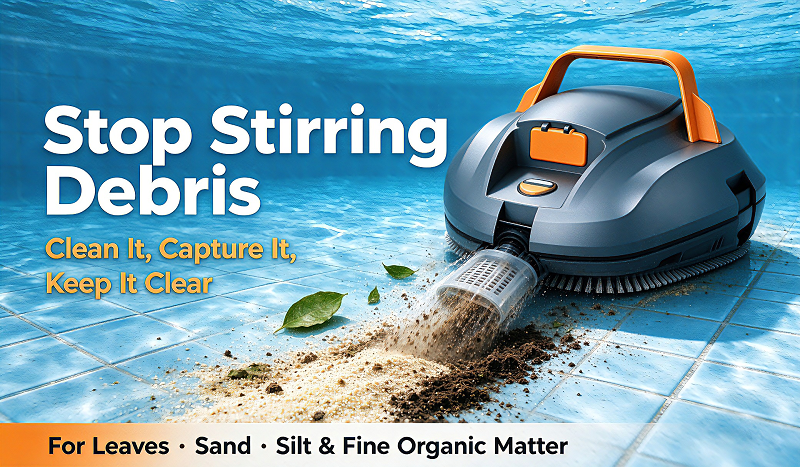
Empty and rinse the basket after every cycle in a leaf-heavy pool, and at least every second cycle where silt and fine sand dominate. A loaded fine-mesh basket is the most common reason a working cleaner starts trailing dirt: the suction is intact, but the debris has nowhere to go. Rinse with a hose and a soft brush rather than a high-pressure jet, because 0.1 mm mesh tears under pressure.
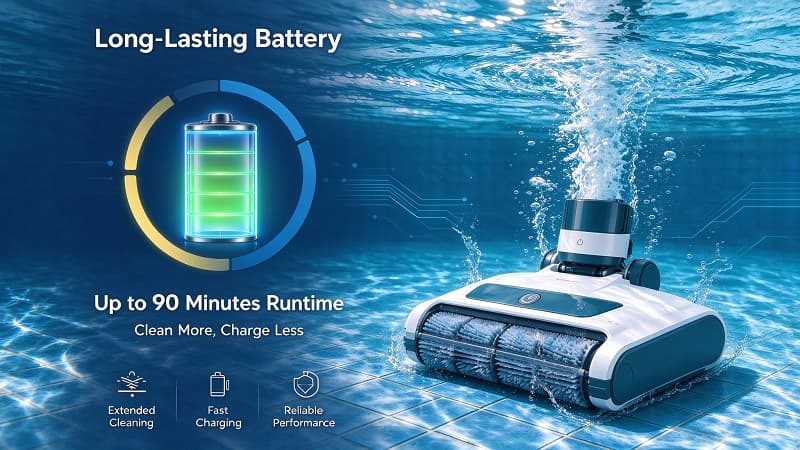
Work through four causes in order: a clogged or torn filter basket, worn brushes or drive belts that no longer agitate the floor, a battery that no longer holds a full charge, and debris lodged in the impeller housing. Basket and brush wear explain most cases. A failing battery usually shows up as a shorter cycle rather than weak suction, so check runtime before blaming the motor.
An IPX8 unit is rated for continuous immersion, so the water itself is not the problem. What degrades the cleaner is a loaded basket left to decompose and charging contacts that stay wet. Lift the unit out, empty and rinse the basket, and dry the contacts before charging. Leaving organic debris in a sealed filter housing for days is what produces the smell and the film that later blocks the mesh.
Charge the battery to roughly half, remove it if the design allows, clean and dry every basket and brush, and store the unit indoors, out of direct sun and above freezing. A lithium pack stored fully discharged, or in a shed that drops below freezing, ages fastest. Recharge to about half every three to four months so the pack does not fall into deep discharge.
Yes. A saltwater pool is still water, and an IPX8 unit is rated for continuous immersion in both cases. What changes is the maintenance interval: salt accelerates corrosion on metal parts and leaves a residue on the charging contacts, so rinse the unit and the basket after each cycle, dry the contacts before charging, and inspect the seals and the battery compartment at the start of every season rather than once a year.
Five items cover almost every failure that ends the working life of a cleaner: rinse the basket after each cycle, check brushes and drive belts monthly, inspect the motor and battery-compartment seals each season, keep charging contacts clean and dry, and replace the battery when runtime drops noticeably. Consumables decide the service life far more than the electronics do.