Buyer’s Guide
Most pool vacuums that fail in the field were never the wrong price. They were the wrong type for the pool, the wrong filter for the debris, or the wrong voltage for the market they were sold into. This guide walks through the whole decision in the order it actually happens — what the machine does, which of the four types you are really choosing between, which specs change performance, which pools punish the wrong choice, and what to verify before money changes hands.
I have spent the last several years on the supply side of pool and floor cleaning equipment, quoting orders for pool builders, service contractors, resort facility teams and private-label brands. The same six questions come up in almost every conversation. What follows is the long version of the answers I give on those calls, written for distributors, importers and cleaning operators rather than for someone buying a single unit for a backyard pool.
The short answer
- Match the cleaner to the pool floor before you look at price. A flat-bottom above-ground pool, an in-ground pool with a hopper, and a spa with steps are three different cleaning problems. One cleaner rarely covers all three well.
- Filter micron rating decides what the unit can actually pick up, not suction alone. Leaves and sand are easy. Silt and algae are the test. Our fine-filter units run to 0.1 mm; that number matters more than a marketing suction figure.
- Runtime must cover your pool’s surface area in one charge. A 100–120 minute unit suits most flat-bottom above-ground pools. A 110–180 minute unit with a larger battery is what keeps an in-ground pool or a service route from needing a mid-clean rescue.
- IPX8 is the waterproofing standard to insist on, not “water-resistant”. Everything in our range is IPX8 rated, and underwater electronics are exactly where cheap units die.
- Cordless beats corded once you sell across markets. No cord means no 110 V / 220 V split, no transformer, and one SKU that serves North America, Europe and the Gulf.
- Sample before you commit. In this category one unit on a real pool answers more than three weeks of supplier emails.
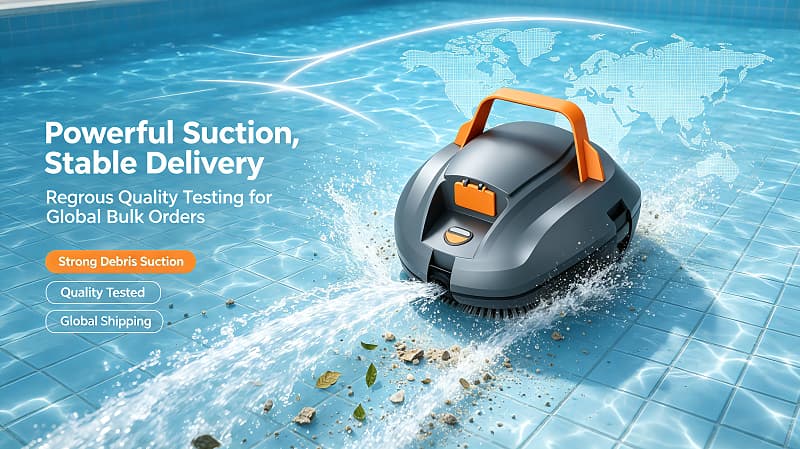
What a pool vacuum cleaner actually does — and what it will not do
Strip away the marketing and every pool vacuum does the same three things: it loosens debris from the pool surface, it lifts that debris into a collection point, and it keeps the debris out of the water column long enough for you to dispose of it properly. A unit that does two of those three leaves you with a pool that looks clean for a day and cloudy again by the weekend.
The third step is the one buyers underestimate. Debris that is loosened but not captured does not disappear — it drifts, settles in a different corner, and starts feeding algae. This is why a cheap suction-head vacuum that only stirs up the floor can leave a pool looking worse than it did before anyone touched it. The measure of a pool vacuum is what ends up in its filter basket, and how fine a particle that basket can hold onto.
What a pool vacuum will not do, no matter what you pay for it:
- It will not fix the water chemistry. A vacuum removes physical debris. If the pool is green because the chlorine and pH are wrong, no cleaner of any type solves that, and a unit marketed as an “algae solution” is usually just a fine filter doing its normal job.
- It will not un-stain a surface. Metals, scale and organic staining bond with plaster and liner. Cleaning removes the debris on top of the stain, not the stain itself.
- It will not climb beyond its design. A floor-only cleaner is a floor-only cleaner. If a pool has a wall-scrubbing requirement, that is a specification decision made before the order, not something a customer can be talked into afterwards.
- It will not replace circulation and filtration. A cleaner is a maintenance appliance, not part of the hydraulic system. Service contracts that assume otherwise generate callbacks.
Set those expectations internally before you stock a unit, and again with whoever ends up using it. A large share of “this cleaner is useless” complaints trace back to a job that no cleaner at any price was designed to do.
The four types you are actually choosing between
Product listings blur the categories, because everything is called a pool vacuum. In practice a buyer is choosing between four distinct machines, and the differences show up in the first hour of real use — especially in how much of your own labour the machine removes.
| Type | How it cleans | Where it wins | Where it hurts |
|---|---|---|---|
| Manual hose-and-head vacuum | Head on a telescopic pole, hose to the skimmer; the pool pump supplies the suction | Cheapest entry point, useful for spot work and pre-season cleanouts, no battery to manage | One operator tied up for the whole clean; useless on a service route with several pools a day |
| Suction-side automatic cleaner | Random-pattern crawler connected to the skimmer, driven by the pool pump | Low attention once installed; decent on flat in-ground floors and leaves | Needs the pump running for hours; can clog the skimmer line; struggles with fine silt |
| Pressure-side cleaner | Separate booster pump drives a bag-equipped cleaner around the pool | Bag captures larger debris before the filter; good on in-ground pools with the plumbing for it | Extra pump, extra energy, extra failure point; retrofit cost is real |
| Cordless robotic vacuum | Self-driven unit with an onboard battery and filter basket; independent of the pool pump | No plumbing, no pump hours, no operator; fine filtration; works on above-ground and in-ground pools | Battery runtime per charge becomes the limiting factor; battery is the main wear item |
The practical takeaway for anyone buying to resell or to run a service route: manual vacuums are an accessory, suction- and pressure-side cleaners are a plumbing decision the pool owner makes once, and the cordless robotic category is where the growth is. It solves the two complaints that come up most often in service work — the hours of labour and the pump running all afternoon — which is why our own pool vacuum cleaner range is built entirely around it, with each model aimed at a different pool type rather than at a different price point.
The mismatch I see most often is a buyer who standardises on one model across an entire catalogue, then discovers the same unit behaves differently on a flat above-ground liner and on an in-ground pool with a slope and a hopper. It is not a defect. A drive system tuned for a smooth flat floor climbs less predictably on a gradient, and the runtime that covers 100 m² easily may not cover the same pool when the cleaner spends half of it re-tracing a slope. Ask what pool the unit was designed to cross, then ask what pool it is going into.
The specs that decide whether the unit works
Six numbers decide almost everything about how a cordless pool vacuum performs day to day. Two of them are published honestly by most suppliers, two are published confusingly, and two are usually missing altogether — which is worth knowing before you compare two units side by side.
Battery capacity and runtime per charge
Runtime is the constraint that shapes the whole cleaning routine. A unit that runs for 100 minutes cleans a typical flat-bottom above-ground pool comfortably in one pass. A larger in-ground pool or a service route needs more headroom, which is why our larger models carry a 5200 mAh battery and run 110–180 minutes depending on floor load and cleaning mode.
When comparing units, ask what the runtime figure was measured under. A number quoted for a single slow pass on a clean floor is not the same as a number measured with the brushes engaged and the filter loading up, which is the condition a cleaner actually works in by minute sixty. Ask the second question — runtime under load — and you will get a straight answer or you will get silence, and both are useful.
What the battery rating behind that runtime does and does not tell you — how the pack ages across charge cycles, and when replacement becomes the deciding cost — is covered in runtime under load, and how charge cycles age.
Filter rating, in millimetres
This is the spec I would keep if I could only keep one. Filter mesh size determines the smallest particle the unit can capture, and it is the difference between a pool that stays clear and a pool that turns cloudy again within days. Coarse baskets hold leaves and let silt pass straight through, where it resettles. Our fine-filter models are rated to 0.1 mm, which is fine enough to hold the silt and fine organic matter that cause most post-cleaning cloudiness.
Read the filter spec together with the debris profile of the pool. A leaf-heavy pool with a coarse basket can be emptied weekly. A silt-heavy pool needs the finer mesh, and a finer mesh needs rinsing more often — a trade-off worth explaining to whoever cleans the basket, because a clogged fine filter quietly turns a good machine into a poor one.
Waterproofing: insist on IPX8, not “water-resistant”
Underwater electronics fail in one of two ways: water gets in, or heat cannot get out. IPX8 means the unit is rated for continuous immersion, which is the only rating that reflects how the machine is actually used. “Water-resistant” and IPX7-style claims describe a splash or a short immersion, not a two-hour working life at the bottom of a pool.
Everything in our pool range is IPX8 rated. When you compare suppliers, treat the rating as a pass/fail item rather than a feature, and ask for the test documentation behind it. Motor seals, battery compartment seals and charging contacts are the three points where a cheaper unit will let water in first, and they are invisible in a product photo.
For the difference between IPX8 and IPX7, and what to inspect on a sample unit before you commit, see what IPX8 covers and how to verify it.
Drive system, brushes and obstacle crossing
How a cleaner moves decides whether it cleans the whole floor or only the middle of it. Two elements matter: the number of driven brushes or tracks in contact with the surface, and how large an obstacle the unit can cross without stalling. Our dual-brush units agitate the floor as they go, which helps on a liner where fine debris clings, and our in-ground models cross obstacles up to 6 mm — the lip of a main drain, a floor fitting, a small step edge — without getting stuck on them.
This is where a cheap unit shows its limitations in a way no spec sheet admits. Stalling on a drain cover does not just leave that spot dirty; it ends the cleaning cycle early, and the customer concludes the machine is weak rather than that it was specified for a simpler floor.
Coverage area and the pool geometry behind it
Coverage is usually quoted as a floor area, and that is a reasonable shorthand — our larger models are rated for flat-bottom pools up to 120 m². But geometry matters as much as area. A long, narrow pool and a square pool of the same area are different navigation problems, and a pool with a slope or a hopper takes more passes than a flat one.
Ask the question in the form the answer is actually useful in: what pool shape was this drive pattern designed for, and what happens on a gradient? A supplier who can answer that has tested the machine. A supplier who answers only in square metres has read the catalogue.
Cordless or corded — and what it means for resale markets
Corded units can run indefinitely, which suits a single large pool with a convenient power point. Cordless units keep their appeal everywhere else: no cable across the deck, no tangled float line, no risk of a connector sitting in a puddle. For anyone buying to resell, there is a second reason that matters more than convenience. A corded unit has to be built in regional voltage variants, which doubles inventory and splits spare-parts stock. A single cordless SKU covers North America, Europe, the Gulf and Asia without a separate production run.
Voltage is not the whole story if you do import corded units or accessories: plug type, cord length and socket compatibility still have to be confirmed per market, and they belong in the written order rather than in a verbal understanding.
Matching the cleaner to the pool it will clean
Buyers who get this right work backwards from the pool list rather than forwards from the product page. Write down the pools the machine will actually clean in a typical week, and the shortlist builds itself.
Flat-bottom above-ground pools
This is the simplest and the highest-volume segment. The floor is flat, the liner is usually the most delicate surface in the pool, and the debris load is predominantly leaves, grass and sand. What matters here is light weight, a soft-touch drive that does not scuff the liner, and enough runtime to finish in one pass. The ST-SP1 cordless robotic pool cleaner is our entry profile here — IPX8 rated, 4500 mAh, and small enough that a homeowner will actually put it in the water rather than leave it in the shed. Buyers who want the same pool covered with more cleaning action should look at the ST-SP1X with its triple-action brush, rinse and suction cycle, which runs 100–120 minutes on a 30 W drive system.
In-ground pools with a slope, a hopper or floor fittings
In-ground pools punish a cleaner that cannot cross anything. Floor drains, main drains, steps and a sloped transition all interrupt the drive path, and a unit that stalls on the first fitting finishes a quarter of the floor. The requirement here is a bigger battery, a drive system with more grip, and verified obstacle crossing. The ST-SP2 covers flat-bottom above-ground and in-ground pools up to 120 m² with dual brushes, a 0.1 mm fine filter and a 5200 mAh battery, and the ST-SP2X adds 6 mm obstacle crossing with a 110–180 minute runtime for pools where the cleaner has more hardware to get over.
Spas, hot tubs and pool steps
Spa and hot tub work is a different job with a different failure mode. The volume of water is small, so anything the cleaner stirs up becomes visible immediately, and the surfaces include seats, jets and textured acrylic that hold body oils as well as grit. A compact unit with a fine filter is the right answer here, run as a scheduled cycle rather than as an emergency response. The same applies to pool steps, which collect the sand that falls off feet — a step that is cleaned weekly never becomes the reason a pool needs a shock treatment.
Service routes, resorts and commercial pools
Once a fleet is involved, the decision moves from cleaning performance to daily cost per pool. A cordless unit that runs a full cycle without supervision changes the labour model: a technician who used to spend the first hour of every visit vacuuming by hand can start with water testing and skimmer work while the robot runs, which is the difference between servicing eight pools a day and servicing twelve with the same crew. The specs that matter in that calculation are runtime per charge, filter cleanout time, and how fast the battery is back in service — not headline suction.
Two of the strongest orders we have shipped were fleets, and in both cases the deciding factor had nothing to do with the machine’s peak performance. The first was runtime: the unit had to finish the largest pool on the route on one charge, or the technician had to stand there waiting. The second was filter access — how many seconds it takes to pull the basket, rinse it and drop it back in, multiplied by fifteen pools a day, five days a week. A unit that saves two minutes per pool saves a working week over a season. Buyers who calculate that number before ordering rarely need a second conversation.
Debris is a separate decision from pool type
Two pools of the same size and shape can need different cleaners, because what falls into them is different. Debris profile is the variable that catches out buyers who standardise on one model.
Leaves and coarse debris
The easy category. Leaves, twigs, grass clippings and insects are large enough that almost any basket holds them, and the risk is not filtration but blockage — a basket that fills quickly needs emptying mid-cycle or it stops collecting altogether. A coarse pre-basket with a fine inner filter handles this combination better than a single fine layer, because the fine layer does not have to carry the bulk load.
Sand and silt
Sand sinks fast and settles into the floor texture; silt behaves almost like a liquid and re-suspends at the smallest disturbance. This is the category where fine filtration stops being a feature and becomes the requirement. Under 0.1 mm mesh, silt and fine sand are captured rather than stirred; more than that, they pass through the basket, drift, and settle again a metre away. If a pool sits under trees or near a beach or a construction site, spec the finest filter the unit offers and be honest about the rinsing routine it needs.
Algae and organic film
Green algae is a chemistry problem with a cleaning symptom. A vacuum removes the dead algae that has settled on the floor, which is real work and makes a visible difference — but if the chlorine and pH are not corrected at the same time, the pool is green again in a week and the cleaner gets the blame. The commercial angle for anyone selling into this market is straightforward: pair the equipment recommendation with the chemistry conversation, because a customer who fixes both renews their service contract, and a customer who only buys a vacuum does not.
The range at a glance: which model is built for which pool
Everything above explains what to look for. This table is the shortlist itself — the four cordless models we manufacture, mapped to the pool each one was designed for. Read the pool column first; the specification columns then tell you what you are paying for as you move up the range.
| Model | Pool type & floor | Battery / runtime | Filtration | Drive & obstacle crossing | Best fit |
|---|---|---|---|---|---|
| ST-SP1 | Above-ground, flat bottom | 4500 mAh battery, IPX8 body | Coarse basket — leaves, sand, algae | Single soft-touch drive, liner-safe | Entry point for above-ground pools and the natural first stock order for a new distributor. |
| ST-SP1X | Above-ground, flat bottom | 30 W, 100–120 min per charge, IPX8 body | Same basket class, with rinse assist | Triple-action: brush, rinse, suction | Above-ground pools where fine silt keeps settling rather than sitting in a heap. |
| ST-SP2 | Above-ground and in-ground, flat bottom to 120 m² | 5200 mAh battery, IPX8 body | 0.1 mm fine filter | Dual brushes | Mixed fleets, and the step-up model where customers own both pool types. |
| ST-SP2X | Above-ground and in-ground, flat bottom to 120 m² | 110–180 min per charge, IPX8 body | 0.1 mm fine filter | Dual brushes, 6 mm obstacle crossing | Larger pools and service routes where the unit has to finish the biggest pool on one charge. |
Two things the table cannot tell you. First, all four are floor cleaners — they work the pool floor, and none of them cleans walls or the waterline, so do not let a customer expect wall climbing. Second, the X versions are not simply “better”; they add brush-rinse-suction and finer filtration for silt-heavy water. If a market buys almost entirely for coarse leaf debris over a vinyl liner, the ST-SP1 is the correct specification and the X premium buys nothing. For the full parameter set on every model — including what ships in the box — compare all four cordless models side by side.
From shortlist to purchase order: what to verify first
Once two or three models are in contention, the deciding factors move away from the machine and towards the supply. This is the part of the process most buyers skip, and it is the part that determines whether the units become stock or become a problem sitting in the warehouse.
- Get a sample unit and use it hard. Not a showroom demonstration on a clean pool floor. A sample, on real debris, with the filter and accessories that actually ship in the box. Check the runtime on the largest pool it will serve, how heavy it feels coming out of the water, how long the basket takes to rinse, and whether it climbs the transition from the floor to the step.
- Confirm the consumables picture before the first container. Filter baskets, brushes, drive belts and batteries are the parts that wear. Ask how long each of those stays available and whether they can be ordered in small quantities, because a cleaner with no replacement basket becomes scrap at the first torn mesh.
- Check what the battery replacement looks like in year three. This is the single most common end-of-life event for a cordless cleaner. A user-replaceable pack is a service part; a sealed, glued-in pack turns a working machine into waste and a review into a refund.
- Ask for the test documentation that covers your market — and your exact model. Suction performance, immersion testing and electrical safety results should cover the model number you are importing, not a sibling unit. Re-testing a modified unit is a genuine cost that belongs in your landed cost calculation, not in your margin.
- Write the order terms down. Voltage where relevant, plug type, cord length, accessory kit, packaging language, user-manual language, defect-rate threshold and the warranty spare-parts ratio all belong on the purchase order or the proforma invoice. Verbal confirmations are worth very little when a container lands short.
- Lock the packaging before production, not after. If the cleaner is going onto a retail shelf, carton artwork, colour-box print and manual language have to be signed off before assembly. Changing artwork during production is how launch dates slip and how mixed-language stock ends up in a warehouse.
If you are buying one unit for a single pool, the sample test and the battery-replacement question are the two that matter most. If you are buying to sell — shelf stock for retail, or a fleet for a service business — the picture widens. The bulk, OEM and private-label terms for wholesale pool vacuum cleaners cover MOQ tiers, branding and packaging in one place; if your question is still which model fits which pool, start by comparing specs on the pool vacuum cleaner category page and shortlist from there.
Commercial terms every bulk buyer should confirm before ordering
The machine is only half of a purchase decision. The other half is the terms around it, and they are the half that most first-time buyers leave to a verbal understanding. Four items decide whether a container becomes stock or becomes a problem, and all four should be confirmed in writing before the deposit moves.
MOQ and order structure
There is no single minimum order quantity for this range, and any supplier who quotes one number for everything is describing one scenario. Sample orders, ready-to-ship stock, logo-branded runs and full private-label programmes each sit at a different threshold, and the threshold moves with the depth of customisation you ask for.
Three questions are worth asking in the first email. Does the minimum apply per model, per line, or per order? Can mixed-model orders be combined to reach a volume tier? And do the tiers apply to the whole order or to each line item? A supplier who lets you build one mixed container across models gives you a far stronger commercial position than one who does not, because it lets you test several price points in a single shipment instead of freezing capital in one SKU. We support mixed-model orders for qualified wholesale and OEM buyers, so a portfolio can be built across the range without meeting a separate minimum on every model.
Landed cost, not the ex-works price
Most new buyers compare the unit price at the factory gate and stop there, which is the most reliable way to lose money on a container. Ocean freight, insurance, import duties, VAT, inland delivery, inspection fees and the additional handling charges that apply to shipping lithium-ion batteries all sit on top of it.
Landed cost — not the factory price — is what determines your real margin, and the gap widens fastest on the units that look cheapest at the gate. A lower headline price is often achieved with a smaller battery or a shorter warranty, and both of those surface later as returns rather than as savings. Build the full landed figure before you set a retail price, and treat any quotation that cannot be broken into its components as incomplete.
Production and delivery lead time
Lead time is not one number either, and treating it as one is how a launch window gets missed. Stock orders ship from inventory. Logo-branded OEM runs are scheduled once artwork is approved and the deposit is settled, because artwork preparation, carton printing and manual production sit between approval and assembly. Deeper private-label projects add a sampling round and a certification review before production begins.
The pattern to plan around is that every layer of customisation adds a stage that can slip independently. Build contingency into your launch plan, particularly around a seasonal selling window, and start the purchase order the moment artwork and deposit are settled rather than assuming the clock starts at the enquiry. Before committing to a fixed launch date — a trade show, a seasonal listing, a retail shelf date — ask for the schedule in writing against your exact configuration.
Certification and safety compliance
This is the item that turns a profitable order into a stuck one, because it is the only one you cannot fix after the container lands. For the main export markets expect CE for the EU and EEA, FCC for the United States and RoHS compliance on hazardous-substance restrictions, and confirm which of them apply to the exact model and configuration you are importing rather than to the range as a whole.
Pool cleaners carry a second layer ordinary small appliances do not. They are powered devices used continuously underwater, which is why we rate the bodies to IPX8 — continuous immersion — rather than to a vague “water-resistant” claim, and why the test documentation behind that rating belongs in your supplier file. Because these are lithium-ion products, battery transport documentation is a separate requirement on top of product certification and has to be passed to your freight forwarder. Two habits prevent almost every problem here: insist that test reports cover the exact model and configuration you are ordering, and write the defect-rate limits, warranty spares ratios and inspection criteria into the purchase agreement instead of relying on verbal assurances.
Where the terms live. MOQ thresholds, volume pricing bands and the three levels of private-label customisation are grouped on our wholesale pool vacuum cleaner supply page, and the full parameter set for every model sits on the pool vacuum cleaner model comparison page. Send us your target market and expected annual volume and we will confirm the structure in writing.
Mistakes I see repeatedly in this category
After enough quote conversations, the same handful of errors comes around. All of them are cheap to avoid and expensive to fix.
- Specifying on suction alone. A unit with headline suction and a coarse basket leaves silt in the pool. Filtration, drive and runtime decide the outcome; suction is only one input.
- Assuming one model covers every pool. Flat liner pools and in-ground pools with a slope need different drives. Standardising on one SKU is a procurement convenience, not a cleaning decision — and it is fine as long as it is a deliberate choice.
- Ignoring runtime against pool size. A cleaner that stops 80% of the way through a cycle leaves the deep end dirty, and the customer reads it as a weak machine rather than a small battery.
- Buying on price per unit and discovering the true cost in spares. The cost that matters over two seasons is unit price plus baskets plus brushes plus one battery. That total often reverses the ranking of the two units you were comparing.
- Treating the battery as an afterthought. Runtime, charge time and replaceability drive customer satisfaction more than any other component in a cordless cleaner.
- Skipping the sample. A sample unit costs a fraction of a bad bulk order and answers questions no catalogue answers — the feel of the filter basket, the noise level, the behaviour on a step.
Where this category is heading
None of the following is speculative product vapour. These are the directions visible in current hardware roadmaps and in what buyers keep asking us for.
Runtime as the competitive battleground. Battery capacity has become the headline spec in the cordless segment, because it is the constraint customers feel. The next step is smarter power management — reducing draw on a clean floor and pushing power into the passes that need it — rather than simply adding cells.
Finer filtration as standard. Fine mesh is moving down-market as buyers understand that silt capture is what keeps a pool clear. Expect coarse baskets to become a pre-filter layer in a two-stage system rather than the only filter.
Navigation that understands geometry. Pattern-based coverage is giving way to sensing-based coverage that recognises a wall, a step and a slope. The practical effect on a service route is fewer repeat passes for the same floor area.
Water chemistry sensing. Units that report temperature and, in time, basic water parameters turn the cleaner from an appliance into a monitoring device as well. That is a bigger opportunity for service businesses than for households, because it creates a reason to visit and a reason to keep the contract.
Honest spec labelling. Distributors and retail buyers are both pushing suppliers to state filter mesh size, immersion rating and runtime-under-load rather than peak figures. Buyers who start asking those questions now will be the ones whose listings hold up when the claims get checked.
Frequently asked questions
How do I choose a pool vacuum cleaner for an above-ground pool?
Start with the floor: most above-ground pools have a flat bottom and a vinyl liner, so the priorities are a light unit, a drive that will not scuff the liner, and enough runtime to cover the whole floor in a single cycle. A cordless robotic unit with a fine filter is the most practical choice because it removes leaves, sand and fine debris without a hose connection or the pool pump running. Check the filter mesh size and the runtime under load before you check the price.
Do robotic pool cleaners really work, or is a manual vacuum better?
Both work, and they solve different problems. A manual hose-and-head vacuum cleans well but requires an operator for the entire cycle, which makes it expensive on any service route and tedious for a household. A robotic cleaner runs its own cycle, filters to a finer mesh than most pump-and-hose setups, and needs no plumbing connection. The honest limitation is battery runtime and, on simpler models, the ability to climb a slope or cross fittings. Choose robotic for routine maintenance and keep a manual head for spring cleanouts.
What filter rating do I need for sand, silt and algae?
Fine sand and silt are the demanding materials, because anything that passes through the basket re-suspends and settles again. A mesh rated to around 0.1 mm captures both and makes a visible difference to water clarity. Coarser baskets are adequate for leaves and twigs and clog less often, which is why some pools benefit from a two-stage setup: a coarse pre-filter holding the bulk debris and a fine layer doing the actual capture. Match the mesh to the debris profile, then accept the more frequent rinsing that comes with it.
How long should a cordless pool vacuum run on one charge?
Long enough to finish the largest pool it serves in one cycle — that is the only useful benchmark. In practice, a 100–120 minute runtime covers most flat-bottom above-ground pools, and a 110–180 minute runtime with a larger battery suits larger in-ground pools and service routes where a mid-cycle rescue is not an option. Ask for the runtime under load rather than a peak figure measured on a clean floor, and factor in that colder water and a heavily loaded filter both reduce it.
Cordless or corded robotic pool cleaner — which should I stock?
For a single large pool with a convenient power point, a corded unit is defensible because it runs indefinitely. For everything else, cordless wins on safety, setup time and customer acceptance. If you sell into more than one region there is a commercial argument that usually settles it: a corded unit needs separate voltage variants, which doubles inventory and splits spare-parts stock, while one cordless SKU can serve North America, Europe, the Gulf and Asia without a separate production run.
What should a distributor check before placing a bulk pool vacuum cleaner order?
Six things: a sample unit tested on real debris, the runtime under load on the largest pool it will serve, the filter mesh rating, the immersion rating and its test documentation, the spares and battery-replacement path, and the written order terms covering voltage, plug, accessory kit, packaging language and defect-rate threshold. Add the certification scope for your specific market and model, and confirm that the artwork and manual language are locked before production rather than during it.
What is the minimum order quantity for pool vacuum cleaners, and can I mix models?
The minimum is not one number, and it moves with the model and with how much customisation you ask for. Sample orders, ready-to-ship stock, logo-branded runs and full private-label programmes each sit at a different threshold. We also support mixed-model orders for qualified wholesale and OEM buyers, so you can build a portfolio across the range without meeting a separate minimum on every model — which matters commercially, because it lets you test several price points in a single shipment instead of freezing capital in one SKU. Send us your target market and expected annual volume and we will confirm the structure in writing.
What lead time should I plan for a wholesale pool vacuum cleaner order?
Lead time depends on your configuration and order volume, so treat any single figure with suspicion. Stock orders dispatch from inventory. Logo-branded OEM runs are scheduled once artwork is approved and the deposit is settled, because artwork preparation, carton printing and manual production sit between approval and assembly. Deeper private-label projects add a sampling round and a certification review before production begins. Every layer of customisation adds a stage that can slip independently, so build contingency into your launch plan — particularly around a seasonal selling window — and ask for the schedule in writing against your exact configuration before committing to a fixed date.
What certifications and safety documentation do I need to import pool vacuum cleaners?
For the main export markets expect CE for the EU and EEA, FCC for the United States and RoHS compliance on hazardous-substance restrictions — confirmed against the exact model and configuration you are importing rather than the range as a whole. Pool cleaners carry a second layer ordinary small appliances do not: they are powered devices used continuously underwater, which is why we rate the bodies to IPX8 (continuous immersion) rather than to a vague water-resistant claim, and why the test documentation behind that rating belongs in your supplier file. Because these are lithium-ion products, battery transport documentation is a separate requirement on top of product certification and has to be passed to your freight forwarder.
Buying for resale?
Flexible MOQ, tiered pricing, OEM and private-label branding, custom cartons and manuals in your market’s language.
See bulk and OEM termsThe rest of this series
This page is the hub for everything we publish on pool vacuum cleaners and pool floor care. Each guide below takes one decision and goes all the way down into it. Titles are listed here first and linked as they go live, so you can bookmark this page and come back to it.
-
Robotic vs suction-side vs pressure-side pool cleaners: which type for which pool
A side-by-side breakdown of how each type is driven, what it costs to run, and the pool setups where the cheaper option genuinely wins.
In progress - Cordless robotic pool cleaners explained: battery, runtime and IPX8 waterproofing
- Cordless robotic pool cleaners explained: battery, runtime and IPX8 waterproofing — what the battery figures actually mean under load, how charge cycles age, and why immersion rating is a pass/fail specification.
-
Above-ground pool vacuum cleaners: flat-bottom liners, hose kits and the waste setting
Flat-floor cleaning, liner-safe practice, and how a manual hose setup still fits alongside a robot for spring cleanouts.
In progress -
Pool vacuum cleaner problems: suction loss, stalled drive and clogged filters
The diagnostic order to work through when a cleaner stops performing: basket, brush, battery, drive, then the pump if there is one.
In progress -
Cleaning sand, silt and algae out of a pool: what actually works
Which debris needs which filter mesh, why algae comes back, and how to pair the cleaning recommendation with the chemistry fix.
In progress -
Are robotic pool cleaners worth it? Payback maths for households and service routes
Labour hours saved, pump hours avoided and the consumable cost over three seasons, worked through for both a private pool and a commercial route.
In progress -
How long does a robotic pool cleaner last? Battery, brushes, seals and spares
Which components fail first, what a realistic working life looks like, and how to check that replacements will still exist in year three.
In progress -
Pool cleaning equipment for business: building a service route kit
The equipment list a pool maintenance company actually needs, priced against the number of pools a crew can realistically service per day.
In progress
Related in-depth guides
This page covers the decision end to end — pool type, the six specifications that matter, debris profile, and the commercial terms around a bulk order. The pages below take the next step: full model parameters, wholesale terms, and the sourcing framework for the wider cleaning-equipment category.
Compare all four cordless models
Battery capacity and runtime, filter rating, brushes and obstacle crossing, side by side — with the pool type each model was designed for.
View the pool vacuum cleaner rangeWholesale pool vacuum cleaners: MOQ, OEM and private label
Minimum order structure, volume pricing bands and the three levels of customisation, for distributors and pool-service businesses.
See bulk and OEM termsSmart Floor Washer Wholesale & OEM Sourcing Guide
The same sourcing framework applied to floor-care equipment — useful if your catalogue covers more than one cleaning category.
Read the floor care sourcing guideAbout our factory and quality process
How we test suction performance, waterproofing and lifespan before shipment, and what a bulk buyer can expect from the supply chain.
See how we manufactureWritten by the Stonebotclean product team. We design and supply cordless robotic pool vacuum cleaners and floor care equipment for distributors, retailers and professional cleaning operators, and we publish our battery, runtime, filter and immersion ratings for every model. If a specification question is not answered here, ask us and we will answer it with the number.