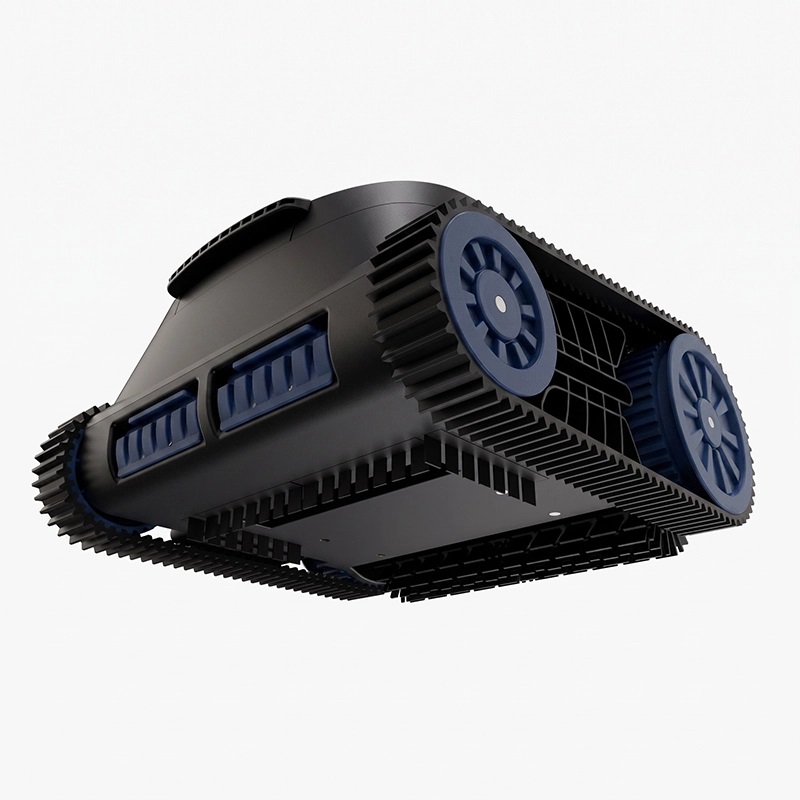
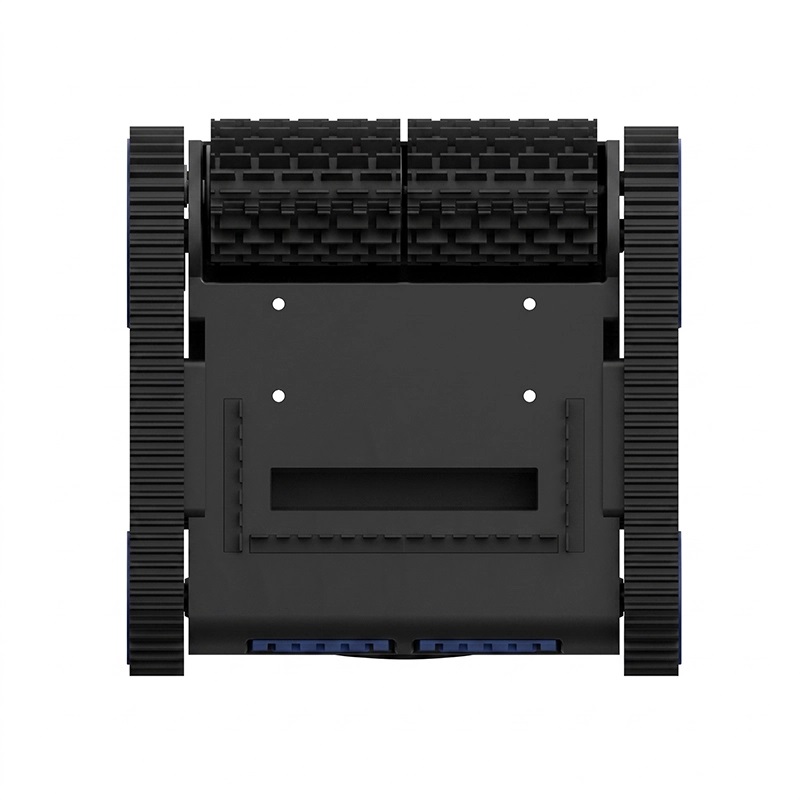
| ST-BQ5 — Specification | |
|---|---|
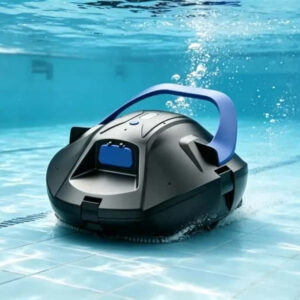
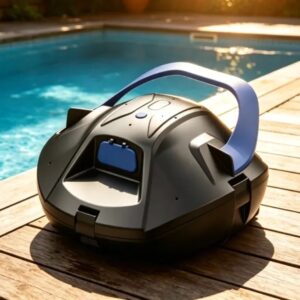
| Color | Black body, navy blue top cover, track wheels and intake grilles |
| Plug type | Cordless body, no plug; charger plug matched to the destination order |
| Voltage | 25.2 V DC charging, charger rated 25.2 V / 2.2 A |
| Model | ST-BQ5 |
| SKU | ST-BQ5 |
| Power system | Differential drive with dual roller brushes |
| Total power | 45–60 W; 60 W maximum during wall climbing |
| Battery capacity | 4,500 mAh (6S1P, 21700 cells) |
| Charging time | Approx. 2.5 hours at 25.2 V / 2.2 A |
| Runtime | Approx. 150–170 minutes per charge |
| Water flow rate | 240–350 L per minute |
| Pool coverage | Inground pools up to 300 m² |
| Cleaning surfaces | Pool floor, walls and waterline |
| Navigation | Inertial navigation, high-precision gyroscope, arch path navigation |
| Motor configuration | Three high-power brushless motors |
| Waterproof rating | IPX8 |
| Product dimensions | L384 × W386 × H242 mm |
| Net weight | 8.2 kg (18 lbs) |
The ST-BQ5 is a cordless inground pool cleaner built around a single claim from the specification sheet: it will work a pool of up to 300 m² for 150 to 170 minutes on one battery, pulling 240 to 350 litres of water a minute through a mouth that two roller brushes feed. It climbs walls, it follows the waterline, and it turns at the pool wall rather than waiting for a tether to pull it back, because it carries its own battery. This page is written for the people who buy it by the unit and resell it by the container — distributors, dealers, pool service companies and pool builders — so it leads with the numbers you would put in a line card rather than with adjectives.
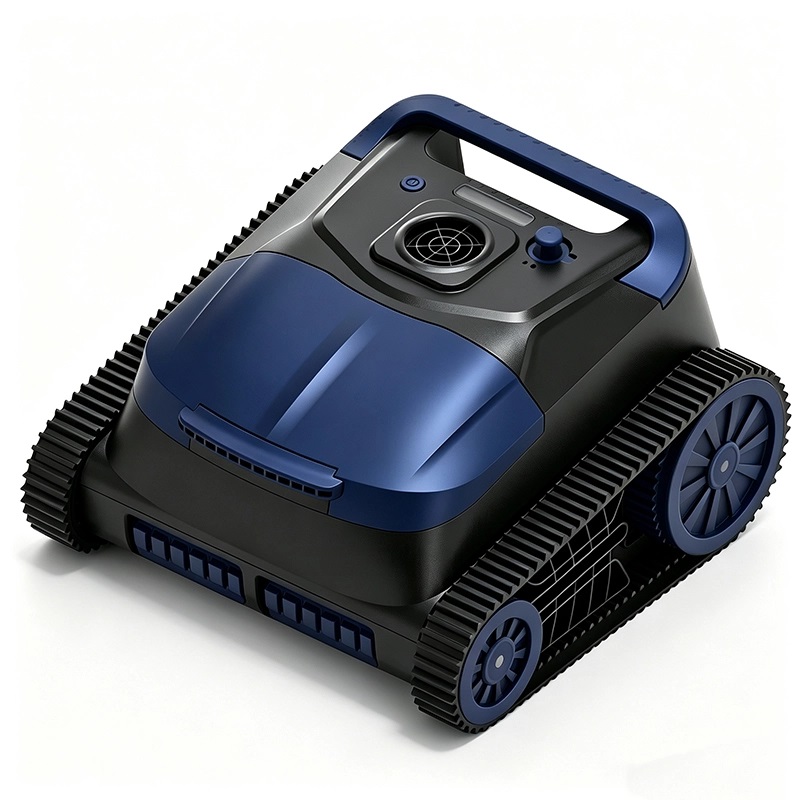
ST-BQ5 at a Glance
One body, two colours, four working numbers. The shell is black; the top cover, the track wheels and the intake grilles are navy blue. Inside are three high-power brushless motors on a differential drive, a 4,500 mAh pack built from 6S1P 21700 cells, and a flow path rated at 240–350 L per minute. Length 384 mm, width 386 mm, height 242 mm, mass 8.2 kg — light enough for one person to lift out by the handle on the top deck and carry to a storage position without a trolley.
It charges on a 25.2 V / 2.2 A charger, runs on its own battery, and is rated IPX8 — three facts that settle most of the commercial questions before the conversation starts. One accessory to stock, nothing to install at the customer’s pool, and a charger plug that has to match the destination market.
Throughput: 240 to 350 Litres a Minute
Flow rate is the number that separates a machine that looks busy from one that clears a pool. At 240–350 L per minute the ST-BQ5 moves roughly four to seven and a half bathtubs of water every sixty seconds past the intake, and the debris that comes with it is what the brushes have already lifted off the surface.
On an inground pool cleaner this is the figure to read before the run time, because water movement is what carries debris to the intake in the first place. A long runtime with a thin flow just spends longer over the same square metre.
Set against the power figure, the ratio is worth writing down: 240 L per minute at the 60 W ceiling is four litres for every watt drawn, and 350 L per minute at 45 W is just under eight. That spread — four to almost eight litres per minute per watt — is the efficiency band a trade buyer can compare against another machine on the same shelf, because both halves of the fraction are printed on the sheet.
Two Roller Brushes Feeding One Intake
The front of the body carries a pair of cylindrical roller brushes that turn against the surface ahead of the intake mouth. Their job is sequencing: loosen first, then collect. A surface film, fine sand and leaf fragments behave differently — the first two sit tight against plaster or liner until something disturbs them, while leaves only need water movement — and a brush pair running ahead of the flow handles the first two before they are asked to travel.
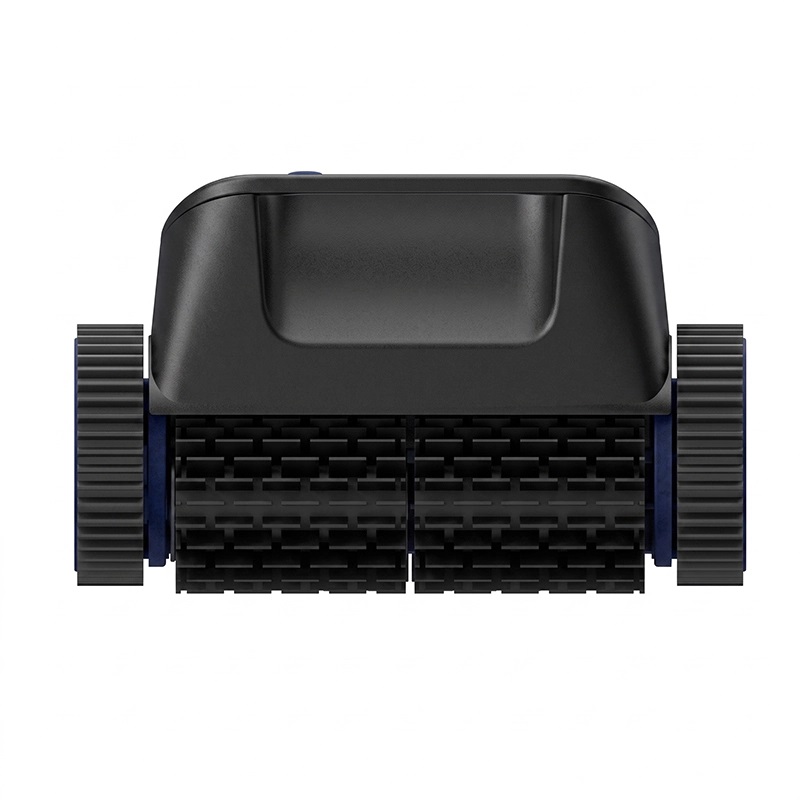
Because both brushes sit at the front edge, the machine cleans in the direction it travels rather than dragging a trailing head. On a rectangular pool that matters at the corners, where a trailing head arrives after the body has already turned.
Three Brushless Motors, Differential Drive
Brushless motors were chosen for the reason they usually are in a watertight body: no brushes to wear, no sparking, and a longer service interval between the moving parts that do exist. Three of them split the work — drive on the two tracks, and the flow path — through a differential arrangement, so the body can turn on the spot by running its tracks at different speeds instead of steering with a rudder.
For a distributor this is a stock-keeping point rather than a marketing one. A differential drive has fewer separate steering parts than a tracked chassis with a mechanical linkage, and the parts that see the most contact are the brushes and the tracks, both external and both visible on a pre-ship inspection.
Tracks, Not Wheels
The ST-BQ5 runs on two lugged tracks rather than on wheels, and the side profile shows why the choice was made: the track runs the full length of the body and stays in contact with the surface from the front roller to the rear. On a flat floor that is unremarkable. On a vertical wall it is the difference between grip and slip, because the load is spread along the whole track instead of resting on four small contact patches.
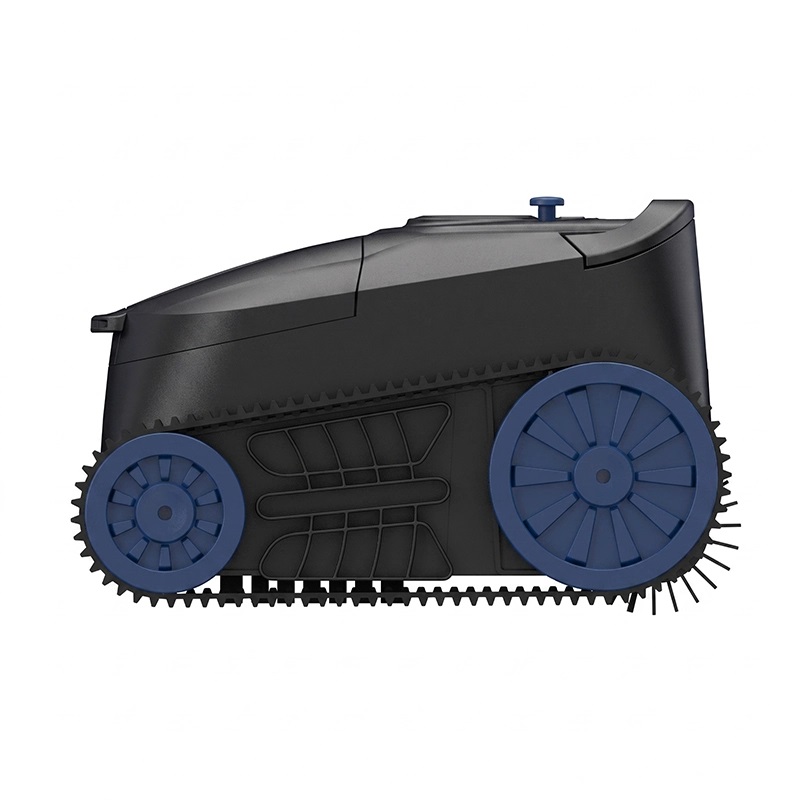
The same geometry helps at the surface break. Where a wheeled body tends to lose traction as it breaks the surface and the effective weight changes, a long track keeps a working contact area above and below the transition.
The Battery: 4,500 mAh at 25.2 V
Six cells in series at 25.2 V nominal, 4,500 mAh of capacity, 21700 format. Multiply amp-hours by volts and the pack holds about 113 watt-hours — a useful figure because it lets a buyer check the runtime claim instead of accepting it.
Spread 113 Wh across a 150 to 170 minute run and the implied average draw lands between 40 and 45 W. The specification band is 45–60 W. The two are consistent once you read the band as the range of draw at working moments rather than a constant: the machine pulls hardest while it is climbing, where the sheet puts the maximum at 60 W, and settles below the band’s floor on the flat. A 60 W figure held for the full 170 minutes would need 170 Wh, which is more than the pack holds — so the peak reading is a peak, and the sheet is telling you where the load sits, not what the machine draws on average.
Charge Time and Run Time Are Roughly One to One
The charger is rated 25.2 V / 2.2 A and brings the pack back in about 2.5 hours. Run time is 150–170 minutes. One hour of charging therefore returns roughly one hour of running, which is the ratio that decides how a service company schedules the machine: a single charge covers one pool per visit for a 300 m² pool, and the next pool waits for the charger.
For anyone running an inground pool cleaner on a daily route, that ratio sets the route rather than the pool list. Two units per van turn a single-charge machine into a continuous one; a single unit is scheduled around the charge window.
300 m² in 150 to 170 Minutes
Divide the covered area by the run time and you get the rate the machine has to hold: 300 m² over 170 minutes is 1.76 m² a minute, and over 150 minutes it is 2.0 m² a minute. That is the working pace the route has to sustain, and it is why the navigation pattern matters more than the top speed — a route that re-covers ground spends minutes twice on the same square metre.
The stated pattern is arch path navigation, run from inertial navigation with a high-precision gyroscope as the reference. In plain terms: the machine lays down an arching track across the floor rather than a random walk, and the gyroscope keeps each pass parallel to the last. Overlap is what a buyer is paying for here, because overlap is the only thing that converts 170 minutes of runtime into 300 m² of cleaned surface instead of 200 m² of cleaned surface with 100 m² of it done twice.
Floor, Wall and Waterline
Three surfaces, one route. An inground pool cleaner that works only the floor leaves two of them untouched, and both of those two are the ones a customer notices. The floor is the bulk of the 300 m²; the walls are where the drive and the tracks earn their place; the waterline is the band that collects the film nobody sees from the deck until it has cured. The machine is specified to clean all three, and it transitions between them without being lifted out and repositioned.
The waterline band is the one worth explaining to an end customer, because it is the part of the pool that a manual brush reaches least often. It is also the part where a cleaner that stops at the floor leaves a visible line, and visible lines are what generate callbacks. A specification that includes the waterline removes that conversation altogether.
8.2 kg and a 384 by 386 mm Footprint
The footprint is close to square — 384 mm long, 386 mm wide — so the machine reads as a box rather than a hull, and the 242 mm height is dominated by the top deck and the handle. That shape matters in two places: it passes a wall-to-floor corner without needing clearance behind the body, and it stacks predictably on a pallet because the top is flat.
At 8.2 kg — 18 lbs — it sits in the range one adult lifts with a single hand on the handle. For a pool service company that is a shift-length question rather than a specification detail: a unit that needs two hands and a bent back at every pool gets left in the van by the third visit.
IPX8 and the Dry Side of the Routine
IPX8 is the continuous-immersion rating, and it is the right rating to look for on a machine that spends its working life below the surface. It describes the body, not the charger: the charging circuit is a dry operation, and the sequence is out of the water, onto the deck, connect, wait about 2.5 hours, disconnect, back in.
Two routine disciplines keep that sequence honest, and both are worth putting in writing on a dealer’s handover sheet. Bring the body out of the pool before anything is connected, and do not leave the machine in the water between visits — the rating covers immersion during operation, not indefinite storage in a pool that is being dosed.
Navy Blue: What the Colourway Changes
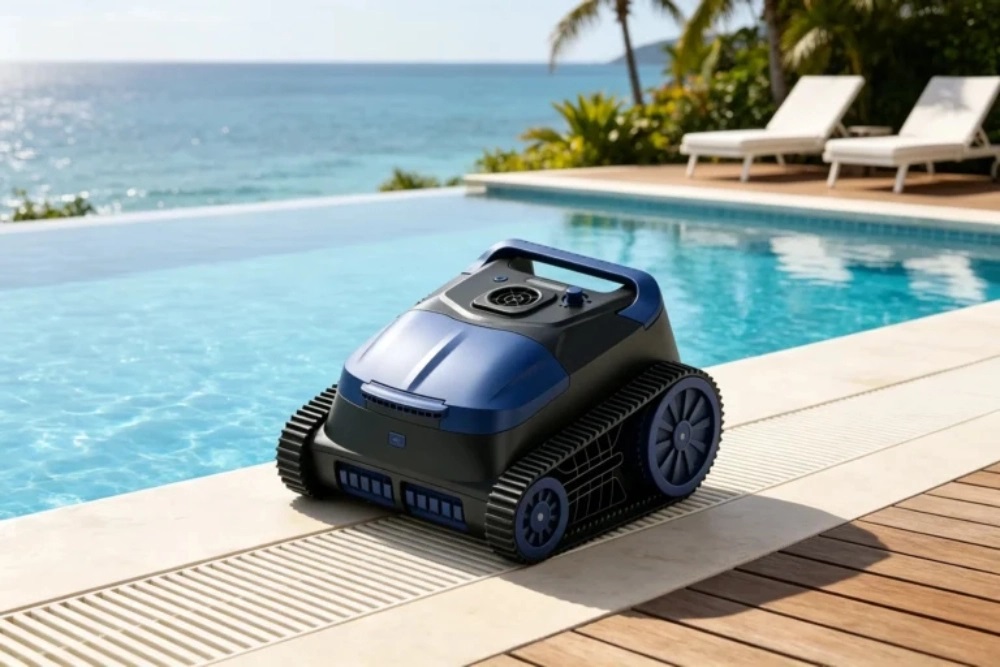
The ST-BQ5 is finished in black with a navy blue top cover, navy track wheels and navy intake grilles. The colourway changes nothing about the specification, and this page will not pretend otherwise. What it changes is range-building: a distributor holding several inground models can separate them on the shelf and in a photograph by colour alone, and a buyer assembling a seasonal catalogue gets a second SKU that reads as a distinct product rather than a repeat of the same photograph.
It is also the fastest way to answer the question a retail customer asks first — “is this the same machine as the one in the other picture?” The honest answer is that the specification is the same and the finish is not, and a distinct SKU number keeps that answer straight on a trade list and in a warehouse.
Who Stocks the ST-BQ5
Five buyer types, each with a different reason to hold it. Pool equipment distributors carry it as a mid-range inground unit with a specification sheet that can be compared line by line against a competitor’s. Pool dealers and retail shops use the colourway to separate it from the rest of the range on a display wall. Pool service companies buy it for the run-time-to-charge ratio, because two units cover a day’s route. Landscapers and pool builders hand it over at completion, when the first clean of a new inground pool is part of the job. Online and marketplace sellers need a unit whose numbers can be reproduced in a listing without a follow-up question.
What all five have in common is that they are buying a specification, not a demonstration, and that none of them is choosing an inground pool cleaner for the first time — they are choosing which one to hold. That is why this page carries the full table at the top rather than a feature list: the table is the document they will forward.
What to Put on the Enquiry
Five lines and the quotation comes back right the first time. Model or SKU — ST-BQ5. Destination market, so the charger plug matches the order. Quantity per shipment, and whether the units ship as single cartons or consolidated. Whether the units go to a warehouse or straight to a dealer, because that decides the carton count. And the pool sizes the end customers actually have, because 300 m² is a ceiling, and a buyer whose market is mostly smaller pools should be told what the machine does below it rather than at it.
Nothing on this page states a commercial term, and none should be read into it. Those come with the quotation, drawn from those five lines.
What Buyers Ask Before Ordering
Is the ST-BQ5 a cordless inground pool cleaner?
Yes. The body carries its own 4,500 mAh battery, and the specification lists it as a cordless body with no plug. Nothing about the machine is tethered to the deck while it works; charging happens afterwards, on the deck, through a 25.2 V / 2.2 A charger.
How large a pool will one charge cover?
The stated coverage is inground pools up to 300 m², against a run time of 150–170 minutes. That works out at 1.76 to 2.0 m² a minute across the charge.
What is the water flow rate?
240–350 litres per minute, pulled through an intake fed by two roller brushes at the front of the body.
Does it clean the walls and the waterline, or only the floor?
All three. The specification lists pool floor, walls and waterline, and the track drive is what holds the body against a vertical surface.
How long does charging take?
About 2.5 hours at 25.2 V / 2.2 A, which is roughly the same length as a full run. A two-unit operation can keep one machine working while the other charges.
What does IPX8 cover?
Continuous immersion of the body during operation. Charging is a separate, dry operation, done on the deck after the body has been lifted out of the pool.
How big is the body, and how much does it weigh?
384 mm long, 386 mm wide and 242 mm tall, at 8.2 kg (18 lbs). One hand on the top handle lifts it.
Is the specification different from the other inground models?
The core specification — 300 m², 240–350 L per minute, 45–60 W, 150–170 minutes, 4,500 mAh, IPX8, 8.2 kg — is shared across the range. What separates one model from another is mostly the finish, so put the specification tables side by side rather than the photographs: where a difference is real, the table is where it shows.
Can the plug be matched to my market?
Yes — the plug is specified against the market on the order, so state the destination on the enquiry and it is quoted with it.
What is supplied with each unit?
The machine and its charger. Anything beyond that is a matter for the order, not for the product page.