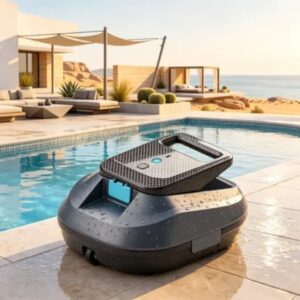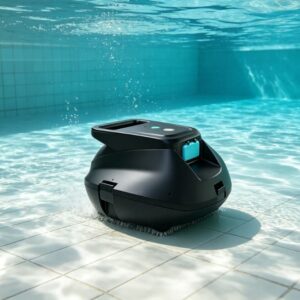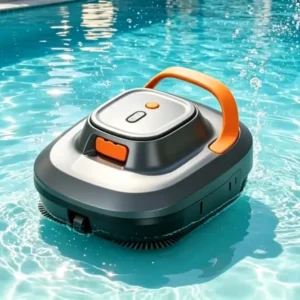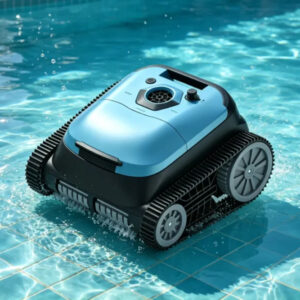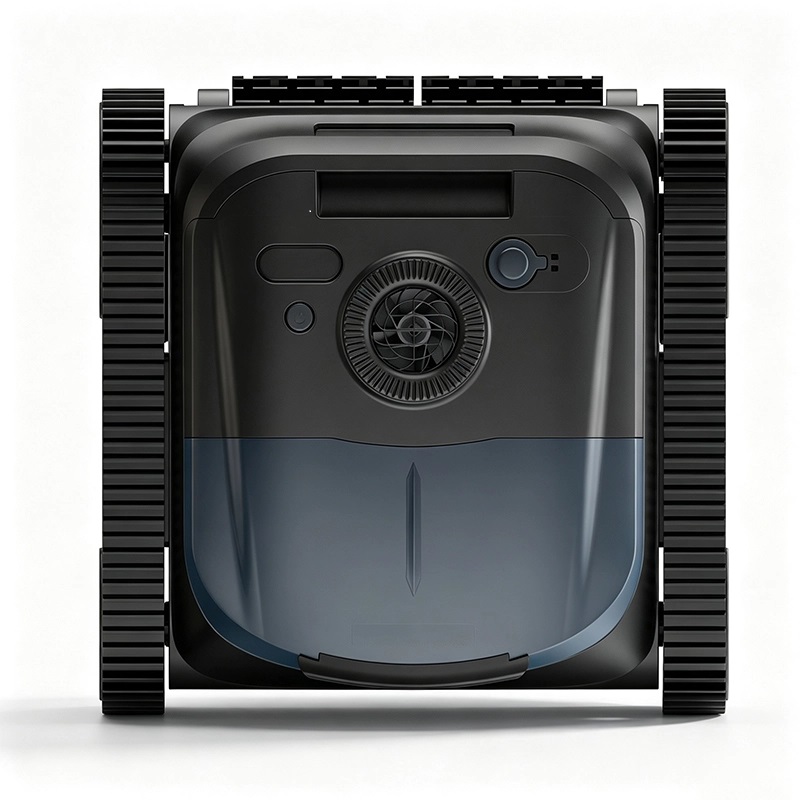
| ST-BX5 — Specification | |
|---|---|
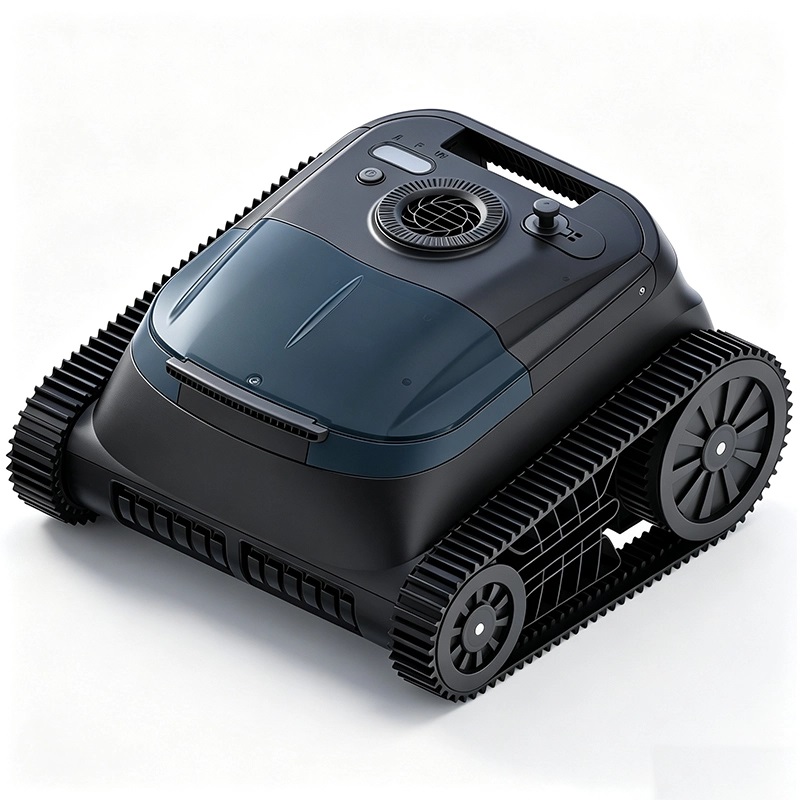
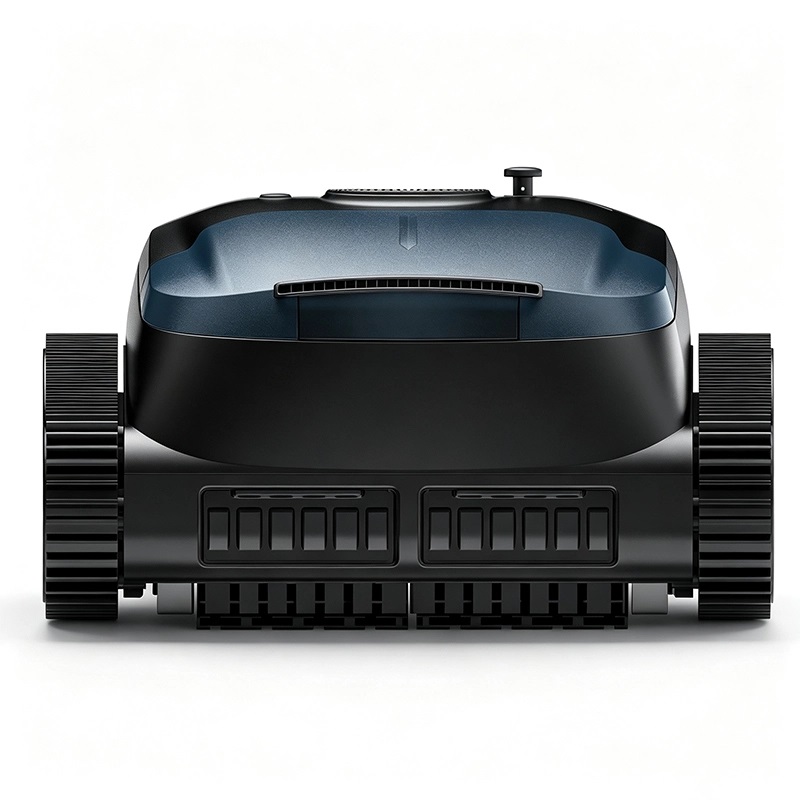
| Color | Black body, blue-grey top cover |
| Plug type | Cordless body, no plug; charger plug matched to the destination order |
| Voltage | 25.2 V DC charging, charger rated 25.2 V / 2.2 A |
| Model | ST-BX5 |
| SKU | ST-BX5 |
| Power system | Differential drive with dual roller brushes |
| Total power | 45–60 W; 60 W maximum during wall climbing |
| Battery capacity | 4,500 mAh (6S1P, 21700 cells) |
| Charging time | Approx. 2.5 hours at 25.2 V / 2.2 A |
| Runtime | Approx. 150–170 minutes per charge |
| Water flow rate | 240–350 L per minute |
| Pool coverage | Inground pools up to 300 m² |
| Cleaning surfaces | Pool floor, walls and waterline |
| Navigation | Arch path navigation, inertial guidance, high-precision gyroscope |
| Motor configuration | Three high-power brushless motors |
| Waterproof rating | IPX8 |
| Product dimensions | L384 × W386 × H242 mm |
| Net weight | 8.2 kg (18 lbs) |
What the ST-BX5 Automatic Pool Cleaner Is
The ST-BX5 is an automatic pool cleaner for inground pools of up to 300 m², built to work the floor, the walls and the waterline in one unattended cycle. Nothing runs from the machine to the pool equipment: no cable back to the skimmer, no hose hanging off the body as it swings from horizontal to vertical.
What separates it from the rest of the battery range is not the pump or the battery. It is the way the machine decides where to go. The route is an arch path, laid out by inertial guidance and a high-precision gyroscope, rather than the random walk that most cordless cleaners fall back on once they leave the floor.
The mechanical side is a differential pair of roller brushes turned by three high-power brushless motors, moving 240–350 litres of water a minute. Power runs 45–60 W, and the ceiling is 60 W while the unit is climbing. The battery is a 4,500 mAh 6S1P pack on 21700 cells, recharged at 25.2 V / 2.2 A in roughly 2.5 hours, carrying the machine for 150–170 minutes. The shell is IPX8 and measures 384 × 386 × 242 mm at 8.2 kg (18 lbs).
Arch Path Navigation Instead of a Random Walk
Two cleaners with identical pumps can leave a pool in visibly different condition, and the difference is usually the route rather than the suction. A random-walk machine changes heading when it meets a wall or an obstacle, then keeps going until it meets another. Over a cycle it travels a long way, but the passes are not spaced, so the same strip gets worked three times while another strip is touched once. On a pool of this size that unevenness is what a buyer sees in the first week.
Arch path navigation replaces that with a planned sweep. The machine runs a series of parallel arcs across the surface, each one offset from the last by a set spacing, and works its way across the pool in a defined direction instead of drifting. The practical effect is that coverage stops depending on luck: the strip the machine has just cleaned is the strip it does not return to, and the strip it has not reached yet is where it goes next.
For a dealer or a service company, this is the difference between a machine that looks busy and a machine that finishes. It is also the reason the runtime figure on this page can be read as coverage: if the route is planned, 150–170 minutes buys a predictable area rather than a hopeful one.
What Inertial Guidance Actually Does
Three things work together here: arch path navigation to set the pattern, inertial guidance to keep it, and a high-precision gyroscope as the reference both of them run from.
A gyroscope measures rotation. In a pool cleaner it answers one question continuously: has the body turned, and by how much. That is the input a differential drive needs in order to hold a straight line, because the two sides of a tracked machine never run at exactly the same speed under load. Without a heading reference, a body that should be crossing the floor in a straight line gradually curves, the arcs stop being parallel, and the spacing between passes collapses.
Inertial guidance takes that further by accumulating heading and travel into an estimate of where the machine is relative to where it started. It is not a map and it does not need one: the machine is not building a picture of the pool, it is keeping its own position honest for the length of a cycle so that the next arc lands where the plan says it should. Gyroscope drift is the limiting factor in that estimate, which is why the specification calls out a high-precision unit rather than a gyroscope in general terms.
Floor, Wall and Waterline in the Same Route
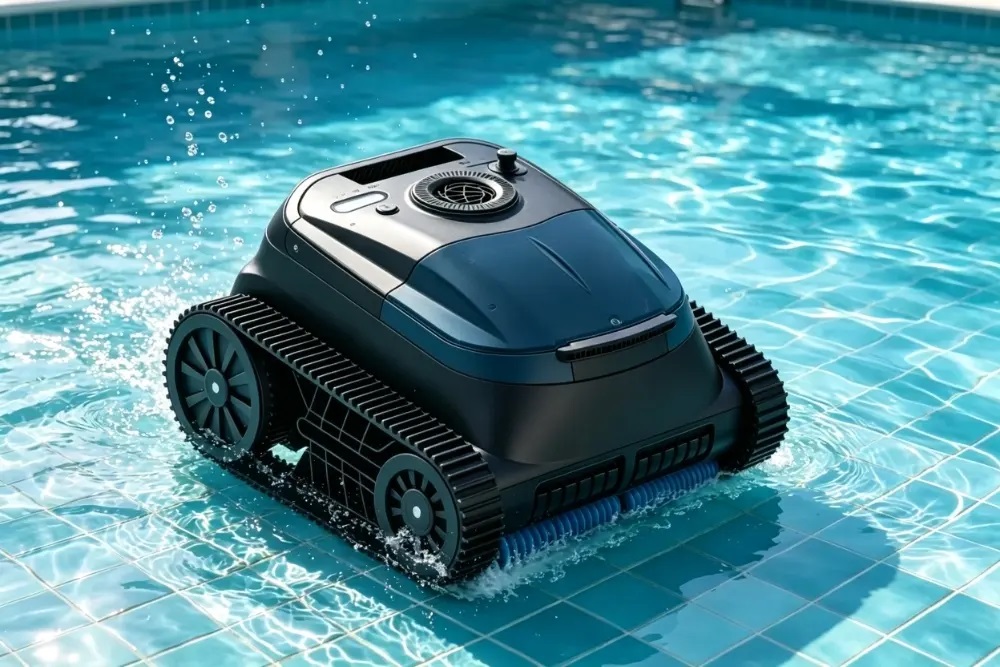
Three surfaces are in scope here, and they are not variations on one job. A unit that is good at the first is often useless on the other two, which is why they are worth separating:
- Floor — leaves, sand and grit settle here, and the load is heavy but concentrated. This is the surface a floor-only vacuum is designed around.
- Walls — algae film and biofilm attach to the vertical surface rather than settling on it, so the brush has to be pressed against the wall while the machine is holding itself up.
- Waterline — the tile band at the surface gathers an oily line of sunscreen, body oils and dust. It is the most visible edge in the pool and the one most cordless cleaners never touch.
A planned route is what makes the third surface practical. Reaching the waterline means climbing, running sideways along the tile and staying attached while the water level moves against the body; doing that on a random walk means the tile band gets whatever time is left over at the end of the cycle. With the surfaces scheduled into the arch path instead, the wall and the tile band are part of the plan from the first minute rather than an afterthought.
240–350 L/min, and What That Means per Square Metre
The machine moves 240–350 litres of water per minute. On its own, a flow figure is hard to judge — it becomes useful when it is put against the area the machine has to cover.
Take the sheet at face value: 300 m² of pool against 150–170 minutes of running time works out to roughly 1.8 to 2.0 m² of surface per minute. Set the flow against that and the machine is passing something in the order of 120 to 200 litres of water over every square metre it cleans, in a single cycle. That is the arithmetic a pool operator can actually use, because it answers the question a flow number on its own does not: is the water being turned over fast enough to lift a film off the tile, or is the machine only moving the debris it happens to pass directly over.
High flow matters most where the debris load is thin. A pile of leaves on the floor will be picked up by almost anything with a brush. An oily line on the tile is a film, and a film needs volume moving across the surface to break it up and carry it away.
Three Brushless Motors, One Differential Drive
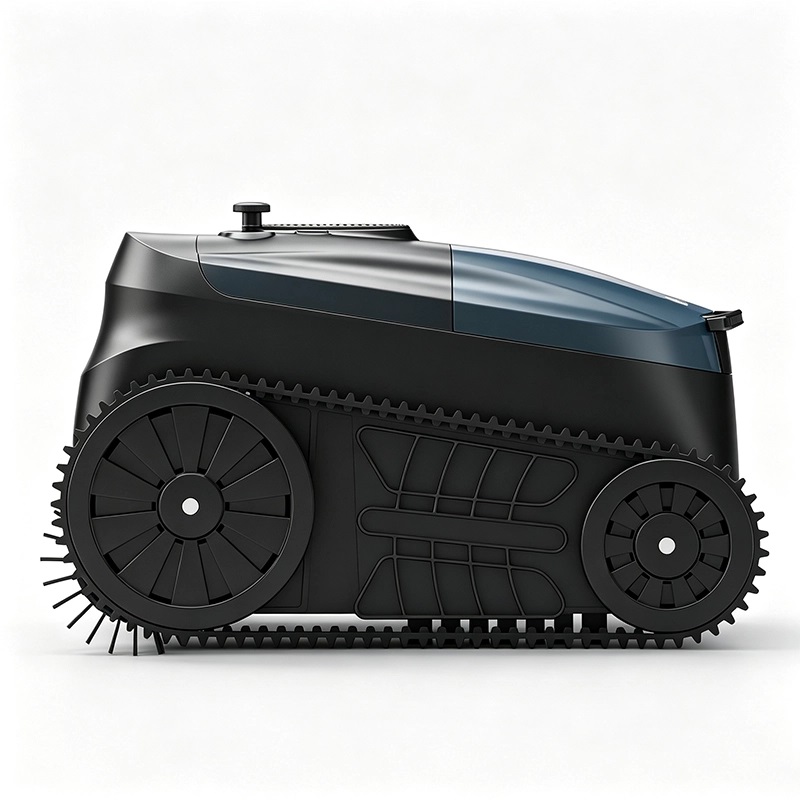
Three high-power brushless motors split the work: circulation on one side of the load, drive on the other two. Because the drive is differential, the left and right sides are controlled independently, so the machine turns by changing the relative speed of its two sides rather than by steering a rudder or a flap.
That arrangement is what makes a gyroscope useful in the first place. A heading sensor can only correct a machine that is able to steer by small amounts, and a differential drive can: a few percent difference between the two sides is enough to hold a line, and a larger difference turns the body on the spot. On the wall it is what allows the machine to change direction along the tile without letting go, and on the floor it is what lets it turn inside a large pool without needing a turning circle it does not have.
Brushless motors also explain why the runtime holds up. There are no carbon brushes to wear down, so efficiency at the end of a season is close to efficiency at the start, and there is no brush arcing inside a sealed IPX8 housing to begin with.
Power: 45–60 W, and 60 W When the Body Is Vertical
The rating on this machine is 45–60 W, and the two ends of that band are two different jobs. Sixty watts is the wall climbing figure; the lower end of the band covers the work it does on the horizontal.
Pushing a tracked body across a pool floor is cheap — friction, pump drag, not much else. Lifting that body onto a vertical face and keeping it there while the pump pulls and both brushes turn costs more, and the gap shows up on the meter as the last 15 W. That is why the band is worth reading as two numbers instead of one: a single figure with no ceiling almost always describes the floor, and the wall is where a climbing machine either holds or does not. Any buyer comparing an automatic pool cleaner for inground pools against a floor-only unit should ask for the ceiling first.
4,500 mAh on 6S1P, 150–170 Minutes, and a Machine That Parks Itself
Energy comes from a 4,500 mAh pack built as 6S1P on 21700 cells, topped up at 25.2 V / 2.2 A over about 2.5 hours, and good for somewhere in the region of 150–170 minutes of work.
Two things in that sentence are worth more than the figures. First, the cell format: 21700 instead of 18650 means a six-cell string can carry the extra current a climb demands without sagging. Second, the pack is not a cassette — it sits inside the sealed body, so a recharge is a scheduled pause in the working day rather than a swap at the coping.
At the end of a cycle the machine returns on low battery and parks itself. On a 150–170 minute run in a large pool that is not a convenience feature — it means the unit is waiting at a known point when the cycle ends, instead of being somewhere against a wall with the operator guessing. For a service company running a route, a machine that parks in the same place every time is a machine that can be collected without a search.
300 m²: 1.8 to 2.0 m² per Minute
The coverage figure is inground pools up to 300 m². Area is the first gate when matching a machine to a site, and it is worth reading against the runtime rather than on its own.
The two figures together give the working rate quoted earlier: roughly 1.8 to 2.0 m² of pool surface per minute of running time. That is a surface rate on a pool of the stated size, and it is a useful number to hold in a quotation, because the objection that comes back from a large-pool buyer is almost always about time rather than about suction.
Shape moves the number without moving the area. Turn a plain rectangle into an L with steps and a spillover and the square metres stay where they were while the length of wall to be climbed goes up — and on a climbing machine, wall length is what eats the clock. Area settles whether this is the right model; the wall line settles how many of those minutes are left for the floor.
Net Weight and Footprint: 8.2 kg at L384 × W386 × H242 mm
At L384 × W386 × H242 mm and 8.2 kg (18 lbs) this is not a unit that goes into the water one-handed. It comes out over the coping on two hands, and that is worth stating to anyone trading up from a small floor vacuum.
Mass is doing work here, not just adding to the freight bill. Holding a vertical face takes downforce, and downforce has to come from somewhere — a lighter machine with the same pump would have to borrow more of its suction for adhesion, and every litre a minute spent holding the wall is a litre a minute not spent lifting debris off it. For the container plan, work from the packed carton that the 384 × 386 × 242 mm shell produces rather than from the machine’s own volume, and allow shelf depth for the pallet, not only the box.
Sealing: IPX8, and What the Rating Is Doing Here
IPX8 on this sheet means the motor and the battery compartment survive continuous immersion — an immersion rating, not a splash one. On a climbing machine it matters in one specific place: the moment the body reaches the surface and sits half in water, half in air, with the seals working right at that boundary. A cleaner that never leaves the bottom is never tested there.
Recharging draws 25.2 V at 2.2 A and takes roughly 2.5 hours. Which mains plug the charger carries follows the order rather than the model, so it belongs on the purchase order: settle it before cartons are printed, because it decides whether one container serves one market or two containers serve two.
Who Buys the ST-BX5
Nobody buys this model for one garden. It is specified by trade buyers who have to range an automatic pool cleaner for inground pools, hold stock and stand behind it:
- Catalogue distributors whose range stops at the pool floor today and needs a unit that also handles the wall and the tile band.
- Builders and dealers quoting the machine with an inground project, where the 300 m² ceiling covers the top of the domestic bracket.
- Service operators with a route of larger pools, for whom a planned pass pattern and a self-parking finish shorten each stop.
- Hotels, resorts and clubs whose guests read the tile band as a standard, where an oily line along the waterline lands as a complaint rather than a detail.
- Marketplace sellers who need enough on the listing for a buyer to decide unattended, navigation method and wall power included.
- Specialist shops writing their own listing copy, who need every figure in one block a customer can weigh up.
All six read the same five things before they commit: how the machine navigates, how much water it moves, how long it runs, how much pool that covers, and what it weighs. Those five are the table at the top of this page.
What to Put on the Order Sheet
Six lines cover almost every query that arrives after a container has been unpacked:
- How it navigates — arch path, inertial guidance, high-precision gyroscope. This is the line that turns coverage from an accident into a promise.
- Water per minute — 240–350 L, which lands at roughly 120–200 litres for every square metre of surface in one cycle.
- Minutes per charge — 150–170, then about 2.5 hours back on the charger at 25.2 V / 2.2 A, with a low-battery return and a park at the end.
- Pool size — up to 300 m² of inground pool, all three surfaces, at about 1.8 to 2.0 m² a minute.
- Carton and handling — 8.2 kg inside a 384 × 386 × 242 mm shell; that is the box on the pallet and the lift at the coping.
- Charger plug — destination-specific. It sits in the quotation rather than the catalogue, and it decides the container split.
Questions Buyers Ask
What is the ST-BX5 automatic pool cleaner for inground pools?
A cordless machine for inground pools of 300 m² or less, covering the floor, the walls and the waterline on one charge. Drive comes from a differential pair of roller brushes turned by three brushless motors; water moves at 240–350 L a minute; the power rating spans 45–60 W, with 60 W taken while climbing; the pack is 4,500 mAh, 6S1P on 21700 cells.
How does arch path navigation differ from a random path cleaner?
A random path machine changes direction when it meets a wall or an obstacle and keeps going until it meets another, so its passes are not spaced and some strips are worked several times while others are barely touched. Arch path navigation runs a series of parallel arcs offset by a set spacing and works systematically across the pool, which is why the coverage on this model can be read as a rate rather than as a hope.
How does the machine know where it is?
It reads its own motion. A high-precision gyroscope tracks rotation, and inertial guidance accumulates heading and travel into an estimate of position relative to the start of the cycle. That is what keeps the arcs parallel and the spacing even on a tracked machine whose two sides never run at exactly the same speed. It is not a map of the pool, and everything it needs to do that comes from inside the machine.
Does the machine go up the wall, or only along the bottom?
Yes. Floor, wall and the tile band at the surface are all on the schedule, and they happen inside one cycle rather than across three separate jobs. The wall climbing phase is the expensive part: 60 W is the ceiling once the body is vertical.
How much runtime do I get from one charge, and how long is the turnaround?
Between 150 and 170 minutes of cleaning from a full pack, depending on how much of that time is spent on the wall. Getting back to full takes roughly two and a half hours at 25.2 V / 2.2 A, and because the pack is sealed inside the body rather than swapped out, the recharge is planned into the day. When the pack runs low the machine brings itself back and parks.
What does 240–350 L per minute mean in practice?
It is the volume of water the machine moves through the body each minute. Set against the coverage figure, the same area in 150–170 minutes works out to roughly 1.8 to 2.0 m² per minute, so each square metre of pool surface sees somewhere in the order of 120 to 200 litres of water in a single cycle. That is the number that matters on the tile band, where the debris is a thin film rather than a pile.
How large a pool will it handle?
Inground pools up to 300 m². Area and outline are two different questions: the same square metres spread across an L with steps and a spillover carry more wall to climb than a plain rectangle, and wall is what takes the minutes.
Why does the machine draw more power on the wall?
Gravity. On the floor the drive only fights friction and pump drag; on a vertical face it also has to support 8.2 kg while the pump and both brushes keep working. The rating spans 45–60 W, and 60 W is what the vertical phase costs.
What do IPX8 and the 25.2 V / 2.2 A figures mean here?
IPX8 is an immersion rating, so the motor and battery sit in a sealed compartment rather than a splash-proof one; the waterline is where that is tested hardest, with the body crossing the surface on every pass. Charging runs at 25.2 V / 2.2 A for about 2.5 hours, and the mains plug follows the order.
What color and size is it, and what mains plug does the charger use?
Black shell with a blue-grey top cover, sized L384 × W386 × H242 mm and weighing 8.2 kg (18 lbs). There is no plug on the machine itself, since it is cordless; the mains plug on the charger follows the destination order.