



ST-V1 Robot Window Cleaner with 2400–3200 Pa Adaptive Suction
The ST-V1 robot window cleaner holds itself against vertical glass with 2400–3200 Pa of adaptive suction, mists the pane with ultrasonic atomization from a 40 ml tank and drives across the surface on a path it plans itself. Suction is adjusted as the machine works rather than fixed at one level, so the body keeps a firm grip without pressing hard enough to mark the glass.
At 273 × 132 × 84.3 mm and about 1.05 kg it is slim enough to work a floor-to-ceiling pane and light enough to move between windows by hand. A 2.4G non-IR remote holds a stable signal up to 30 m, three cleaning modes cover different pane sizes and dirt levels, and a 500 mAh polymer lithium battery keeps the machine running for 20–30 minutes if the mains supply is cut. Model designation: ST-V1.
Key specifications
| Colour | Black |
| Plug type | EU / UK / US / JP / KR (selected per order) |
| Voltage | AC 100–240 V |
| Model | ST-V1 |
| Product name | Automatic window cleaning robot |
| Type | Fully automatic |
| Suction power | 2400–3200 Pa (2.4–3.2 kPa), auto-adjust |
| Rated power | 72 W |
| Output | 24 V / 3 A |
| Water tank | 40 mL |
| Spray method | Ultrasonic atomization, two-level control |
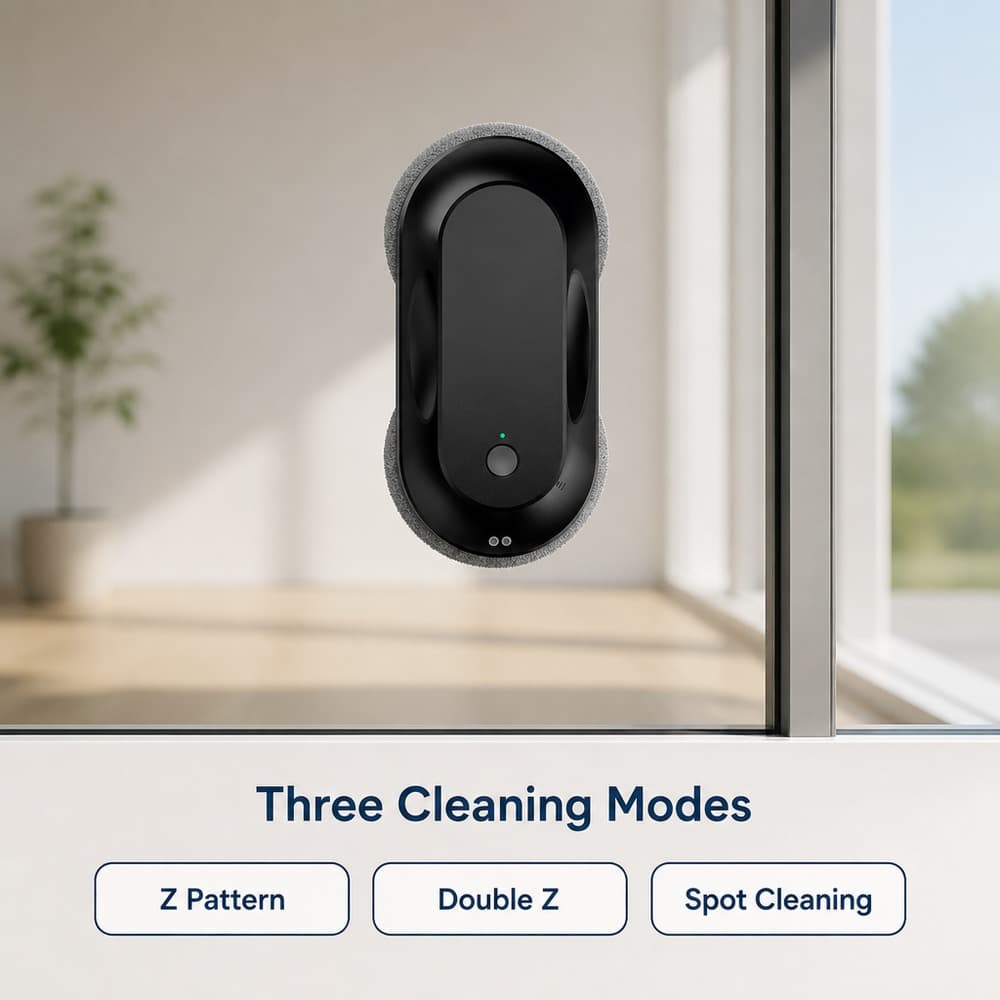
| Cleaning modes | 3 — Z pattern, double Z, spot cleaning |
| Cleaning path | Automatic path planning |
| Control | 2.4G wireless remote (non-IR), up to 30 m |
| Edge protection | Air-pressure edge sensing, works on frameless glass |
| Anti-drop | Polymer Li battery backup + anti-drop protection |
| Battery | 500 mAh / 14.8 V Li |
| UPS time | 20–30 min after power loss |
| Charging time | 25 min to start, 2.5 h to full |
| Fan motor | BDC brushed |
| Noise level | About 70 dB |
| Dimensions | 273 × 132 × 84.3 mm |
| Net weight | About 1.05 kg |
| Min. working area | 30 × 30 cm |
| Cloth | High-density fiber cloths |

What Is a Robot Window Cleaner?
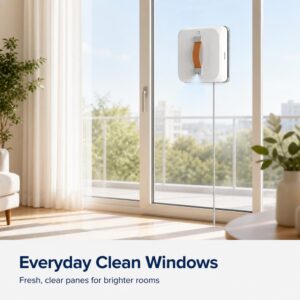
Buyers arrive at this category through several names — robot window cleaner, window cleaning robot, window cleaning robots, window robot cleaner, electric window cleaning robot, automatic window cleaning robot, glass cleaning robot, robot glass cleaner — and they are looking for the same thing: a machine that attaches to vertical glass, wets it, wipes it and moves across the pane without an operator holding a pole at arm’s length. Units sold as a window cleaning machine run on that same principle. What separates one unit from another is suction control, water delivery, path planning and what happens when the power fails, and those four are what this page documents.
Adaptive Suction: 2400–3200 Pa That Follows the Dirt

Suction runs between 2400 and 3200 Pa and moves inside that range automatically instead of sitting at one fixed level. The machine reads the dirt level and matches suction to it, so a lightly dusted interior pane and a soiled exterior one are both handled without changing a setting by hand. Because the body is not pressed at maximum force for the whole cycle, the glass surface is protected and the cloths are not driven hard into grit.
Automatic Path Planning: Ordered Passes, No Missed Areas

The machine plans its own route instead of wandering between edges. It works across the pane in ordered passes so the glass is covered systematically and no patch is skipped. Nothing has to be guided by hand, which is what makes the unit practical on a pane above head height, where you cannot watch every pass yourself.
Three Cleaning Modes: Z Pattern, Double Z and Spot Cleaning

Three modes cover different pane sizes and different jobs. Z pattern runs a zig-zag across the whole pane and suits large glass in reasonable condition. Double Z runs the zig-zag twice, the setting for heavier soiling or a first clean on a neglected window. Spot cleaning concentrates the run on one area, which is the mode for a single mark, a bird dropping or a patch close to the frame. The mode is chosen before the cycle; everything after that is automatic.
2.4G Wireless Remote with a 30 Metre Range

Control is by a 2.4G radio remote rather than an infrared handset. Infrared needs line of sight and loses the command at an angle or behind furniture; the 2.4G link holds a stable signal up to 30 m, so a cycle can be started, stopped or adjusted from anywhere in the room — or from the next room, which matters when the glass is on the far side of a partition.
Edge and Drop Protection, Including Frameless Glass

Air-pressure sensing watches the pane edge. When the machine reaches the frame line, or the edge of unframed glass, the change in pressure is detected and travel stops before the body passes the point where there is nothing left to hold it. That is what allows the unit to work on frameless glass, where there is no frame to bump against and nothing to catch a machine that keeps going.
Power-Off Safety Backup of 20–30 Minutes

A 500 mAh / 14.8 V polymer lithium battery keeps the machine working for 20–30 minutes after the mains supply is cut. It is not a cleaning battery — the unit runs from mains power — it is there so a power failure, an unplugged lead or a tripped breaker does not drop the machine off the glass. In that window the robot keeps holding the pane while the operator retrieves it, which is the difference between a power cut and an incident.
Independent Air Duct System

Water and airflow travel in separate ducts. Mist is not carried into the fan and motor, and the suction side stays dry while the cloths are wet. The design is water-air separation in the literal sense: a wet path for the spray and a dry path for the vacuum, which is what keeps the motor protected over a long season of use and keeps maintenance low.
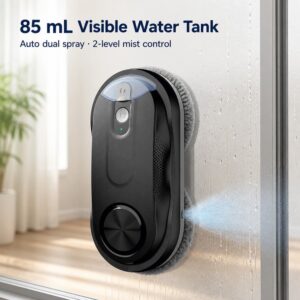
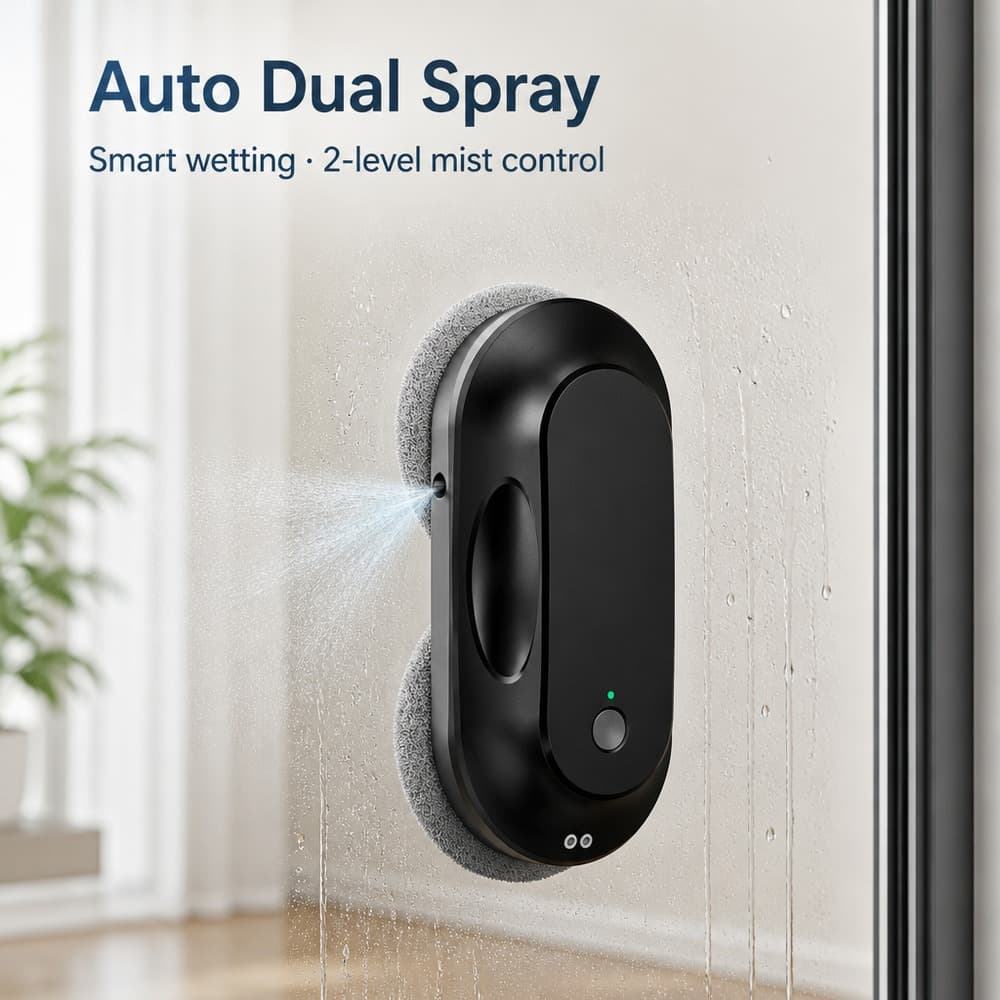
Ultrasonic Mist, Two Levels and a 40 ml Tank
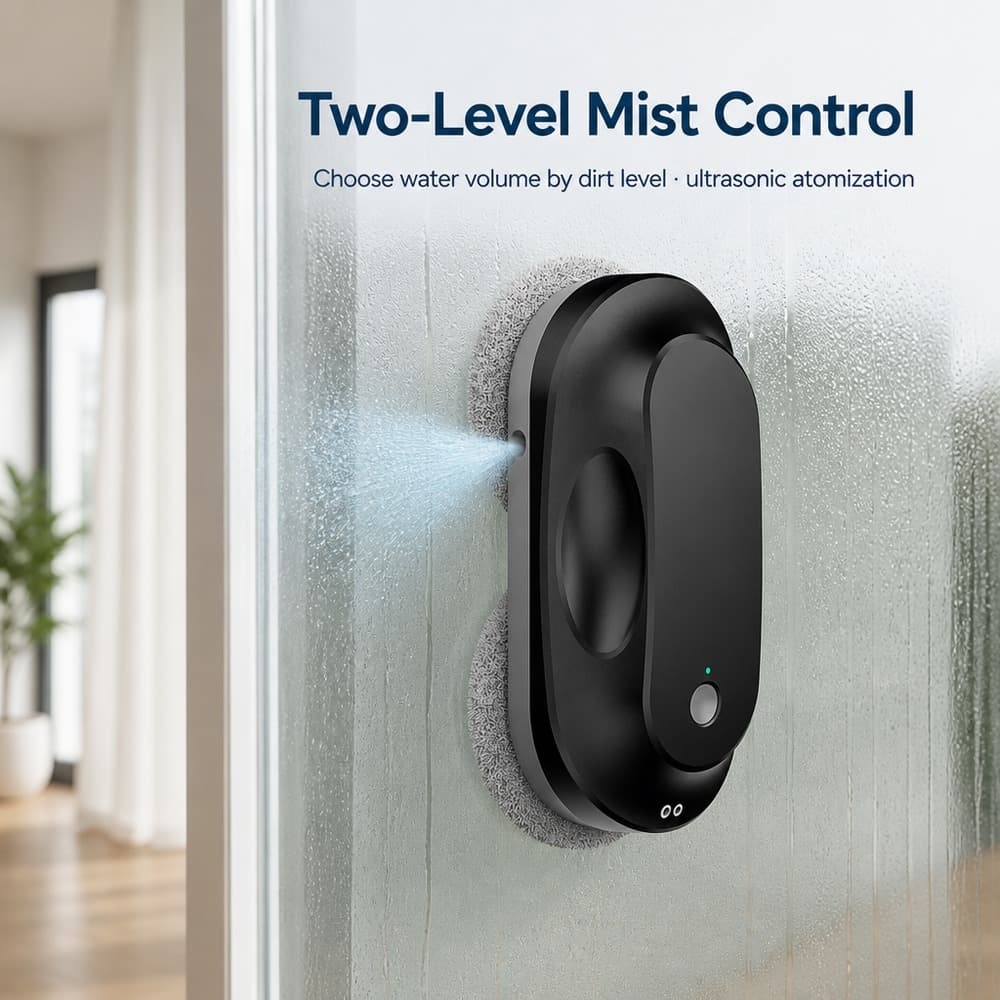
Water is broken into mist by ultrasonic atomization rather than thrown on in droplets, so the pane is wetted evenly instead of being soaked in patches. The 40 ml tank feeds the spray, and two levels let you match water volume to the dirt: a light mist for interior dust, the heavier level for exterior film and marks. Because the mist lands ahead of the cloths, the glass is already damp when they arrive — there is no pre-wetting step and no spray bottle to carry.
High-Density Fiber Cloths

The cloths are high-density microfiber. The dense pile lifts dirt into the fibres instead of pushing it across the pane, and the glass stays scratch-free because grit is caught in the cloth rather than dragged over the surface. The cloth is the only part that touches the window, so it carries most of the cleaning result — suction and path planning only decide where the cloth goes.
One-Key Cleaning
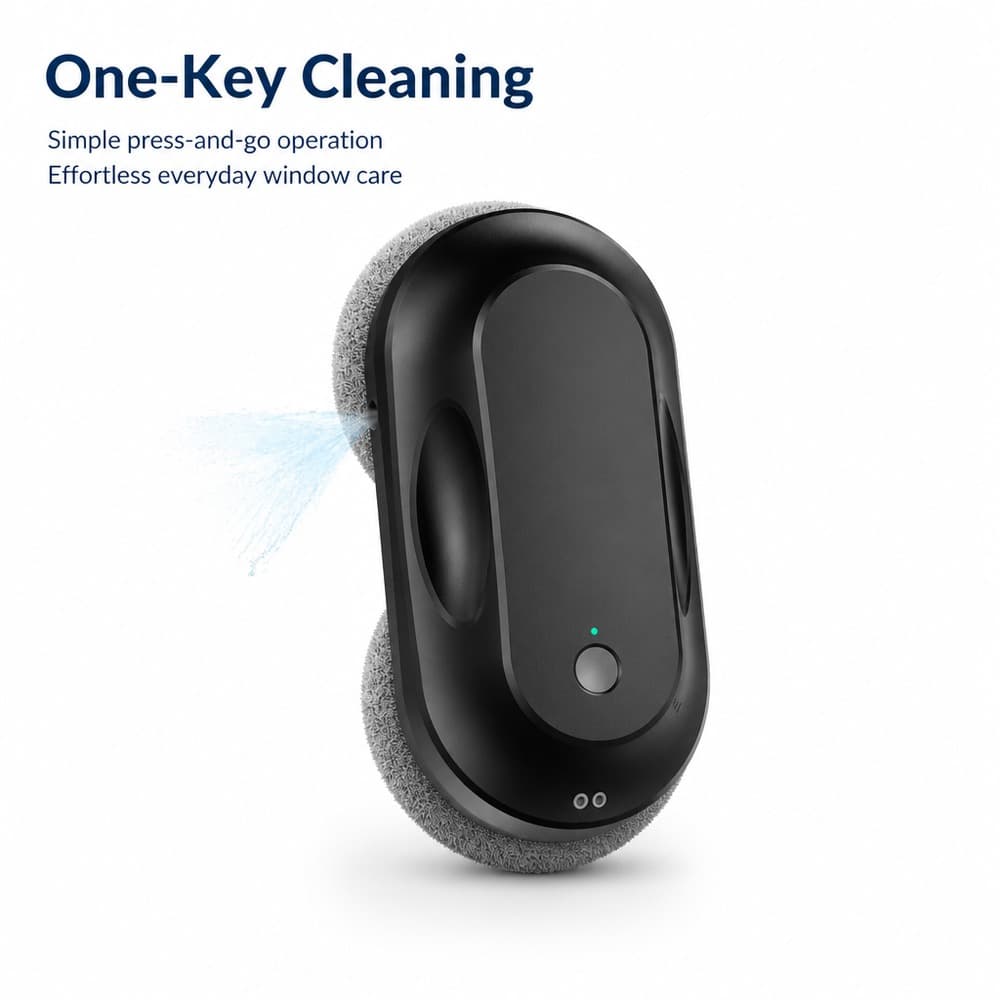
One key starts a cycle. There is no menu to walk through, no app to pair and no sequence to remember: place the machine on the glass, press, and it holds, mists and runs the planned path. For a household doing a seasonal clean, and for a caretaker moving pane to pane, that is the entire operating procedure.
Size, Weight, Noise and Minimum Working Area
The body measures 273 × 132 × 84.3 mm and weighs about 1.05 kg, slim enough to work a floor-to-ceiling pane and light enough to carry between windows. The minimum working area is 30 × 30 cm, so small bathroom panes and side lights fall inside its range as well as full curtain-wall panels. Noise is about 70 dB at the machine, and rated power is 72 W from a 100–240 V input with a 24 V / 3 A output. Charging takes 25 minutes to start and 2.5 hours to full.
For Commercial, Hotel and High-Rise Glazing
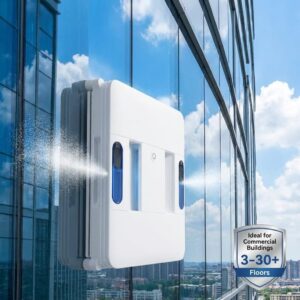
The unit is specified for the panes where setting up access equipment is slowest: hotel window walls, office partitions and glazing above ground-floor level. As a high rise window cleaning robot it works on the same principle indoors and out, because the grip comes from suction rather than from a pole, and the 2.4G remote keeps control at distance. For a commercial window cleaning robot programme the figures that decide a purchase are the same as for a big building contract: 2400–3200 Pa of adaptive suction, a 40 ml tank, 72 W and 20–30 minutes of power-off backup. Buyers comparing it with a professional window cleaning robot will find the comparison turns on exactly those four numbers.
Frequently Asked Questions
What is the ST-V1 robot window cleaner?
It is a mains-powered automatic window cleaning robot for vertical glass. It attaches by suction, plans its own path, mists the pane by ultrasonic atomization from a 40 ml tank and wipes it with two high-density fiber cloths. The model designation is ST-V1.
How does the adaptive suction work?
Suction adjusts automatically between 2400 and 3200 Pa instead of staying at one level. Lightly dusted glass is cleaned at the lower end, heavier soiling at the higher end, and the machine keeps a firm grip without pressing at full force for the whole cycle, which protects the glass surface.
How much water does it hold, and how is it sprayed?
The tank holds 40 ml. Water is broken into mist by ultrasonic atomization rather than sprayed in droplets, and two levels let you set the water volume to the dirt level — a light mist for interior dust, a heavier setting for exterior film.
What are the three cleaning modes?
Z pattern, double Z and spot cleaning. Z pattern runs a zig-zag over the whole pane, double Z runs it twice for heavier soiling, and spot cleaning concentrates the cycle on one area such as a single mark or a patch near the frame.
How far away does the remote work?
Up to 30 m. The handset uses a 2.4G radio link rather than infrared, so it does not need line of sight and a cycle can be started or adjusted from another room.
What happens if the power is cut mid-cycle?
A 500 mAh / 14.8 V polymer lithium battery keeps the machine working for 20–30 minutes after power loss, so it stays on the glass instead of dropping. The unit runs from mains power; the battery is there for exactly this situation.
Does it work on frameless glass?
Yes. Air-pressure edge sensing detects the edge of the pane, and the machine stops travel before it passes the point where there is nothing left to hold it, so no frame is needed for it to know where the glass ends.
How big is it, and how small a pane can it clean?
273 × 132 × 84.3 mm and about 1.05 kg, with a minimum working area of 30 × 30 cm. That covers small bathroom panes and side lights as well as full floor-to-ceiling glass.
How loud is it?
About 70 dB at the machine. Rated power is 72 W, and the air duct system is independent of the water path so the motor stays dry while the cloths are wet.
Will the cloths scratch the glass?
The cloths are high-density microfiber, and the dense pile catches grit inside the fibres rather than dragging it across the pane. The cloth is the only surface that touches the glass, so it is the part that decides whether the finish is scratch-free.
Request a Quotation for the ST-V1
Send the pane size, the number of windows and the glazing area you are quoting for, and we will confirm the specification and availability for your market. Buyers comparing this robot window cleaner with a pad or roller unit usually start from the same four figures: 2400–3200 Pa, 40 ml, 72 W and 20–30 minutes of backup.