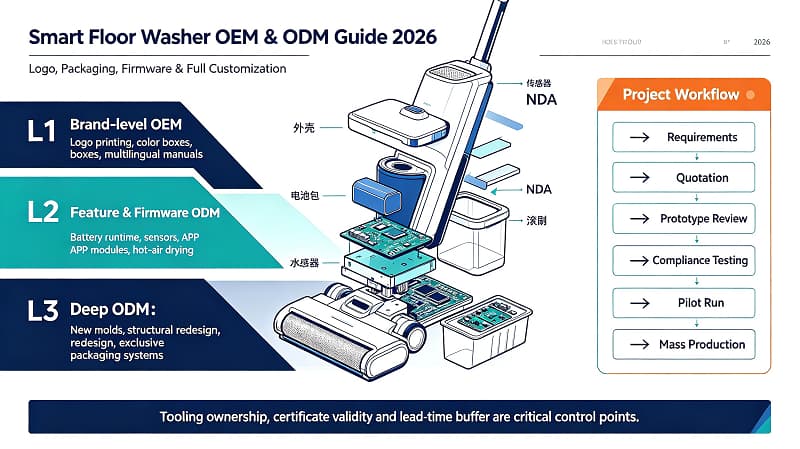
Launching your own branded smart floor washer sounds great on paper. You escape the commodity price wars on Amazon and marketplaces, build real brand loyalty, and lock in better gross margins. But here’s what I tell every first-time client: most people walk into OEM/ODM projects with completely wrong expectations — and that’s how you end up with blown budgets, missed launch windows, and product that gets stuck at customs.
Having worked with dozens of importers and private label brands across Europe, North America and Australia on wet-dry cleaning appliance sourcing, I’ve seen this go wrong more times than I can count. Just last quarter, a US client came to us after wasting $12k on a factory that advertised “full ODM” — only to find out they only did logo printing, and any hardware change would cost extra on top.
Here’s the reality: “custom” covers a huge spectrum, from a 5-cent logo print to a full mechanical redesign. The cost, MOQ, risk and lead time at each end are night and day. If you’re still early-stage comparing general bulk sourcing strategies, start with our complete wholesale smart-floor-washer sourcing guide to get the basics down first.
OEM vs ODM vs Private-Label: Stop mixing up these manufacturing terms
Buyers throw around OEM and private-label interchangeably all the time, but factories treat these as completely different workflows with separate pricing and MOQ structures. Below is a plain-spoken breakdown — no marketing fluff, just the actual terms used by Chinese floor-washer factories:
| Model | What it means for smart floor washers | Typical MOQ | Pre-production cost | Time-to-market |
|---|---|---|---|---|
| OEM (Logo-on-existing-unit) | Use factory’s proven base model; apply your logo, custom colour box, multilingual manuals. Hardware and core firmware unchanged. | 300–1000 units (depends on factory) | Low: screen-print / die charges only, no new moulds | 30–45 days after sample confirmation |
| ODM (Modified-spec development) | Modify existing platform: alter battery pack, adjust suction profile, rewrite firmware logic, re-design outer housing shapes. | 1500–5000 units baseline | High: mould tooling, PCB rework, prototype iteration, re-certification fees | 60–110 calendar days, can stretch further with certification delays |
| Pure private-label resale (no-mod) | Buy ready-made stock units; stick your sticker on retail packaging only, zero factory-side hardware alteration. | Low-MOQ wholesale tiers available | Almost zero upfront engineering cost | Fast, limited by existing inventory availability |
Let me save you some headache: ODM is not a “build your dream product for cheap” service. You can’t just throw random features at the wall and expect them to work. There are electrical safety limits, component supply constraints, and certification hoops you have to jump through. Any decent factory will walk you through the trade-offs — if they don’t, walk away.
Layer-1 Customisation: Brand-level tweaks (low-risk, entry-level OEM)
This is where 70% of first-time private label buyers start, and honestly? It’s the smartest place to start for most people. No hardware redesign, no certification headaches — you’re just putting your brand on a proven platform that’s already passed CE, FCC and RoHS. Risk is low, lead times are predictable, and MOQs won’t break your first order budget.
- Logo application: Silk-screen printing, laser-etch on plastic housing, heat-transfer decals. Laser engraving looks far more premium, but comes with a higher per-unit processing cost.
- Custom housing colourways: Custom plastic injection colour matching to your Pantone codes. Just know: custom colours almost always bump up the MOQ compared to standard white/grey stock chassis.
- Retail packaging overhaul: Full-custom colour gift boxes, outer shipping carton marking, insert cards, multilingual quick-start manuals tailored for your sales territory.
- Accessory bundle configuration: Bundle alternate roller-brushes, extra filters, storage hooks; mix-and-match accessory kits for your target customer demographic.
Layer-2 Customisation: Feature & firmware adjustments (mid-complexity ODM)
Once you move past logos and packaging, you’re into actual ODM territory. These changes touch the electronics, battery, and embedded software — which means safety certifications usually need to be re-verified. From what I’ve seen, this tier is the sweet spot for established distributors: enough differentiation to stand out, without the massive cost and risk of a full redesign.
- Battery-runtime tuning: swap in different-capacity lithium-ion cells to extend or shorten cleaning cycle time for your market.
- Smart-sensor calibration: adjust automatic water-spray algorithm, dirt-detection sensitivity, self-cleaning cycle duration.
- App / Wi-Fi module white-labelling: re-brand mobile-app UI splash-screen, custom server endpoints for connected smart floor washer models.
- Electrolytic-sterilisation function on/off configuration, hot-air drying workflow adjustments.
A quick note for EU buyers in particular: if you’re modifying anything with the battery or wireless module, your original CE marking won’t cut it anymore. You’ll need updated CE-RED documentation, and that can easily add 2–3 weeks to your timeline if testing labs are backed up in peak season.
Layer-3 Customisation: Full mechanical re-design (deep-ODM, highest risk & cost)
This is full deep ODM: brand new injection mould tooling for the body shell, handle assembly, water-tank geometry. This is not for startups testing the market. This is for established brands with proven sales volume and a clear 12-month product roadmap.
New mould tooling for a floor washer will run you anywhere from $8,000 to $20,000 — and that’s before prototypes, testing, and certification. I’ve seen more than one promising brand burn through their entire launch budget on tooling alone, with nothing left for inventory. Don’t do that. If you’re going this route, you need a solid 6–12 month order forecast to amortize those costs properly.
Step-by-step OEM / ODM project workflow for smart floor washers
Over the years, I’ve refined this workflow with our factory partners to keep projects on track and avoid the usual last-minute surprises:
- Document your requirements clearly: target-market certifications, desired feature list, branding assets (logo files, Pantone colours), expected annual order volume.
- Submit requirement pack to manufacturer, request a formal project quotation breaking out unit price, one-time tooling fees, sample cost, projected MOQ and production lead time.
- Sign NDA if you are sharing proprietary design concepts.
- Pre-production prototype sample review: evaluate cosmetics, real-world cleaning performance, battery runtime, packaging mock-ups.
- Complete third-party compliance testing if modifications invalidate existing certificates.
- Confirm pilot small-batch run before jumping to huge mass-production POs.
- Mass-production, inline quality-control inspections, shipment arrangements.
Key pitfalls to avoid during custom floor-washer projects
After running dozens of these projects for clients across the EU, US, and Australia, these are the four mistakes that kill margins and derail launches almost every single time:
- Assuming “ODM = everything you want for cheap”. Every custom modification has real engineering, tooling and certification costs attached.
- Neglecting contract clauses about tool-ownership: if you paid for custom moulds, make certain the contract explicitly states you own the tooling assets — not the factory.
- Forgetting re-certification risk after hardware changes. Many buyers only discover certification invalidation after samples are already finished.
- Setting unrealistic launch deadlines. Certification lab backlogs commonly add multiple-week delays to consumer-electronics projects in peak season.
FAQ: OEM & Private-Label Smart Floor Washer Projects
Explore wholesale-ready & OEM-customisable smart floor washer product lines
Our catalogue includes multiple mature floor-washer platforms supporting logo-OEM, packaging customisation and selective feature tuning. We ship to 30+ countries and regions with full certification documentation.