Bulk Smart Floor Washers: MOQ, Lead‑Time & Realistic Pricing (2026)
Reading time: 11 min | Field notes for importers, distributors & private-label buyers worldwide Over 8 years advising wet-dry cleaning
Smart floor washers combine vacuuming, mopping and self-cleaning in one pass, and this section collects Stonebot’s practical sourcing guides for the product. The guides here cover the decisions a B2B buyer has to make, in the order they come up: how bulk orders are priced and quoted, how MOQ and lead times are calculated for importers and distributors, how real landed cost is built up beyond the EXW price, and how OEM/ODM private-label customisation works from logo and colour to packaging and user manuals. They are written for distributors, importers, e-commerce sellers, facility and property teams and private-label brand founders building their own floor-care line, and cover cordless 3-in-1 wet-dry floor washers used on tile, hardwood, marble and vinyl in homes, hotel rooms, offices, cafes, restaurants and retail spaces. Use them to benchmark a quotation, prepare a sourcing brief, or brief your team before requesting bulk pricing. To see the hardware itself, compare cordless smart floor washer models and specs; for bulk pricing and OEM/ODM private-label production, go to wholesale smart floor washer supply.
Reading time: 11 min | Field notes for importers, distributors & private-label buyers worldwide Over 8 years advising wet-dry cleaning
Reading time: 11–13 min | For distributors, e-commerce sellers & private-label brand operators worldwide Sourcing smart floor washers in bulk
Reading time: 12 min | For private-label founders, brand operators & volume importers Launching your own branded smart floor washer
Written by the Stonebotclean sourcing team · Last updated: October 2026 · Reading time: about 18 minutes · For importers,
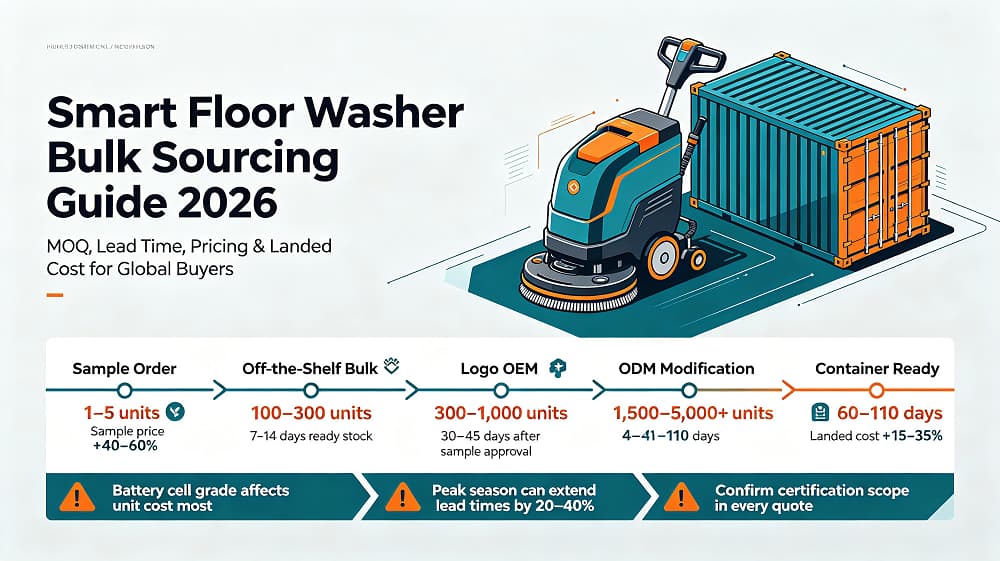
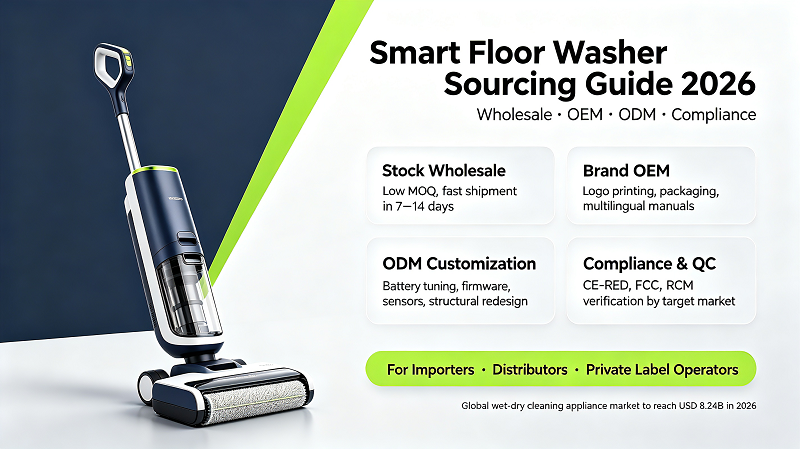
MOQ is not one number; it scales with how far you customise. Sample evaluation orders run 1–5 units, uncustomised stock runs 100–300 units per model, logo printing plus custom retail packaging pushes the floor to 300–1,000 units, and ODM work needing new moulds starts at 1,500–5,000 units. Many factories will approve a trial run below their standard minimum, often 80–100 units, if you can show a credible 6–12 month reorder forecast.
Three different timelines get sold as one lead time. Ready stock ships in 7–14 working days after deposit; standard logo OEM runs 30–45 calendar days from sample sign-off; ODM projects that change hardware run 60–110 calendar days. Add 20–40% between Q3 and Q4, when production lines fill ahead of retail peaks. Most delays come from slow buyer-side sample approval rather than from production itself.
Because an EXW price stops at the factory gate. Ocean freight and terminal handling, import duty, local VAT, inland delivery and battery-related surcharges on lithium-ion goods typically add 15–35% on top of EXW value: regional short-haul lanes land nearer 15–25%, intercontinental lanes nearer 22–35%. Build the full door-to-door cost before signing the purchase order, because landed cost, not unit price, is what sets your margin.
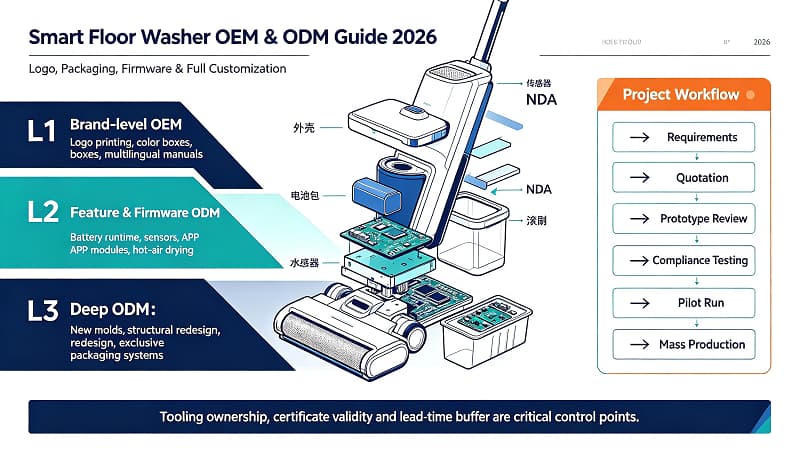
Treat it as a ladder rather than a switch. Layer 1 is brand-level and low-risk: logo, housing colour matched to a Pantone reference, retail packaging and multilingual manuals, all on a platform already certified to CE, FCC and RoHS. Layer 2 changes electronics, battery capacity or firmware, which normally forces re-certification. Layer 3 is a full mechanical redesign with new moulds, commonly quoted at USD 8,000–20,000 before prototypes and testing.
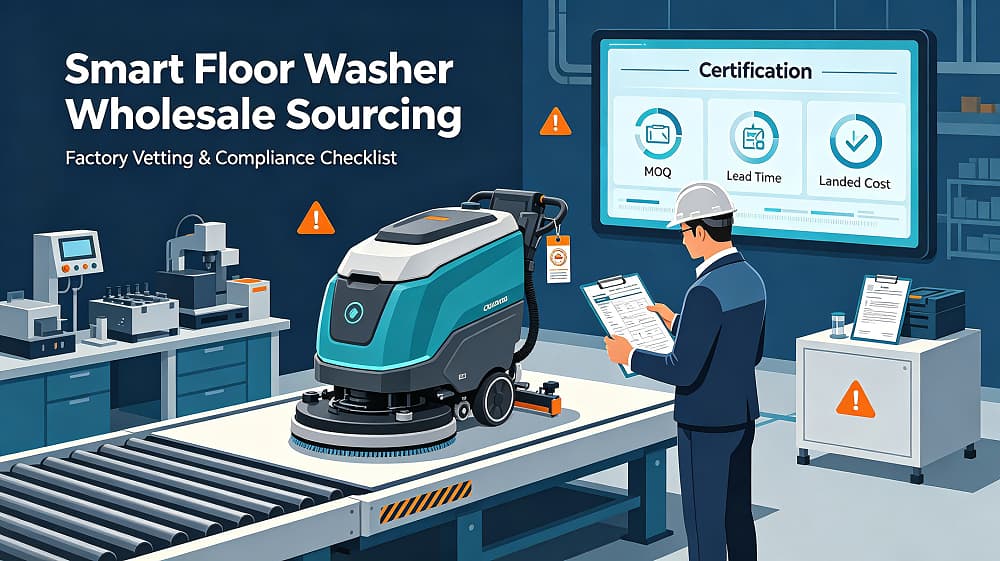
It depends on the destination market, and the test reports must match the exact model you are buying. EU and EEA: CE, plus CE-RED for wireless models, plus RoHS. United States: FCC Part 15 and UN38.3 lithium-battery documentation. Australia and New Zealand: RCM and C-Tick for EMC. Where certification is quoted as an add-on it typically adds 3–8% per unit, so fix the scope in writing rather than accepting a verbal promise.
Consumables decide service life far more than electronics do: roller brushes, filters, sealing strips and the battery pack are the parts that drive repeat orders. Ask for a stated warranty spare-parts allocation with each shipment, and confirm the spares list, part numbers and lithium-battery shipping documents before the first container. Sourcing a single battery pack after the fact costs far more than including it in the original order.